


Zedoary entered European texts as a root arriving along the routes of the Indian Ocean. In the early 16th century, Duarte Barbosa counted it among the commodities of Calicut. Apothecaries later ground it into cordial powders, antidotes, and formulas used during epidemics. Its mystery is not that of a secret plant: it lies in the journey of an aromatic rhizome, transformed by trade into a material of protection and prestige.
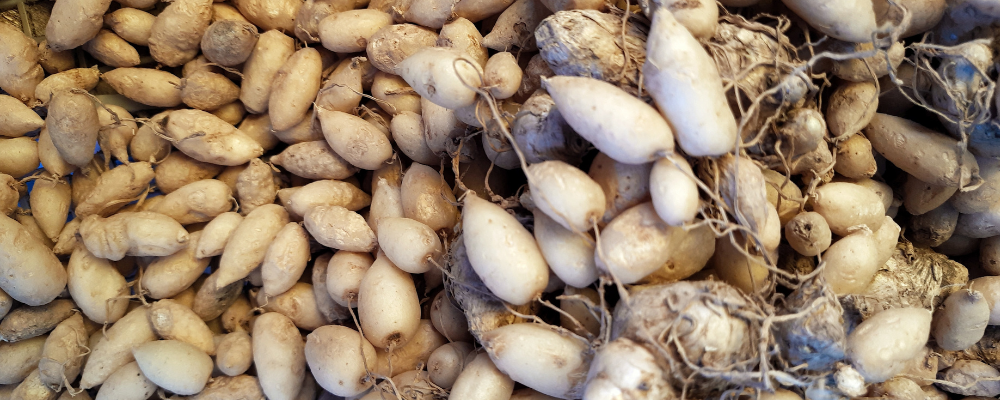
Zedoary is Curcuma zedoaria (Christm.) Roscoe, a Zingiberaceae with an underground rhizome. Its large leaves emerge in a clump, and its inflorescence bears pale or pinkish bracts around small flowers. When cut, the rhizome gives off a camphoraceous, spicy scent.
The names zedoary, zedoaria, zedoaire, and the Middle English cetewale mark its circulation. Pharmacy books attributed many virtues to it according to the medicine of their time. The historical magic of the root lies at this crossroads between spice, antidote, cordial, and distant commodity.
A Rhizome in the Ginger Family
Curcuma zedoaria is a perennial herb that passes through a dormant period thanks to its rhizome. The long, sheathing leaves emerge from the ground. The inflorescence may appear before the foliage has fully developed.
Kew accepts the species and places its native range from the eastern Himalayas to Assam. Kew, Curcuma zedoaria. The plant has been introduced and cultivated in other tropical regions.
The rhizome is not a root in the botanical sense, even though commerce uses this word. It is an underground stem bearing nodes, buds, and reserves. This clarification enriches the symbol: zedoary preserves underground the ability to produce new shoots.
Zedoary on the Quays of Calicut
In the early 16th century, Duarte Barbosa described the ports and commodities of the Indian Ocean. In his account of Calicut, zedoary appears among the spices and drugs traded alongside pepper, ginger, and other aromatic substances.
The text is available in a digitized edition from Project Gutenberg. Duarte Barbosa, goods from Calicut. The reference places the rhizome within a network of ships, brokers, taxes, and translated knowledge.
The scarcity of Zedoary in Europe stemmed less from a hidden power than from distance, control of trade routes, and transportation costs. The root therefore carries a magic of passage and displaced value. Each stage adds a name, a price, and a risk.
Zedoary protects in books because it first crossed ports, languages, and hands.
The root in cordial powders
European pharmacopoeias incorporated Zedoary into complex preparations. A history of pharmacy recalls its presence with Saffron in officinal cordials, followed by the disappearance of certain formulas during the revisions of the 19th century.
The work is available on Project Gutenberg. Chronicles of Pharmacy, Zedoary formulas. These recipes bear witness to a historical medical system, not to magical efficacy that should be reproduced.
In the apothecary's shop, the isolated ingredient took on meaning within a measured, named, and preserved mixture. Modern magic can retain this compositional discipline: know every material, record its provenance, and reject silent substitutions.
The mystery of crisis antidotes
Medical treatises from the early modern period place Zedoary in preparations reputed to offer protection during epidemics. Thomas Willis mentions it among aromatics to chew or ingest as part of a prophylactic regimen.
These recommendations show what society expected from an exotic drug in the face of a poorly understood threat. Project Gutenberg, works by Thomas Willis. They must never be used as treatment.
The true magical lesson lies in the need to act when danger remains invisible. The fragrant rhizome gave protection a tangible form. Today, the symbol can accompany a written crisis plan, while health measures fall under current medical recommendations.
Mapping the rhizome’s route
Draw a rhizome at the bottom of a page and a port at the top. Between them, place five stages: harvesting, drying, transport, sale, and use. Under each, write what you actually know about your material.
Circle the missing information: species, country, batch, treatment, or date. Add the question to ask the supplier. The ritual transforms the exotic object into a visible chain rather than a decorative mystery.
On the right, draw a protection plan without a plant: a contact to call, a safe place, a document to keep, and an immediate action. Keep this page with your important information. The zedoary remains closed in its pouch and serves only as a historical reference.
Historical correspondences
| Reference point | Correspondence |
|---|---|
| Botanical name | Curcuma zedoaria (Christm.) Roscoe |
| Family | Zingiberaceae |
| Organ | Aromatic rhizome |
| Historical route | Indian Ocean, Calicut, and apothecaries’ shops |
| Magical domains | Protection, travel, provenance, and crisis |
| Safe form | Paper provenance card |