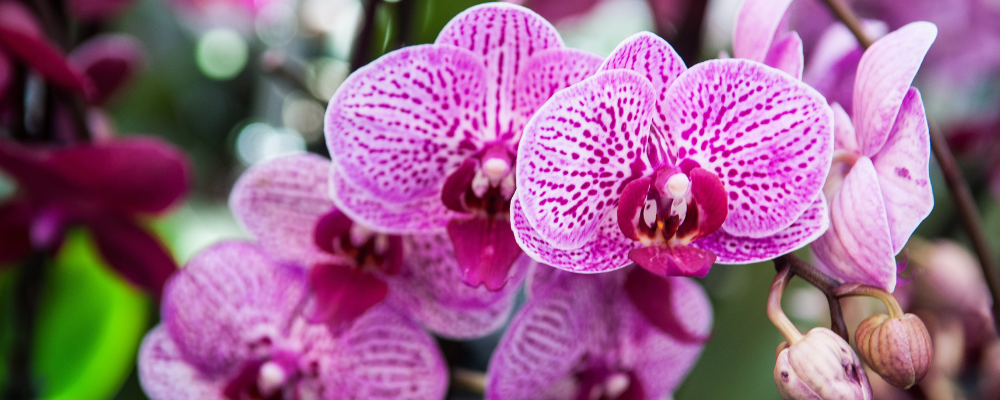
“Orchid” does not name a plant, but a family comprising tens of thousands of species. Some live in the ground with two tubers, others attach themselves to trees, and Vanilla climbs like a vine. Greek herbalists noted the shape of Orchis tubers and linked it to generation. The mystery of the orchid arises from its form, floral deception, relationship with its pollinator, and the time required for the fruit to develop.
The Orchidaceae family includes nearly 700 genera accepted by Kew. A single planet, a single origin, or a single use cannot encompass all orchids. A living-room Phalaenopsis, the Orchis mascula of a European meadow, and the Vanilla planifolia of Mexico each carry distinct histories.
The Western historical thread begins with the Greek word orchis, “testicle,” applied to the paired tubers of certain terrestrial species. Medical texts drew claims about sexuality and the sex of children from this resemblance. Contemporary magic can study this old logic of signatures without taking it as a biological fact.
A family of countless forms
The Orchidaceae form one of the largest families of flowering plants. Kew accepts 691 genera in its reference system. The species live on every continent except Antarctica, in grasslands, forests, peatlands, and mountains. Kew, Orchidaceae family.
The flower has three sepals and three petals. One of the petals forms a labellum that guides or attracts the pollinator. The reproductive organs come together in a column. The pollen forms masses called pollinia, carried from one flower to another.
Many orchids depend on a close relationship with a pollinator. Fragrance, color, shape, and flowering season compose an adapted message. Some offer nectar, while others imitate a presence or a resource.
The magic of the flower therefore belongs to targeted communication. It does not radiate in the same way toward everyone. It creates a precise address and awaits the encounter capable of continuing the cycle.
The Greek name and paired tubers
The Orchis genus gave its name to the entire family. The Greek word means “testicle” and refers to the two tubers of several terrestrial orchids. Orchis mascula, the male orchid, remains a European example of this architecture.
Kew describes Orchis mascula as a tuberous geophyte whose range extends from Macaronesia, northern and central Europe, and as far as Iran. Kew, Orchis mascula.
One tuber nourishes the year's growth, while another prepares the next year's growth. The pair therefore shows a passage between consumed reserves and future reserves. The anatomical resemblance caught the eye, but the plant cycle also tells a story of transmission.
In magical work, the pair controls neither sex nor fertility. It represents a relay: what is spent now and what is formed for the next season.
The Sexual Signatures of Dioscorides
In the 1st century, Dioscorides described orchids with two tubers and reported uses associated with desire and the presumed sex of an unborn child. Illustrated Renaissance editions transmitted these passages with botanical images.
In Mattioli's manuscript, illustrated by Gherardo Cibo in the 16th century, the commentary associates the full tuber with conceiving a boy and the withered tuber with conceiving a girl. The Royal Botanical Garden of Madrid places the plate within the history of the text. Mattioli and Cibo, Orchids from Dioscorides.
This interpretation stems from the resemblance between the plant and the body. It fueled the aphrodisiac reputation of salep, a drink prepared from orchid tubers. It does not determine a child's sex.
The signature reveals how a reader connects forms. It belongs to the history of magic and medicine, not genetics.
Vanilla, an Orchid That Becomes Perfume
Vanilla planifolia is a climbing orchid from the tropical forests of Mexico and Central America. Its aerial roots attach themselves to supports, and its flowers remain open for only a short time.
Kew notes that the Totonacs and Olmecs used vanilla to flavor food and drink, as well as a good-luck charm. In the 15th century, the Aztecs added it to a cacao beverage. Kew, Vanilla planifolia.
The green fruit does not yet release the expected fragrance. Harvesting, scalding, fermentation, and drying bring out the aroma. Vanilla teaches a magic of revelation through time and work.
This story also recalls the diversity of the family. One Orchid may produce a spice, another a tuber, and yet another a horticultural flower. The common name opens the door; the species provides the real detail.
Giving the flower an address
Draw a flower with three sepals, two lateral petals, and a labellum. In the center, write the real recipient of your message: a named person, a defined group, or your own memory.
On the labellum, write what attracts attention. On the two petals, note what you offer and what you ask for. On the three sepals, write the place, the time, and the limit.
Then draw two tubers beneath the flower. In the first, place the resource expended. In the second, note the reserve to preserve for later.
Read the whole thing again as a message addressed to someone, then remove any promise that exceeds your means. The practice ends with an act of transmission: sending, an appointment, depositing, or a decision kept until a specific date.
Historical correspondences
| Marker | Correspondence |
|---|---|
| Botanical group | Orchidaceae family, 691 genera accepted by Kew |
| Reference species | Orchis mascula for paired tubers |
| Historical source | Dioscorides transmitted by Mattioli and Cibo in the 16th century |
| Another Orchid | Vanilla planifolia, aromatic vine from Mexico |
| Magical domains | Address, desire, relay, revelation, and relationship |
| Safe form | Botanical drawing and targeted message |