





















































































































Beneath birches and pines, the red cap speckled with white emerges like an already familiar image. Fly agaric belongs to European fairy tales, but its most firmly documented ritual history leads to eastern Siberia, where accounts collected from peoples such as the Koryaks give it a specific name, origin, and social role.
The mushroom has been burdened with spectacular claims: berserker warriors, Santa Claus, Vedic soma, or a universal cult. These connections remain debated. The article focuses on Siberia, historical testimonies concerning its use as an intoxicant, and the Western transformations of its image.
Amanita muscaria is not a “psilocybin mushroom.” Its main active compounds are ibotenic acid and muscimol. Their effects, concentration, and the body’s response are unpredictable. The grimoire preserves its history without proposing consumption.
The Red Cap Beneath the Trees
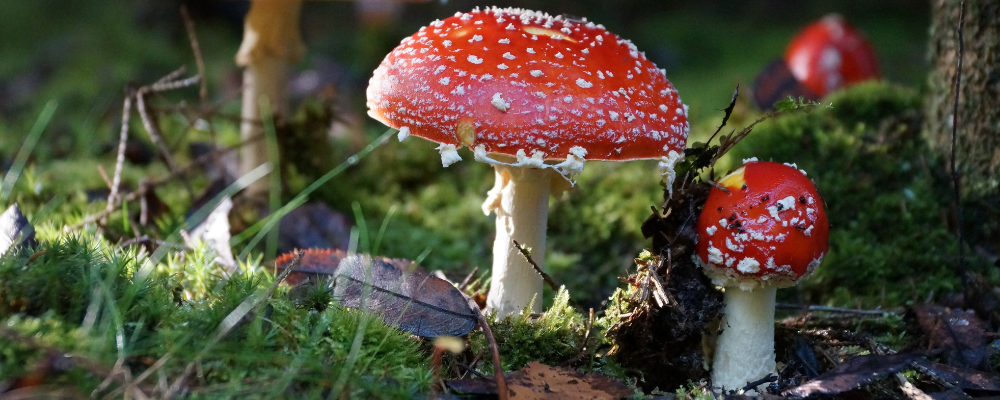
Amanita muscaria is an ectomycorrhizal fungus. Its mycelium lives in association with the roots of certain trees, including birches, pines, and spruces. The visible fruiting body bears a red to orange cap covered with pale warts, remnants of the veil that surrounded the young mushroom. Rain can wash away these spots, and the color may fade.
This variability makes identification from a single image unreliable. Kew chiefly emphasizes the vital relationship between fly agaric and its partner tree: the fungus receives sugars and helps the tree absorb water and nutrients. Kew, “Fly agaric”.
In a magical reading, this underground alliance matters as much as the cap. The red manifestation is merely the fleeting part of a hidden exchange among the soil, the roots, and the forest.
Accounts from eastern Siberia
The strongest historical testimonies concern eastern Siberia. Travelers and ethnographers described the use of fly agaric as an intoxicant in social and ritual contexts. The Koryaks hold a prominent place in this literature, with accounts in which the mushroom plays a role in relationships with spirits and in the speech of the ritual specialist.
A study published by the Royal College of Physicians of Edinburgh summarizes this history and also traces the scientific discovery of its constituents. It discusses the shamans of Eastern Siberia while noting that the observed effects result from powerful pharmacological compounds. Lee, Dukan and Milne, 2018.
These practices belong to specific societies, languages, and specialists. Reducing them to a method of “inner exploration” erases their collective and religious framework.
The Fly Trap and the European Name
The name fly agaric refers to a European domestic use: the mushroom was associated with preparations intended to attract or neutralize flies. The Latin term muscaria likewise preserves this connection to the fly.
Alongside this use, a fairy-tale iconography developed. In the 19th century, illustrated books, fairy scenes, and garden ornament established the red cap as the seat or dwelling of tiny beings. This image does not directly extend Siberian rites; it belongs to another history—that of European illustration and visual culture.
Two histories under one cap. Eastern Siberia preserves situated ritual practices. Modern Europe transforms the mushroom into an emblem of forest wonder. Bringing them together requires keeping their contexts separate.
From Mushroom to Modern Symbol
The Amanita’s silhouette has become a visual shorthand for magic, far beyond what the sources describe. Games, tales, sets, and shops use it to immediately signal an enchanted forest. This graphic effectiveness rests on the contrast between red, white, and dark woodland.
The historical mystery lies less in a planetary correspondence than in the circulation of the image. An organism linked to tree roots becomes an autonomous sign, detached from its environment. The grimoire can restore the mushroom’s landscape: boreal forest, plant partner, autumn, and Siberian narrative.
The proposed connections with Odin, the berserkers, soma, or Santa Claus’s costume should remain separate hypotheses. They do not serve as a foundation for a practice.
Reading the forest without picking
Work from a photograph in which the host tree is visible. Draw two levels on a page: above, the red cap that appears; below, the network of mycelium and roots. Write down what you show the world, then what silently supports this appearance.
To study Koryak accounts, note the name of the people, the date, and the author of each source. Avoid turning the word “shaman” into a personal title or decorative identity. Reading then becomes an act of precision and respect.
During a walk, observe the mushroom without touching, picking, or moving it. Also photograph the surrounding trees. Returning it to its living environment corrects the isolated image of the “magic mushroom.”
Historical correspondences
| Reference point | Correspondence |
|---|---|
| Scientific name | Amanita muscaria |
| Habitat | Mycorrhizal association with birch, pine, and other trees |
| Major ritual context | Eastern Siberia, including Koryak traditions |
| Main compounds | Ibotenic acid and muscimol |
| European image | Fly agaric, illustrated tales, fairies, and enchanted forest |
| Safe support | Photography, mycelium drawing, and critical reading |