















































































































































































































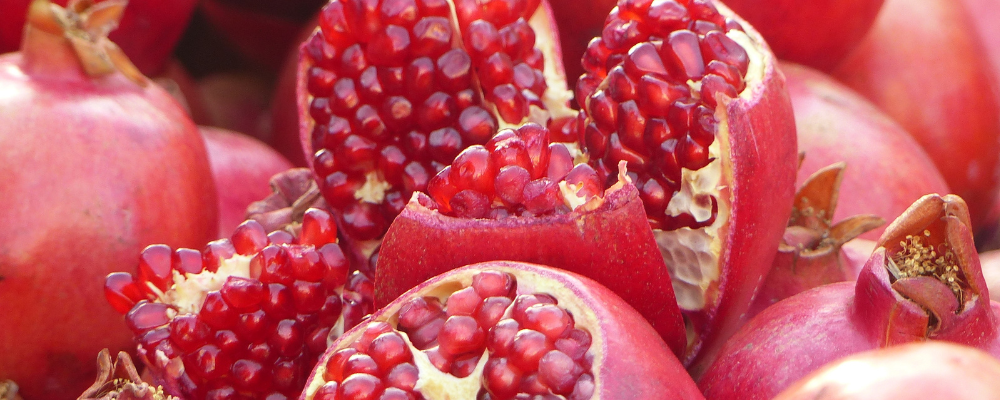
The pomegranate preserves a multitude of seeds behind a rind that already bears a crown. When it opens, the fruit reveals red chambers separated by pale partitions. In the Greek world, it belongs to Persephone, tombs, return, and the secrets of sovereignty. Its magic binds abundance to a more serious rule: eating creates an obligation, receiving creates a bond, and returning does not mean breaking the pact.
The pomegranate is Punica granatum L., a shrub or small tree in the Lythraceae family. It originates in a region extending from northeastern Turkey to western and northern Pakistan, and cultivation later spread it throughout the Mediterranean and far beyond.
Greek stories give its fruit a distinct place. A few seeds are enough to divide Persephone’s year between two worlds. A statue of Hera holds a pomegranate whose sacred meaning Pausanias refuses to reveal. This entry follows these sources before addressing fertility, the pact, royalty, and the funerary passage.
A Fruit Divided into Chambers
Punica granatum has glossy leaves, red flowers with a thick calyx, and branches that may end in a point. The ripe fruit retains the calyx at the top: this botanical crown has nourished its association with royalty.
Kew describes the pomegranate as a leathery berry measuring 5 to 10 centimeters, filled with tightly packed seeds. Each seed is surrounded by a translucent, juicy covering that may be red, pink, or pale. Kew, Punica granatum.
Cutting it open reveals an order concealed by the rind. The seeds do not form a confused mass: membranes distribute them into chambers. The fruit’s abundance therefore has an architecture. This structure suits workings involving community, sharing, and inheritance.
The fruit does not merely gather future life. Its dry rind, bitter membranes, and rigid crown surround the pulp. The pomegranate holds desire, boundaries, and preservation together.
Persephone and the Seeds of Return
In the Homeric Hymn to Demeter, Hades gives Persephone a pomegranate seed before her departure. She eats it, and this act prevents a permanent return to her mother. Persephone will spend part of the year underground and the rest among the gods.
The text links the fruit to a bond formed in the underworld. The quantity varies in later versions, but the hymn speaks of one seed. Homeric Hymn to Demeter, Account of the Pomegranate Seed.
One seed is enough to share time. The pomegranate does not close the door of return: it imposes a rhythm between absence and presence, depth and surface, mother and husband.
The mystery is therefore not merely an image of the seasons. It concerns the power of a tiny act. Eating in a place creates belonging, accepting commits the body, and every return carries the memory of the other world.
Hera’s Secret Pomegranate
In the 2nd century, Pausanias describes the chryselephantine statue of Hera at Argos, created by Polykleitos. The goddess sits on a throne, holding a scepter in one hand and a pomegranate in the other. When he reaches the fruit, the traveler interrupts his explanation: its story belongs to a sacred secret.
This restraint is a source in itself. It shows that a symbol can be visible in the sanctuary without becoming knowledge offered to every reader. Pausanias, Description of Greece, 2.17.4.
The calyx’s crown, the number of seeds, and the fruit’s place in Hera’s hand open interpretations of sovereignty, marriage, and fertility. Yet Pausanias does not provide the key. The grimoire respects this closure rather than filling it with an invented story.
The magical lesson concerns the secret kept. Not every symbol demands a complete explanation. A practice may contain a name that no one else reads, a promise made without publicity, or part of the experience left in its sanctuary.
Funerary Fruit and the Promise of Return
Archaeologists have found terracotta pomegranates in Greek funerary and votive contexts. The Metropolitan Museum holds an example from the 5th or 4th century BCE and connects its form with funerary rites and Persephone’s fate. Metropolitan Museum, Greek Terracotta Pomegranate.
The fruit that is deposited does not need to be eaten. Its lasting representation accompanies the dead and preserves the image of the seeds beneath the skin. Terracotta transforms a perishable food into a presence capable of remaining in the tomb.
The Pomegranate then carries death and renewal without one erasing the other. The seeds speak of generation; the funerary deposit preserves separation; Persephone crosses both realms.
In grief work, the fruit suits a rhythmic remembrance. It allows dates for returning to the memory, followed by a return to daily life. Fidelity does not require continuous presence.
Sharing the year and keeping the secret
Draw a closed Pomegranate with its crown. Inside, draw six chambers. Give three chambers to what remains visible and three to what must remain protected. Write one word in each space, then close the outline with a red line.
Below it, draw a line divided into two periods. Write down the dates of presence, withdrawal, work, or rest that structure your commitment. The calendar prevents you from promising permanent availability.
Choose a chamber whose contents remain secret and color it without rereading its word. Place an image of the fruit near the page until the first return date. This practice draws on Persephone’s crown, chambers, and rhythm without ingestion, funerary offering, or imitation of a cult.
Historical correspondences
| Reference | Correspondence |
|---|---|
| Botanical name | Punica granatum L. |
| Family | Lythraceae |
| Central story | Persephone in the Homeric Hymn to Demeter |
| Sacred object | Pomegranate held by Hera at Argos |
| Magical domains | Pact, return, sovereignty, secrecy, and abundance |
| Safe form | Compartmentalized drawing and calendar |










