


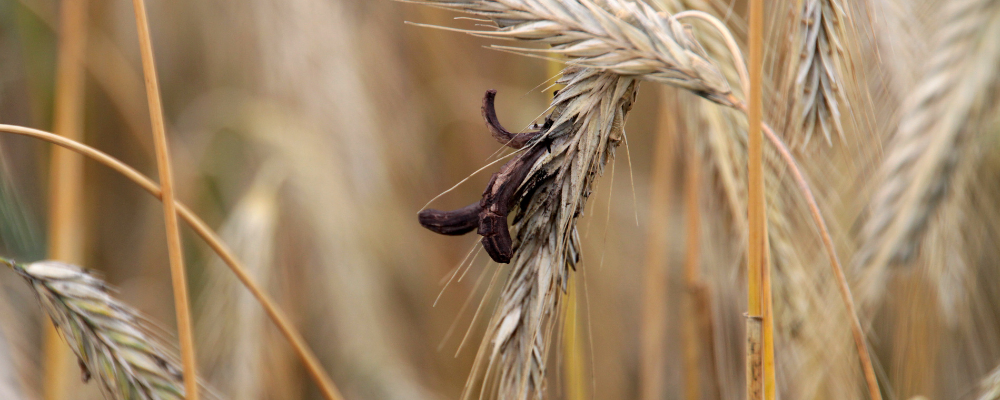
In the rye ear, a grain turns into a black horn. It is no longer the cereal, but the sclerotium of a parasitic fungus: Claviceps purpurea. When it entered flour, the bread could cause burning sensations, convulsions, gangrene, and visions. In the Middle Ages, this scourge was given the name Saint Anthony’s fire.
Ergot is not a matter of chosen magic. It belongs first to the history of mass poisonings, religious fear, and organized care centered around the Antonines. Its dark claw-like silhouette also fueled hypotheses about visions and accusations of witchcraft.
A famous hypothesis proposes that Ergot was prepared in the kykeon of the Eleusinian Mysteries. Recent studies examine its chemical and archaeological plausibility, but the hypothesis does not become an established fact. The fungus’s toxicity rules out any experimentation.
The horn that replaces the grain
Claviceps purpurea is a parasitic fungus of grasses, particularly well known on rye. It infects the flower and replaces the ovary with an elongated, hard, purplish-black sclerotium. This structure falls to the ground, overwinters, then produces fruiting bodies that release new spores.
The word “ergot” describes the shape of a spur or claw. The fungus is therefore neither a seed nor an outgrowth of rye: it is a distinct organism that hijacks the grain’s development.
A medical history published by the Royal College of Physicians of Edinburgh describes ears of grain marked by black horns and the two major forms of ergotism, gangrenous and convulsive. M. R. Lee, History of Ergot up to 1900.
Saint Anthony’s fire
Breads made with contaminated rye caused outbreaks of ergotism in Europe. Those affected experienced intense burning sensations, spasms, or convulsions; vasoconstriction could lead to gangrene and the loss of a limb.
The name “Saint Anthony’s fire” connects these sufferings to the saint and the hospital order that cared for those affected. The image of fire describes the bodily sensation as much as a punishment interpreted in a Christian world.
The transition from nourishing bread to dangerous bread gives ergot its symbolic power. The danger hides in everyday food, then becomes visible through the black horn. Grain sorting thus takes on the value of discernment and survival.
Eleusis and the Kykeon Hypothesis
The initiates of Eleusis drank kykeon, a beverage mentioned in the Homeric Hymn to Demeter. A modern theory proposes that grain contaminated with ergot provided psychoactive compounds during the Mysteries.
A 2026 study tested the transformation of certain alkaloids under conditions considered possible for an ancient preparation and linked the hypothesis to archaeological evidence. The authors still describe it as a psychedelic hypothesis and emphasize the major toxicity of ergot. Magiatis et al., study on the kykeon.
Eleusis remains an initiatory mystery whose secret cannot be reduced to a molecule. Ergot may be studied as a debated candidate, without being presented as the certain key to the rite.
The Grain and the Secret. A possible substance does not exhaust the meaning of a liturgy, a myth, or the experience of an initiated community.
Visions, Witchcraft, and Explanations
Convulsions, hallucinations, and collective outbreaks have encouraged researchers to reread certain historical episodes, including witchcraft accusations, through the lens of ergotism. Such an explanation may shed light on symptoms, but it is not enough to reconstruct an entire society.
Trials also depend on conflicts, power structures, religious doctrines, and coerced testimony. Ergot is a possible cause in certain agricultural and climatic contexts, not a general solution for every strange event.
In the grimoire, its function is critical: it teaches how to distinguish the experience, its interpretation, and its material cause. The black horn becomes the sign of a hidden factor that an investigation can make visible.
Separate the grain from the story
Work with an enlarged photograph of a contaminated ear. Draw the ear, replacing each sclerotium with a question: bodily cause, religious context, the witness’s words, political interest, transmission of the account. The exercise shows that an event can receive several levels of explanation.
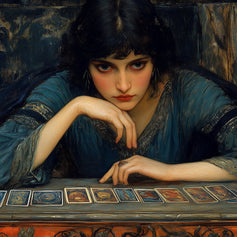
For Eleusis, place three cards side by side: an ancient text, archaeological data, and a modern chemical experiment. Connect only the claims that the sources support. The space between the cards preserves what remains unknown.
Do not buy or keep any actual ergot. An image or a black clay model fulfills the entire symbolic function without introducing a mycotoxin into the home.
Historical correspondences
| Reference point | Correspondence |
|---|---|
| Scientific name | Claviceps purpurea |
| Major host | Rye and other grasses |
| Visible form | Blackish-purple sclerotium replacing the grain |
| Historical name of the disease | Saint Anthony’s fire, or ergotism |
| Ritual hypothesis | Ergot in the kykeon of Eleusis, a debated proposal |
| Safe support | Photograph, inert model, and source comparison |