















































































































































































































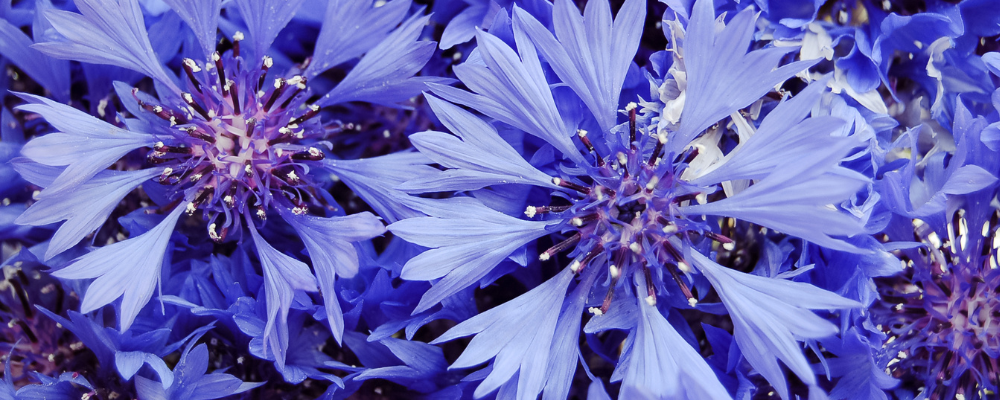
The Cornflower mingles its vivid blue with cereal fields. This presence earned it the names harvest flower, blue bottle, and sickle-breaker. Old herbals place it under Saturn, while funeral wreaths and Egyptian jewelry show that a field flower can also cross the threshold of the tomb.
The species is Centaurea cyanus L., an annual Asteraceae that has become rare in several agricultural landscapes as a result of seed sorting and herbicide use. The “blue” in the name does not permit confusion with chicory, borage, or other centaureas.
Its historical magic brings together the harvest, fragility, Saturn, and remembrance. It is not based on a universal power of vision or eye healing, even though herbals have passed down such medicinal uses.
The Centaurea of the harvests
Centaurea cyanus belongs to the Asteraceae family. Its slender stem bears narrow, gray-green leaves. The flower head contains central purple flowers and large blue, funnel-shaped peripheral flowers.
Kew recognizes the species as native to the central and eastern Mediterranean. It followed cereal cultivation across Europe and then to other continents. Kew, Centaurea cyanus.
The Cornflower is a segetal plant: it lives among crops. Its visible history therefore depends on how fields are sown, sorted, and treated. Where agricultural practices change, the flower may disappear even though the grain remains.
This dependence provides a first correspondence: the Cornflower recalls what accompanies a work without being its main product, then disappears when efficiency leaves no room for it.
Sickle-breaker and field flower
The English name blue bottle describes its shape and color. Other European names associate it with rye, wheat, and the sickle. “Sickle-breaker” or hurt-sickle imagine its stem capable of dulling the reaper’s tool.
The stem does not actually stop a blade. The name gives a voice to the unwanted plant in the field: it causes trouble, resists, and demands a place amid production intended to remove it.
The magic of the cornflower can begin with this image. It accompanies work devoted to remembering the margins, to beauty that persists within a productive system, and to refusing to erase everything that does not belong in the harvest.
Saturn and the full moon in Culpeper
Culpeper describes the Blue Bottle among field plants and places it under Saturn. He also reports that transplanting it at the full moon causes it to lose its blue color, a remark rooted in the astrological botany of his time. Nicholas Culpeper, The English Physitian.
Saturn associates the flower with time, boundaries, and cultivated land. The lunar account adds a color enigma: moving the plant at the wrong time would alter what makes it recognizable.
Blue becomes a quality to preserve. In the book, the celestial calendar protects the flower’s visible identity.
This passage does not make it possible to predict the color of a modern plant. It provides precise evidence of how an astrologer-herbalist linked cultivation, time, and appearance.
Flower wreaths and jewelry
The cornflower and related knapweeds appear in floral ornaments from New Kingdom Egypt. The Metropolitan Museum preserves a faience bead necklace imitating cornflower buds, flowers used in bouquets intended for sanctuaries and in broad floral collars. The Met, cornflower-shaped bead necklace.
The British Museum also preserves a fragment of a funerary wreath combining leaves, lotus, acacia, and flowers identified as cornflowers. British Museum, plant funerary wreath.
These objects attest to the presence of the floral form in offerings, adornment, and funerary furnishings. They do not prove a fixed Egyptian correspondence for Centaurea cyanus. The identification of dried or stylized plants may remain disputed.
The mystery of the Cornflower lies here between real flower and enduring flower: the bouquet withers, while the blue faience preserves its image.
Keeping a place in the harvest
Draw a rectangle like a field, then fill it with vertical lines representing the cereal crops. Leave a space in the center for an eight-pointed blue flower.
Inside the flower, write the name of what your work risks erasing: rest, relationship, memory, play, or silence. Then draw a narrow path from the edge of the field to this flower.
Keep the drawing near your workspace for a week. The gesture echoes the segetal flower and the Saturnian limit. It uses neither eye infusion, smoke, nor contact with the product.
Historical correspondences
| Marker | Correspondence |
|---|---|
| Botanical name | Centaurea cyanus L. |
| Historical context | Cereal fields and segetal flora |
| Names | Cornflower, blue bottle, and blade breaker |
| Astrological source | Saturn according to Nicholas Culpeper |
| Magical domains | Memory, limit, margin, and fidelity to color |
| Safe form | Drawing of the field and blue flower |










