















































































































































































































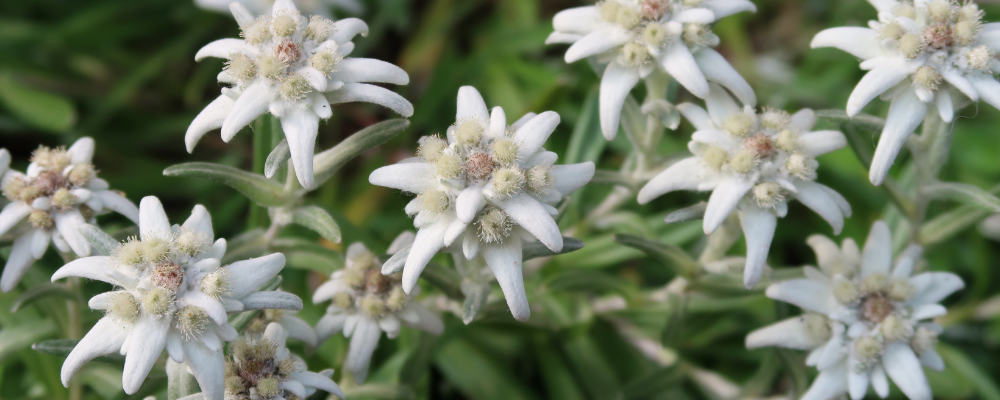
Edelweiss seems to carry an antiquity that its cultural history does not possess. The image of the almost inaccessible flower, gathered at the edge of a precipice as proof of love, became established with mountaineering and tourism in the 19th century. The real plant grows in calcareous grasslands and scree, not only on impossible cliffs. Its mystery comes from this collective construction: a small woolly star becomes an emblem of courage, then a national, military, commercial, and protective symbol of the Alps.
The name accepted by Kew is Leontopodium nivale subsp. alpinum (Cass.) Greuter, Asteraceae. Leontopodium alpinum, still widely used, is treated as a synonym. The white “petals” are woolly bracts surrounding several small yellow flower heads.
Edelweiss does not appear here as a relic from an old grimoire. Its cultural magic took shape in Alpine modernity through the courage of gathering it, love offered, and mountain identity. Current practice preserves the commitment and rejects uprooting: the drawing replaces the wild flower.
A star made of bracts
Leontopodium nivale subsp. alpinum is a low-growing perennial plant. Its leaves and bracts bear a covering of white hairs. At the center of the apparent star are several flower heads composed of tiny flowers.
Kew accepts this subspecies and places its native range in the mountains of Europe, from the Pyrenees to the Carpathians and the Balkans. It lives in the temperate biome, on rocky, calcareous soils. Kew, Leontopodium nivale subsp. alpinum.
The felted covering limits certain effects of radiation, wind, and water loss. The white form that the eye reads as a flower therefore also belongs to a protective envelope.
This botany corrects the solitary image. The star results from an arrangement of bracts and flower heads. Mountain courage can therefore be read as the coordination of small protections, not as an isolated feat.
The 19th-century Alpine myth
The Swiss Confederation traces the birth of the modern Edelweiss myth. In the 19th century, the first urban mountaineers valued this flower as a trophy of an ascent and a sign of difficult access.
The legend of the young man risking his life to bring an Edelweiss to the one he loves reinforces themes of love and bravery. The story grew alongside tourism, popular imagery, and political uses. Swiss Confederation, history of the Edelweiss myth.
The page also emphasizes that the real plant does not grow only on the most inaccessible cliffs. The danger is partly part of the narrative that turned picking it into a feat.
Inaccessibility became a stage for love. The flower acquired its heroic aura at the moment when modern mountaineering was inventing its emblems.
From flower to collective symbol
The Austrian Alpine Club adopted the Edelweiss as a symbol in 1870. At the time, the association linked the flower to love of the mountains, Alpine life, and nature protection.
The same sign would be adopted by hotels, brands, military units, and political movements. Its whiteness therefore guarantees no innocence of context. Austrian Alpine Club, history of the emblem.
This circulation lies at the heart of its cultural magic. A symbol can unite, sell, decorate, or command. Before wearing it, one must ask who chose it, when, and for which community.
The Edelweiss supports visible commitments and freely made promises. It does not seal fidelity through coercion. Its value lies in freely assumed risk and responsibility toward the environment that sustains the flower.
Love the mountain without picking the flower
The popularity of the Edelweiss led to intensive picking and prompted protective measures as early as the late 19th century in several Alpine regions. Current rules depend on the territory.
The Innsbruck municipal archives link the flower to mountaineering, Empress Elisabeth, and the first protection efforts. Innsbruck City Archives, history of the Edelweiss.
The heroic act then changes direction. Courage is no longer bringing back a plucked flower, but giving up the trophy, staying on the trail, and letting the plant complete its cycle.
The magic of Edelweiss unites love and limits. A promise that destroys its own symbol contradicts itself. A commitment worthy of the mountain protects the place, accepts distance, and conveys an image rather than taking a specimen.
Forming a commitment star
Draw an Edelweiss with eight bracts around several small central circles. In the center, write the commitment you wish to make visible.
In four bracts, note what you will do. In the other four, write what you will refuse to take, force, reveal, or damage in order to honor this commitment.
Add a path beneath the flower consisting of three achievable steps. Give each step a date and a witness. A promise without a path remains at the center without reaching the mountain.
Sign the page and keep it without a real flower. If you encounter an Edelweiss in the mountains, observe it from the trail and keep only a photograph that respects the place.
Historical correspondences
| Reference | Correspondence |
|---|---|
| Botanical name | Leontopodium nivale subsp. alpinum |
| Family | Asteraceae |
| Cultural construction | Heroic love and nineteenth-century mountaineering |
| Association emblem | Austrian Alpine Club since 1870 |
| Magical correspondences | Commitment, courage, limits, and protection of the place |
| Safe form | Drawn star, no picking |










