















































































































































































































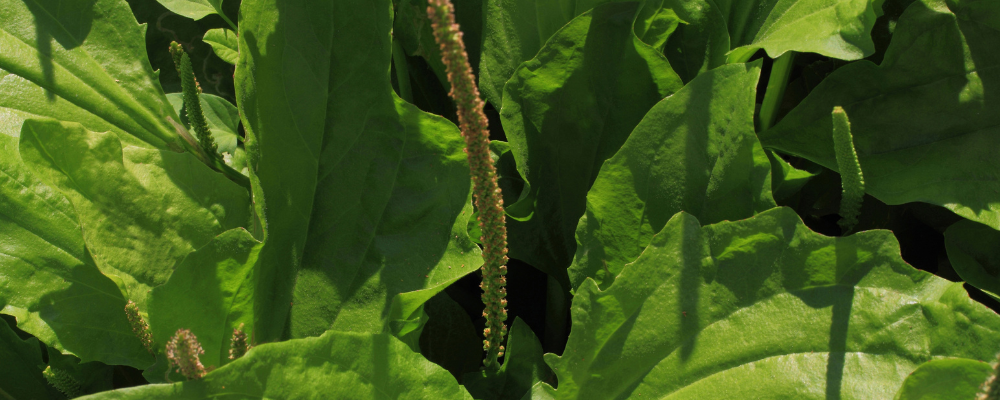
Plantain grows where the path presses down. Its rosette stays low, its veins hold the leaf together, and its seeds travel with footsteps. In the Charm of the Nine Herbs, copied in England at the beginning of the 11th century, it is given the title “mother of herbs.” Chariots, women, wives, and bulls pass over it; it resists. All its magic lies in this scene of road, pressure, and response.
The main reference is Greater Plantain, Plantago major L. Ribwort Plantain, Plantago lanceolata L., belongs to the same genus but has narrower leaves and long spikes. Old English texts use wegbrade, “broad of the road,” whose identification points to Plantain without guaranteeing every species detail.
The manuscript combines a recipe, spoken words, repeated gestures, and religious references. It does not separate medicine and charms according to our current categories. The entry preserves this structure while proposing a writing exercise without preparing the balm.
A rosette beneath the footsteps
Plantago major belongs to the Plantaginaceae family. Its oval leaves emerge from a basal rosette. Several parallel veins run upward from the base. The tiny flowers cluster on erect spikes, then produce capsules filled with small seeds.
Kew places its native range in temperate Eurasia, the Arabian Peninsula, Macaronesia, and much of Africa. The plant has become naturalized on many continents. Kew, Plantago major.
The rosette offers little purchase underfoot. The veins remain visible when the leaf tears, and the flower stalk rises above compacted ground. Plantain thrives in disturbed ground, yards, roadsides, and trampled lawns.
The path therefore belongs to its biology as much as to its medieval name. Its magic of resistance begins with a simple observation: the plant lives in repeated contact with human and animal pressure.
The charm preserved in Harley 585
The Charm of the Nine Herbs occupies folios 160r to 163r of the Harley MS 585 manuscript. The British Library dates this collection to the early 11th century. It brings together medical recipes, prayers, and invocations in Old English, Latin, and Old Irish. British Library, Harley MS 585.
The poem names nine plants and combats poison, contagion, and an adversary that travels throughout the land. Woden strikes a serpent with nine twigs. Christ also appears in the text. The manuscript thus preserves several religious layers within a single remedy.
The instructions call for grinding the plants, mixing them with soap and apple juice, then singing the charm three times over each herb, over the apple, into the mouth, in the ears, and over the wound.
Repetition builds the rite’s effectiveness. The plant, the word, the number, and the area of the body act together. Isolating a single ingredient would mean losing the structure that gives the passage its meaning.
The Mother of Herbs on the Road
The Plantain receives a remarkable address: wegbrade, mother of herbs, open to the east and powerful within. The text evokes creaking carts, passing women, wives who cry out, and bulls that bellow above it.
After this ordeal, the poem asserts that the plant endured and grew back. Resistance to passage becomes the reason for its power against poison and contagion. Rutgers, translation of the Old English metrical charms.
The opening to the east may describe the leaf, its orientation, or a ritual feature. The text leaves these possibilities together. Above all, it gives the rosette a direction: the plant of the ground receives the day and preserves an inner strength.
What endures the passage becomes a response to the passage. The Plantain draws its poetic authority from the road that presses it without erasing it.
Resisting Without Becoming Immobile
The Plantain’s resistance does not consist in blocking all circulation. The plant occupies the path, bends underfoot, and continues growing. It teaches a low, continuous defense adapted to pressure.
In a magical working, the rosette can represent a center that distributes force toward several veins. When the load arrives, it does not depend on a single point. Supports, habits, and limits form a network.
The title “mother of herbs” adds the capacity to contain and nourish a response. It does not place Plantain above all plants in a universal ranking. It belongs to the charm’s voice and its setting.
The path ultimately provides a question: what pressure returns to the same place? Repeated fatigue calls for changing the passage, not merely increasing endurance. Plantain helps read the trace before choosing the response.
Drawing a resilience rosette
Draw a small circle in the center of a page and eight veins radiating toward the edge. In the circle, write what must remain intact despite the pressure.
On four veins, name the repeated passages: requests, schedules, words, or constraints. On the other four, write down the supports already available. A support may be a person, a rule, evidence, or time to rest.
Then draw a path that crosses the leaf without cutting through the central circle. Wherever it crosses each vein, note a brief, feasible response. Keep the verbs in the present tense.
Orient the page eastward in the morning, then read only the word in the center. In the evening, mark the response actually used. After nine days, keep the active veins and redraw those that offered no help.
Historical correspondences
| Reference | Correspondence |
|---|---|
| Botanical reference | Plantago major L. |
| Family | Plantaginaceae |
| Old English name | Wegbrade, broad plant of the road |
| Magical source | Charm of the Nine Herbs, Harley MS 585, early 11th century |
| Magical domains | Resilience, road, protection, and repeated response |
| Safe form | Rosette drawing and nine-day journal |










