















































































































































































































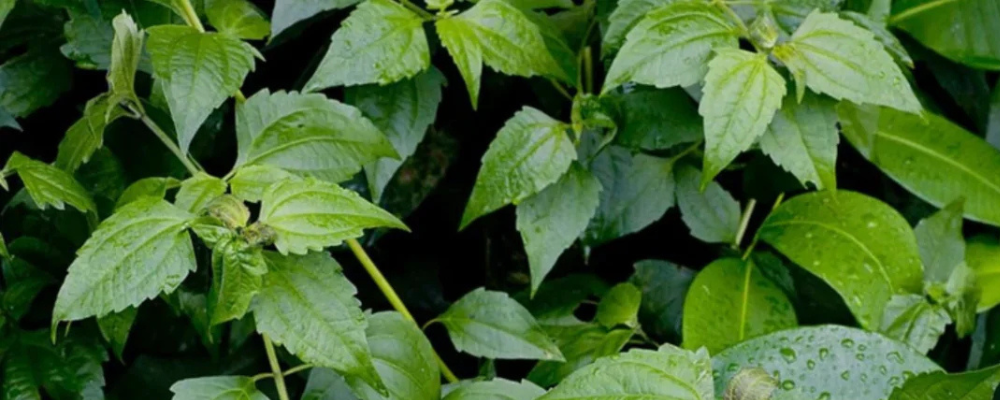
In the Cuban countryside, Rompe Saragüey bears a name of action: it breaks, opens, and undoes. Behind this name lies Chromolaena odorata, a large American Asteraceae that became a plant used for baths, cleansings, and protection in Afro-Cuban religions. Its history calls for particular care, because a common roadside plant may belong to religious knowledge whose practices are not all public.
Botany long classified the species under Eupatorium odoratum. Both names appear in herbaria, Caribbean inventories, and works devoted to Santería and Palo Monte plants.
This article presents published uses and their context without reproducing preparations reserved for initiation. The plant remains closed: no bath, decoction, or dispersal in nature is proposed.
An Asteraceae of the Americas
Chromolaena odorata (L.) R.M.King & H.Rob. is a herbaceous shrub with branched stems. Its opposite, triangular, toothed leaves have three main veins visible from the base. When crushed, they release a strong scent. The pale flower heads form clusters and produce seeds equipped with a pappus.
Kew places its native range in the tropical and subtropical regions of the Americas, from Florida and Mexico to Argentina. The species subsequently spread to Africa, Asia, and the Pacific. Kew, Chromolaena odorata.
The synonym Eupatorium odoratum retains historical value. It makes it possible to identify the plant in nineteenth- and twentieth-century books. A reader searching only for the current name may lose part of the medicinal and religious archives.
In regions where it has been introduced, Rompe Saragüey can form dense stands, smother other plants, and fuel fires. Ritual work with seeds or a living plant outside its native range therefore requires strict ecological vigilance.
Breaking and cleansing in Cuban traditions
The Spanish name combines the verb romper, “to break,” with a Caribbean term whose spellings vary: saragüey, saraguey, or zaragüey. In published Cuban practices, the plant is used in baths and cleansings intended to undo a harmful influence or prepare for a transition.
The writer and ethnographer Lydia Cabrera collected the words of Afro-Cuban practitioners in the mid-20th century. Her book El Monte connects plants, orishas, the dead, illnesses, and daily life. Rompe Saragüey appears there under the botanical name then in use, within a body of material in which each leaf acts through its relationship to a power, a ritual language, and a specialist.
A contemporary bibliography devoted to these subjects extends this history in Las plantas de la santería y la Regla de Palo Monte. Bibliographic presentation of the book.
The cross of leaves behind the door
Among the practices made public is placing leaves in a cross behind a door. The shape marks intersection and closure: two directions meet at the very place where the house connects with the outside.
The plant’s name gives the act its verb. Placing Rompe Saragüey at the threshold means that the obstacle, harm, or negative influence encounters an action that breaks it. This word-based magic, founded on the name, appears in many ritual systems, but its Cuban expression retains its own frameworks.
The threshold receives an action. The cross does not decorate the door: it gives a stable form to the verb “to break” and to the decision to keep the inside protected.
The public presentation of this act does not authorize anyone to copy a Santería or Palo Monte ceremony. The prayers, mixtures, offerings, and destinations of the remains may be matters for a religious house and an authorized practitioner.
Between medicinal plant and religious herb
In the Caribbean, Chromolaena odorata has also been used for wound care, washing, and other household purposes. The TRAMIL network brings together regional ethnopharmacological surveys and notes that the same plant may have different names and functions from one island to another. TRAMIL, Chromolaena odorata.
The Smithsonian lists several Caribbean names associated with the species. Smithsonian, botanical inventory of the West Indies. This plurality shows the journey of a plant through herbaria, markets, patios, temples, and roadsides.
The mystery of Rompe Saragüey lies in this dual presence. An ordinary herb to anyone passing by, it becomes an effective utterance when a name, ritual authority, and destination bring it together. The material alone does not contain the ceremony.
Marking a break at the threshold
Cut two strips of paper and cross them behind an interior door with a removable thread. Write on the vertical strip what must stop, then on the horizontal strip the concrete boundary that will be upheld.
Place the sealed sachet nearby while writing. Do not add water, perfume, or any other herb. Read the boundary once, then remove the product and store it with its botanical label.
After seven days, remove the cross and note the action taken: an expressed refusal, closed access, a canceled appointment, or help requested. The practice uses the threshold, the cross, and the verb from the name without imitating a religious ceremony.
Historical correspondences
| Reference | Correspondence |
|---|---|
| Botanical name | Chromolaena odorata (L.) R.M.King & H.Rob. |
| Former botanical name | Eupatorium odoratum L. |
| Cultural context | Afro-Cuban religions and Caribbean household practices |
| Published practice | Cleansing baths and leaf crosses at the threshold |
| Magical uses | Breaking, cleansing, protection, and opening the passage |
| Safe form | Paper cross and sealed sachet |










