






















































































































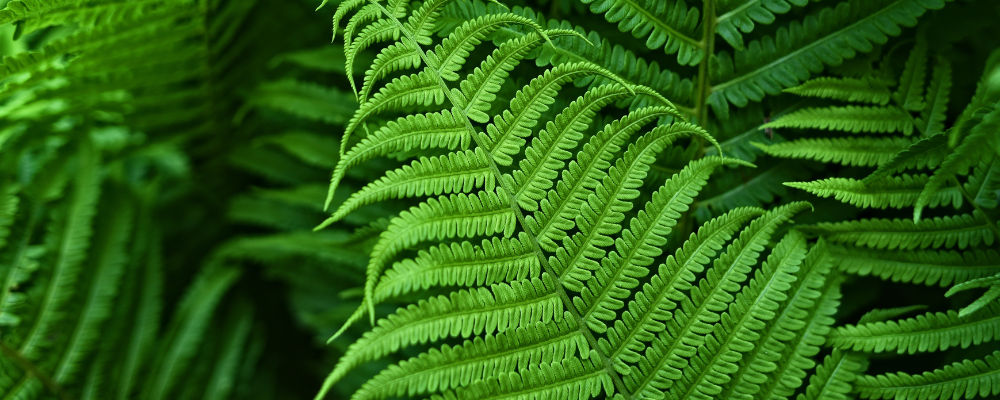
Fern unfurls a frond without ever producing a flower. This visible absence nourished one of Europe's most beautiful botanical secrets: an elusive seed, gathered on Saint John's Eve, that was said to make its bearer invisible. Shakespeare puts the phrase in the mouths of thieves and immediately follows it with a joke: the night hides them better than the seed.
The name “Fern” covers thousands of species. This entry focuses on Pteridium aquilinum (L.) Kuhn, bracken, because it is linked to European tales of “fern-seed” and has a toxicological profile that requires a clear warning.
A fern produces neither flowers nor seeds. It produces tiny spores beneath or along the edges of its fronds. The historical mystery stems precisely from this reproduction, which is difficult to observe with the naked eye: what escaped notice was imagined as a secret seed endowed with the same power.
Bracken and Its Spores
Pteridium aquilinum belongs to the Dennstaedtiaceae family. Its triangular fronds rise from an extensive network of underground rhizomes. Each frond is divided several times and can form large expanses in heathlands, open woodlands, and disturbed areas.
Kew accepts the species and assigns it an immense range across temperate and tropical regions. Kew, Pteridium aquilinum.
The spores form in sporangia arranged along the folded edge of the leaflets. They are not seeds and do not descend from a hidden flower. The young fiddlehead, adult frond, and rhizome represent three very different stages of the plant.
This biology provides an exact foundation for the invisibility tale. Reproduction exists, but its substance escapes the hurried eye. Fern magic therefore centers on secrecy, discretion, and what acts from an underground structure.
The invisible seed of a flowerless plant
European folk practices attributed to Fern a flower or seed that appeared for a moment during Saint John's Eve. Collecting it required precise timing, a cloth or container placed beneath the plant, and vigilance against the beings guarding the secret.
The reasoning follows a powerful symmetry: an invisible seed grants invisibility. Whoever carries it can move unseen, discover treasures, or understand hidden things. The actual smallness of spores may have fueled this imagination.
Midsummer places the quest near the summer solstice, when light reaches its greatest extent before beginning to wane. Seeking the invisible during the shortest night reverses the usual order: the secret appears when the world seems least suited to concealing it.
The grimoire preserves this paradox without claiming that a spore erases a body. Invisibility becomes the art of not attracting attention, protecting information, and knowing when silence serves better than exposure.
Shakespeare and the invisible thieves
In the first part of Henry IV, Gadshill assures his accomplice that they possess the Fern-seed recipe and that they walk invisible. The Chamberlain replies that they owe their invisibility more to the night than to the seed.
The play, composed toward the end of the 16th century, shows that the allusion was familiar enough to support an immediate joke. William Shakespeare, King Henry IV, Part I, Act II.
The Fern promises invisibility, while the scene recalls the power of night. Magic and human cunning look at each other in the same line.
The scene gives life to two voices at once: Gadshill claims the plant’s secret, while the Chamberlain attributes their discretion to the night. The mystery of the invisible seed remains, accompanied from the outset by a skeptical view of what truly conceals men.
The hidden network beneath the frond
The frond disappears in winter while the rhizome remains underground. Fire or cutting can remove the visible part without destroying the network. The plant regrows from buds distributed far from the affected point.
This architecture completes the imaginary seed. In the story, hidden power lies in a tiny point; in botany, persistence lies in an extensive network. Both lead us to seek the cause where direct observation cannot find it.
The Fern accompanies work involving confidentiality, strategy, and the investigation of invisible connections within a problem. It must not be used to promise impunity. Shakespeare, moreover, places the seed in a scene of theft, then makes the ironic answer heard.
Its mystery remains fertile because it already contains its own critique. The reader can love Midsummer’s Eve, the impossible flower, and the silent quest while knowing that the spores, rhizome, and darkness explain another part of the story.
Protect what must remain discreet
Draw a frond above a line of soil and a branched rhizome below it. On the frond, write what may be made public. Below the line, place the information that requires protection: address, unfinished project, name, or date.
Surround each hidden element with a precise boundary: authorized person, storage location, password, or deadline. Invisibility becomes a confidentiality rule rather than a wish without a method.
Place the sealed product next to the drawn rhizome. Reread Shakespeare’s answer: the night contributes to the concealment. Then check the actual conditions for discretion before putting away the leaf. No spores, fronds, or smoke are dispersed.
Historical correspondences
| Reference point | Correspondence |
|---|---|
| Selected species | Pteridium aquilinum (L.) Kuhn |
| Actual reproduction | Spores, without flower or seed |
| Legendary moment | Midsummer's Eve |
| Literary source | Shakespeare, Henry IV, Part I |
| Magical domains | Secrecy, discretion, research, and strategy |
| Safe form | Privacy card and sealed product |