















































































































































































































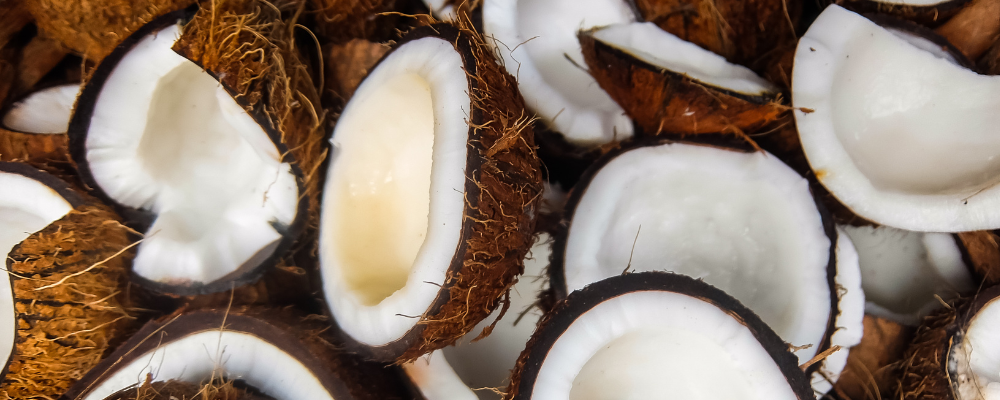
The Coconut travels enclosed in a floating shell. Three pores mark one end like a face, while the water and flesh remain protected behind several layers. On the coasts of Maharashtra, the fruit is offered to the sea when the fishing season ends. In temples in Kerala, it is broken to the rhythm of drums. Its magic connects crossing, offering, opening, and the breaking of obstacles.
The Coconut Palm is Cocos nucifera L., a palm in the Arecaceae family. Its fruit has an outer covering, a thick fibrous layer, a hard shell, and a seed whose cavity contains coconut water. The three visible pores belong to the inner shell.
The act of breaking a Coconut takes on different meanings depending on the place, deity, and community. Two public practices, one in western India and the other in Kerala, demonstrate this diversity. A temple offering retains its religious context and does not become a decorative exercise.
A fruit built for the crossing
Cocos nucifera bears a crown of large fronds at the top of an unbranched trunk. The inflorescences produce male and female flowers. The fruit ripens over many months before developing its familiar brown shell.
Kew places the native range of the Coconut Palm in the central Maluku Islands of the southwestern Pacific. Human dispersal established it along tropical coasts worldwide. Kew, Cocos nucifera.
The fibrous layer contains air and cushions impacts. It helps some fruits float and protects the seed in salt water during a crossing. The hard shell then withstands the journey until it settles on a favorable shore.
This structure gives rise to a very tangible travel magic. Protection abolishes neither the current nor the passage of time: it preserves what must arrive alive. A crossing project therefore requires a casing, a reserve, and a destination.
The three eyes and the opening point
At one end of the shell are three germination pores. One allows the embryo to emerge when the seed germinates. Their arrangement forms a face and gives them the common name “eyes.”
The shell appears uniform, but it already contains an opening. This feature supports a magic of the right opening: there is no point in striking everywhere when the material indicates its point of transformation.
The three eyes may represent observation, choice, and passage. The first looks at the situation, the second recognizes the limit, and the third indicates the action that truly opens the way.
The face remains a human reading of a botanical structure. Its force comes precisely from this encounter between anatomy and perception. The plant provides three real marks; the rite assigns them a readable function.
Offering the fruit to the sea
In Maharashtra and along the Konkan coast, Narali Purnima marks the end of the monsoon and the return of the fishing season. Fishing communities prepare boats, repair nets, and offer coconuts to Varuna, the power of the waters.
The Indian Ministry of Tourism portal describes the prayer for protection at sea and a prosperous season. The offered fruit therefore accompanies a concrete return to maritime work. Indian Ministry of Tourism, Narali Purnima.
The offering does not deny the danger of the open sea. It places the departure in a relationship with the sea, the winds, the boat, the network, and the community. Prosperity depends on a world to which the fisherman shows respect before setting out again.
The floating fruit returns to the water before the boat. The offering opens the season by acknowledging the power of the environment that nourishes and threatens.
Breaking the obstacle to the rhythm of the temple
At Kottuvodath Vettakkorumakan Temple in Kerala, the Pantheerayiram ritual involves breaking 12 008 coconuts. The oracle strikes them one after another to the rhythm of the chenda, after a period of preparatory discipline.
The temple presents the rite as an offering intended for the prosperity of the family and village. Accumulation, rhythm, and precision transform breaking into a communal act. Kottuvodath Vettakkorumakan Temple, Pantheerayiram.
The broken shell gives a clear image of the broken obstacle, but the rite goes beyond this isolated symbol. It belongs to a deity, specialists, music, a calendar, and a community.
A personal practice therefore preserves the structure without imitating the offering. Drawing an open shell makes it possible to name what must yield and what the opening makes accessible, without waste or appropriation of a rite.
Open the shell on paper
Draw a thick circle with three points at its top. In the first point, write what you observe. In the second, enter the limit encountered. In the third, note the possible action.
Draw a slit from the third point to the center. To the left of the slit, write what the obstacle protected. To the right, note what becomes accessible after the opening.
Surround the circle with a fibrous layer and write on it the protections needed during the crossing: budget, contact, deadline, shelter, or return solution.
Cut out the page around the circle without separating the two halves. Fold it along the slit, carry out the chosen action, then unfold it to write down the result. The paper preserves the shell, the opening, and the passage without breaking any fruit.
Historical correspondences
| Reference | Correspondence |
|---|---|
| Botanical name | Cocos nucifera L. |
| Family | Arecaceae |
| Reference form | Fibrous fruit, hard shell, and three pores |
| Practices cited | Narali Purnima and Pantheerayiram |
| Magical domains | Crossing, offering, protection, opening, and obstacle |
| Safe form | Drawing of the shell and planned action |










