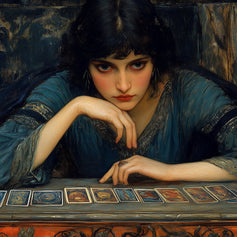




The Violet grows low, but its story spans the abduction of Persephone, troubadour competitions, Good Friday rites, and Napoleon’s political return. Its small flower becomes, in turn, Venus’s gift, a poetry prize, a funeral offering, and a secret sign of a fidelity awaiting spring.
European texts consistently link it to Venus and fidelity. A Golden Violet rewarded the best poem at the Floral Games of Toulouse. In an old English sonnet, the flower speaks on behalf of an attachment that endures. On graves and around the Cross, it also accompanies death and prayer.
Its mystery lies in the union of discretion and return. It bows its head, disappears after its season, and then reappears. This form has allowed the flower to embody romantic, religious, poetic, and political fidelities without losing its modest character.
Sweet Violet
Sweet Violet, Viola odorata L., belongs to the Violaceae family. This small perennial forms a rosette of heart-shaped leaves and spreads by runners. Its five-petaled flowers bear a spur and release a pronounced fragrance. Their color ranges from deep violet to white, depending on the cultivated forms.
Kew places its native range from Europe to western Iran, as well as in North Africa. The plant has been cultivated and transported to many regions. The common name “violet,” however, refers to several species of the genus Viola and even, in horticultural usage, to plants with no direct botanical connection. Kew, Viola odorata.
The flower remains close to the ground, and its fragrance can be detected before it is noticed. This restrained presence nourishes its association with modesty, while its spring reappearance gives form to fidelity and return.
Venus and the Abduction of Persephone
Ancient authors associate the Violet with Venus. Folkard recounts several stories linking its color to the goddess and her jealousy, as well as the tale of a young woman transformed into a flower to escape Apollo’s gaze. The Violet thus unites attraction, modesty, and concealment.
Persephone, called Proserpine in the Latin tradition, was picking Violets and Narcissi when the god of the Underworld abducted her. The flower stands at the edge of the rupture separating the girl from her mother’s world. Each spring, her return recalls that of Persephone to the surface.
This scene gives Violet an association with descent and return, but it does not thereby become a tool for contacting the dead. It accompanies the memory of the seasonal passage: disappearance, sojourn underground, reappearance.
The Troubadours’ Golden Violet
At the Floral Games of Toulouse, attributed in the transmitted accounts to the initiative of Clémence Isaure, a Golden Violet rewarded the best poetic composition. As early as the 14th century, the flower became the material prize for words deemed worthy of being preserved. The current Academy states that the first competition took place on May 3, 1324. Académie des Jeux floraux, history.
The legendary foundress is said to have sent her flower to her knight during an imprisonment, so that he might wear it as an emblem of his constancy. The troubadours in turn made it a sign of fidelity. Richard Folkard, Plant Lore, Legends, and Lyrics, “Violet”.
A small flower to crown the word. The Golden Violet overturns the scale of greatness: what grows close to the ground becomes the poem’s highest prize.
In a grimoire, Violet is therefore suited to written oaths, letters kept safe, and works to which one returns year after year. Its fidelity is not expressed through possessiveness, but through continuity of action and speech.
From the Tomb to the Return of Spring
In the Middle Ages, Violets were scattered around the tomb during the English ceremony known as Creeping to the Cross, held on Good Friday. Here, the flower accompanies lamentation, the body represented as dead, and the expectation of resurrection.
Several centuries later, Napoleon’s supporters adopted the Violet during his exile on the island of Elba. He became the “Corporal Violet,” the flower that would return with spring. Wearing a bouquet then made it possible to display political loyalty under the appearance of an ornament.
These two contexts stage the same structure: an absence held in memory, followed by hope of a return. The Violet denies neither the tomb nor exile. It preserves the sign during the interval.
Keeping a living fidelity with the Violet
Place a pressed flower or an image of a Violet in a letter containing a commitment you are making yourself. Date the text and set the time when it will be reread. The flower becomes the seal of a verifiable continuity, without acting on another person’s freedom.
To honor someone who has died, place a cultivated Violet near their name in spring, then remove it when it withers. The gesture echoes the flower’s funerary function and seasonal return. A photograph can replace the plant if the location prohibits offerings.
To support your writing, draw a small Golden Violet at the top of a completed page. It does not reward perfection: it marks the text to which you have given a complete form. Repeat this sign until you create your own crown of pages.
Historical correspondences
| Reference | Correspondence |
|---|---|
| Botanical name | Viola odorata L. |
| Planet | Venus in ancient and astrological correspondences |
| Stories | Persephone picking flowers; the fidelity of Clémence Isaure |
| Ritual contexts | Floral Games of Toulouse, Good Friday, Bonapartist symbol |
| Magical domains | Fidelity, poetry, remembrance of the dead, return, discretion |
| Ritual forms | Identified pressed flower, image, letter, spring offering |