















































































































































































































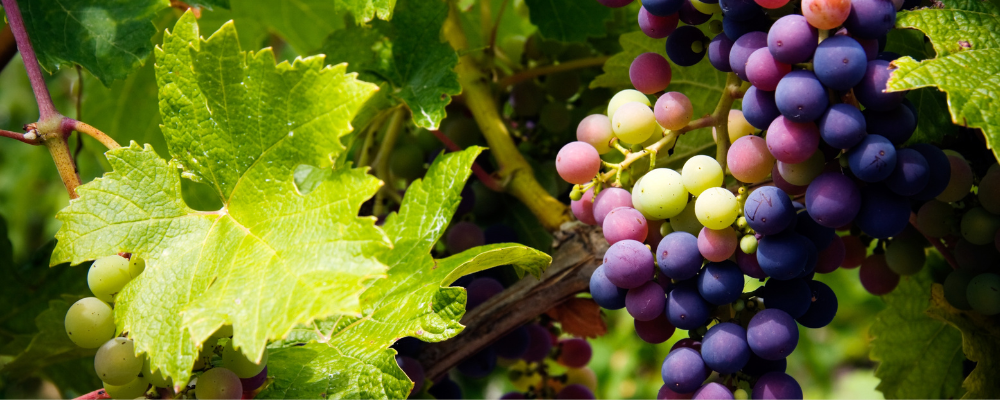
The Vine does more than produce grapes. It clings, spreads, loses its leaves, and grows again from pruned wood. In Greek images of Dionysus, its recognizable branches surround the god, the satyrs, the banquet, and the cup. In Rome, the same plant appears on urns and sarcophagi, where the harvest may evoke a life stronger than death.
The cultivated Vine bears the name Vitis vinifera L. This woody vine of the Vitaceae climbs with the help of tendrils positioned opposite the leaves. Its inconspicuous flowers produce berries gathered in clusters. The species has been propagated into thousands of cultivars intended for fresh fruit, dried fruit, juice, and wine.
Its historical magical use arises from a visible and demanding cycle: pruning, renewed growth, flowering, ripening, harvest, and then fermentation. The Vine stages mastery and excess, the bond that supports and the one that suffocates, collective joy and loss of control. These tensions belong to Dionysus’s procession far more than a simple label of “prosperity.”
A Vine Shaped by Pruning
Vitis vinifera is a vine with alternate, palmate, toothed leaves. Its tendrils wind around a support, while the inflorescences appear on the current year’s shoots. The berry contains seeds, except in cultivars selected to be seedless.
Kew accepts the species and places its native range from central and southeastern Europe through Central Asia and northern Iran. Kew, Vitis vinifera. Domestication and hybridization subsequently extended its cultivation across several continents.
The vinedresser cuts away much of the wood produced in order to guide the next fruiting. This pruning gives the Vine a precise ritual significance: renouncing disorderly growth to concentrate the sap toward selected branches. It speaks of fruitful discipline, not limitless accumulation.
The Vine in Dionysus’s Procession
Greek ceramics make the Vine immediately recognizable around Dionysus. On an Attic pelike painted around 420–410 BCE, the god reclines beneath a branch laden with leaves and grape clusters. The cup, music, and plant share the same ritual space.
The Metropolitan Museum’s description presents this Dionysian banquet and its Vine decoration. Metropolitan Museum, Dionysus beneath the Vine. The image does not separate the plant from the serving of wine, the assembled group, or the divine presence.
Dionysus governs an ambivalent experience: he frees voices and dissolves ranks, but excess can overturn order. The Vine winding around its support makes this ambivalence visible. It unites, bears, and envelops; without pruning, it covers whatever it encounters.
The Dionysian Vine opens the festival while reminding us that every intoxication has a limit.
The cluster facing death
In Roman times, Vine scrolls and grape harvests entered funerary art. A cinerary urn at the Metropolitan Museum associates leaves, clusters, and birds with Dionysus, whose mysteries could promise a form of victory over death.
The museum explains this reading on a 1st-century CE urn. Metropolitan Museum, urn with Vine scrolls. The plant is therefore not neutral decoration: its seasonal return and the transformation of its juice nourish a reflection on passage.
A later fragment of a sarcophagus also depicts the grape harvest. The museum notes the shift from Dionysian language toward a Christian interpretation of the Vine. Metropolitan Museum, sarcophagus with grape harvest. The same plant changes context without losing its power to evoke continuing life.
The mystery of cut wood
In winter, the Vine seems reduced to a gnarled framework. The removed canes bear witness to past growth, while a few buds carry the harvest to come. The plant teaches a temporality in which the absence of leaves is not an ending.
This image is suited to workings of mastery, cycles, and transmission. The vine stock retains a material memory in its wood, but each year calls for a new decision. Not everything must begin again: pruning distributes the effort and makes the harvest possible.
The mystery of old tales is not hidden in a lost formula. It lies in the alliance between a vine and those who train it, and then in the transformation of the fruit. The ritual can retain this structure without using alcohol or pretending to recreate a Dionysian initiation.
Drawing the vine to be trained
Draw a vine with two arms and six shoots. On the trunk, write what must last beyond the present season. On the two arms, place the real supports that give direction to your project.
Cross out four vine shoots and name the habits, expenses, or commitments that scatter your effort. Keep two shoots. Add three buds to each, corresponding to dated, achievable, and verifiable actions.
Finally, connect the two arms with a drawn bunch of grapes. Name each berry after a person who will share the result or a purpose planned for the harvest. The page becomes a symbolic pruning plan: it transforms growth into choice without burning or ingesting the plant.
Historical correspondences
| Reference | Correspondence |
|---|---|
| Botanical name | Vitis vinifera L. |
| Family | Vitaceae |
| Major figure | Dionysus and his retinue |
| Historical motifs | Banquet, harvest, transition, and return of life |
| Magical domains | Mastery, cycle, alliance, and transformation |
| Safe form | Pruned vine on paper |










