


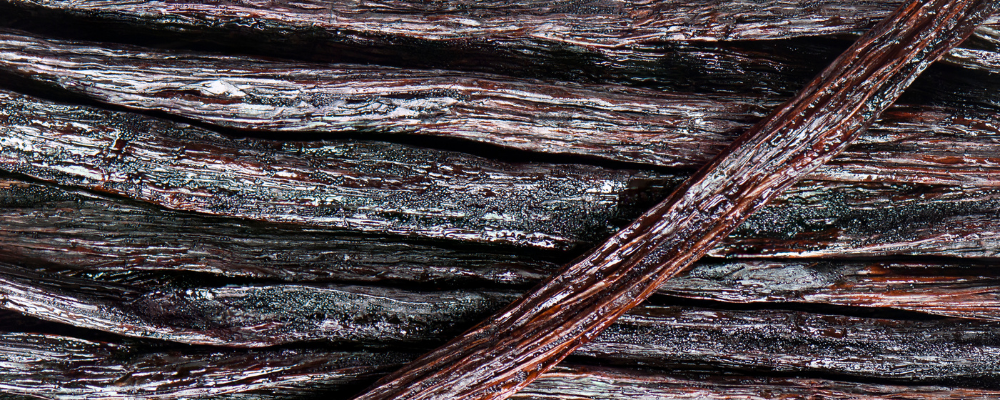
Vanilla conceals its fragrance. The green pod does not release the aroma we recognize: it appears after a succession of heat, moisture, drying, and resting. The flower itself may open for less than a day and must be pollinated within this narrow window. Between the climbing orchid, the human gesture, and the fruit’s transformation lies a magic of perfect timing, patience, and revealed value.
Cultivated Vanilla is Vanilla planifolia Jacks. ex Andrews, a vine-like orchid native from Mexico to northern Brazil. Its fleshy stems bear thick leaves and aerial roots. The greenish-yellow flowers produce long capsules called “pods” in commerce.
The Indigenous peoples of Mexico established the first uses of this orchid. The Totonacs hold a major place in its history, and the Aztecs later associated it with cacao, perfumes, and court preparations. Vanilla is therefore not a European flavor that became magical after its spread: it has a Mesoamerican history predating the conquest.
A Climbing Orchid
Vanilla planifolia is an orchid with an elongated stem that leans on trees without parasitizing them. Aerial roots emerge at the nodes. The flowers possess the labellum and column characteristic of orchids, with a membrane separating the reproductive organs.
Kew accepts the species and places its native range from southern Mexico to northern Brazil. Kew, Vanilla planifolia. The plant is cultivated in many tropical regions.
The fruit is an elongated capsule filled with thousands of tiny seeds. Commercial cultivation relies on vegetative propagation and, outside the range of its pollinators, on hand pollination. Each pod therefore results from an encounter completed at precisely the right moment.
Totonac, Cacao, and Vanilla Routes
Kew notes that Vanilla was used by the Totonac and Olmec peoples in food and beverages and as a charm for good luck, then incorporated by the Aztecs into cocoa drinks. Kew, cultural history of Vanilla.
Smithsonian Gardens also places its domestication among the Indigenous peoples of southeastern Mexico and describes its Aztec uses in cooking, medicine, and perfumery. Smithsonian Gardens, innovation surrounding the Vanilla orchid.
These points place the fragrance within societies, languages, and exchanges. The luck associated with Vanilla does not become a license to invent “Aztec love magic.” It remains a practice mentioned with restraint, alongside a much broader history of agricultural knowledge.
The global fragrance of Vanilla begins with Mesoamerican knowledge, a short-lived flower, and a nearly odorless fruit at harvest.
The flower that does not wait
A Vanilla flower opens in the morning and withers quickly. In plantations outside Mexico, the appropriate pollinator is absent. Manual pollination then brings the pollen and stigma together by lifting the membrane that separates them.
This operation requires monitoring each flower cluster and intervening during a short window. Not all flowers can be pollinated without exhausting the plant. The grower chooses, measures, and accepts that some of the blossoms will not become fruit.
Vanilla therefore accompanies workings involving meetings, attentiveness, and consent. An opening is not unlimited availability. The right contact respects the flower’s structure, the living world’s timing, and the plant’s capacity to bear the result.
The mystery of delayed fragrance
The green pod does not smell like the Vanilla known to perfumers. After harvesting, a controlled treatment triggers enzymatic reactions, then drying and curing develop vanillin and a range of other aromatic compounds.
The fragrance therefore arises from a transformation after separation from the plant. The fruit's life must be interrupted, its warmth preserved, its water reduced, and time allowed to pass. This sequence rules out the image of an immediate gift: the revealed value depends on transmitted knowledge and patient work.
In magic, this pod suits projects whose outcome does not yet resemble the promise. The green, brown, and then fragrant material gives three states to distinguish: potential, transformation, and expression. Confusing them leads to demanding too soon what time has not finished.
Open the pod of steps
Draw a closed pod divided into eight segments. In the first, write the desired outcome. The next six segments receive the necessary operations, each with a date and a person responsible.
Reserve the final segment for the resting period. Write down what must remain intact during this time: budget, confidentiality, health, or quality. A defined wait protects better than a vague deadline.
Beside it, draw an open flower and note the next window of opportunity that will not last. Schedule this action in your calendar. Vanilla thus becomes a model of maturation, without contact with the ritual material or any promise of an automatic result.
Historical correspondences
| Reference point | Correspondence |
|---|---|
| Botanical name | Vanilla planifolia Jacks. ex Andrews |
| Family | Orchidaceae |
| Cultural origin | Indigenous knowledge of Mesoamerica |
| Material mystery | Fragrance developed after harvesting and curing |
| Magical domains | Right timing, value, patience, and opportunity |
| Safe form | Illustrated pod of the steps |