















































































































































































































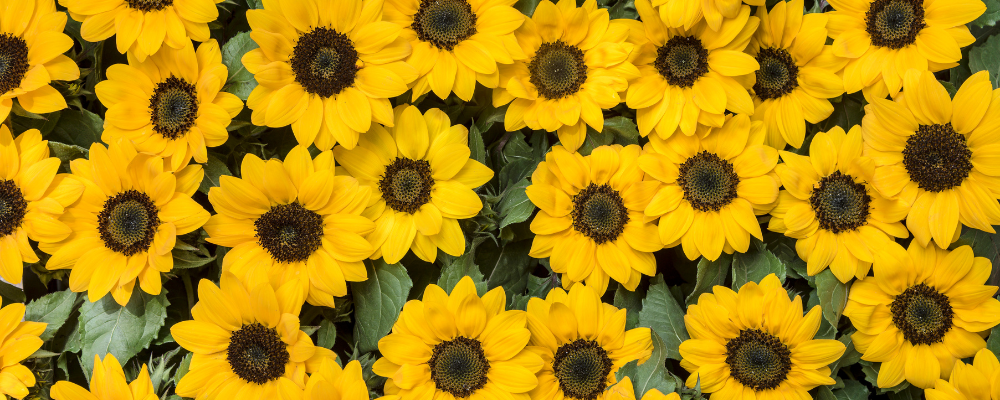
The Sunflower bears a sun composed of hundreds of flowers. Its young bud follows the path of light, then the mature flower head settles facing east. Domesticated in North America long before the arrival of Europeans, the plant entered European herbals in the 16th century. The myth of Clytie would later become associated with it, although Ovid describes a purple flower unknown by that name. Between American origins, actual orientation, and European reinterpretation, the Sunflower asks us to choose which light to turn toward.
The Common Sunflower is Helianthus annuus L., a large annual plant in the Asteraceae family. What the eye takes for a flower is a flower head: ray flowers form the crown, while disk flowers fill the center.
Its historical magic has two distinct focal points. In the Americas, its domestication, uses, and imagery predate the conquest. In Europe, its arrival fostered solar emblems and a new reading of the story of Clytie.
A Sun Made of Many Flowers
Helianthus annuus belongs to the Asteraceae family. Its rough stem bears broad leaves. The flower head brings together ray flowers around the edge and tubular flowers in the center. After fertilization, each fertile disk flower can produce an achene.
Kew recalls a domestication that began more than five thousand years ago among the Indigenous peoples of North America. The plant arrived in Europe in the 16th century. Kew, Sunflower profile.
Young buds move from east to west during the day and return during the night. At maturity, the movement ceases, and the flower heads remain oriented toward the east. The plant therefore does not follow the sun in the same way throughout its entire cycle.
This distinction offers precise magical language. Youth explores movement, while maturity chooses an orientation. Looking toward the light and fixing one’s direction become two separate stages.
Domestication in the Americas
Domesticated forms are distinguished by a main stem and a large flower head rich in seeds. Selection transformed a branched wild plant into a food, oil-producing, and ceremonial crop.
Archaeological evidence places a major center of domestication in the eastern United States. A pre-Hispanic Aztec sculpture and images from 16th-century New Spain also show domesticated sunflowers known before Cortés’s conquest.
A study by Jules Janick brings together these archaeological, linguistic, and iconographic clues. It examines the hypothesis of an independent domestication in Mexico or of pre-Hispanic circulation from the north. Jules Janick, iconography of the domesticated sunflower.
The sunflower’s solar symbol therefore does not begin in a European book. It first takes root in an American plant transformed by generations of cultivation and selection.
Clytie and Ovid’s violet flower
In Book 4 of the Metamorphoses, Ovid tells of Clytie, rejected by the sun god. She remains on the ground for nine days, without drinking or eating, turns her face toward the celestial body, and eventually becomes rooted.
The poet describes a pale plant whose flower resembles a violet. He does not name Helianthus annuus, an American species unknown to the Roman world. Ovid, Metamorphoses, Book 4.
After the sunflower arrived in Europe, painters and authors gave Clytie a large yellow flower. The new plant offered a more spectacular image of love that follows the Sun. The rewriting became so familiar that it obscured the text’s original color.
The myth changed flowers after the plant’s journey. Clytie reveals how a new image can enter a story older than itself.
Orientation, fidelity, and gaze
In the 17th century, the sunflower entered European symbolism as a symbol of fidelity. The image shows a flower turned toward the sun, just as the faithful turns toward their sovereign, their God, or their principle.
Anthony van Dyck uses the sunflower in his English self-portrait, and the motif reappears on the frame of another late self-portrait. The National Portrait Gallery describes it as a kind of personal emblem of the artist. National Portrait Gallery, Van Dyck and the Sunflower.
Fidelity nevertheless requires an object worthy of one’s gaze. Clytie remains attached to a light that rejects her. The mature Sunflower fixes its gaze toward the east instead of following every movement of the sky.
Its magic invites you to choose an orientation rather than submission. The center of the flower head brings many flowers together around a common direction. Each part contributes without losing its place.
Choosing a light and a direction
Draw a large circle and fill it with thirty small points in a spiral. Each point represents an action, a person, or a resource in your project.
Then draw an arrow pointing east. Above it, write the principle that deserves your fidelity. Beneath the arrow, note the behavior that proves this fidelity over the next seven days.
To the left of the flower head, write the lights you have followed out of habit. On the right, indicate those that make the project fairer, clearer, or more alive. Connect only the points that serve the chosen direction.
Place the page facing east for one morning. In the evening, put it away without changing its orientation. The following week, color in each point corresponding to a completed action. The sun in the drawing is built through actions.
Historical correspondences
| Reference point | Correspondence |
|---|---|
| Botanical name | Helianthus annuus L. |
| Family | Asteraceae |
| Cultural origin | Indigenous domestication in the Americas |
| European rewriting | Clytie depicted as a Sunflower after the 16th century |
| Magical domains | Orientation, fidelity, maturity, and choice of focus |
| Safe form | Drawing the flower head and tracking actions |










