
























































































































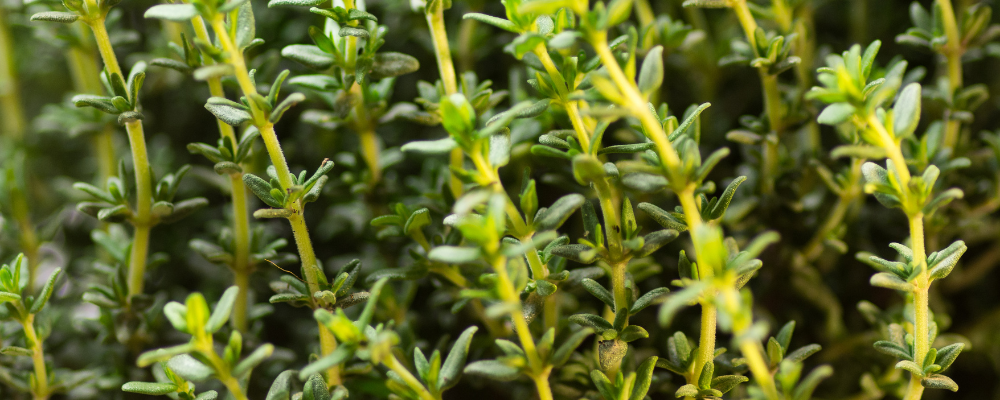
Thyme forms a small bush of closely packed stems, narrow leaves, and flowers offered to insects. For Culpeper, Common Thyme belongs to Venus; Wild Thyme is also associated with Venus and Aries. Another passage in his herbal follows the epithet, a parasitic dodder that takes on the qualities of the plant it entwines while remaining under Saturn. This interplay between host, parasite, and correspondence opens a richer mystery than a simple herb of courage.
Common Thyme is Thymus vulgaris L. Culpeper’s Wild Thyme refers to another species or to a group of small heatherland thymes. The epithet belongs to dodders, parasitic plants of the genus Cuscuta. These three materials must not be confused.
The article follows Culpeper’s precise system from the 17th century. Venus governs Common Thyme. Aries completes the correspondence of Wild Thyme. Saturn governs dodder, which borrows warmth from its host.
A Mediterranean subshrub
Thymus vulgaris belongs to the Lamiaceae family. Its stems become woody at the base. The small opposite leaves limit water loss and bear aromatic glands. The bilabiate flowers cluster at the ends of the branches.
Kew accepts the species and places its native range in southwestern Europe and southeastern Italy. Kew, Thymus vulgaris.
The shrub remains low and branches abundantly. Each small leaf contributes to the overall fragrance. This structure offers an image of distributed strength: no single leaf bears the plant’s presence alone.
Aromatic oils vary according to populations, conditions, and lineages. The word “Thyme” therefore does not indicate an identical chemical composition for every product.

Common Thyme under Venus
In The Complete Herbal, Culpeper calls Common Thyme a remarkable herb of Venus. He connects it with the body, care, and several functions placed under this planet in his astrological medicine.
This attribution contradicts modern tables that mechanically place Thyme under Mars because of its warm fragrance. The seventeenth-century English source chooses Venus. Nicholas Culpeper, entries “Thyme” and “Wild Thyme”.
Venus brings connection, pleasantness, fertility, and the continuity of life. Thyme becomes a plant of relationships sustained by small, repeated acts of care. Its fragrance spreads when a hand touches the sprig.
Wild Thyme also receives Aries, the sign associated with the head in Culpeper’s system. The correspondence adds impulse and openness without removing Venusian rulership.
Epithymum, the parasite of Saturn
Culpeper devotes an entry to Thyme dodder, called epithymum. The parasitic plant germinates in the soil, twines around a host, draws nourishment from it, and then loses its initial connection to the earth.
For the author, all dodders belong to Saturn. Yet each also participates in the nature of the plant it covers. Dodder becomes warmer because it feeds on Thyme, presented as the warmest host.
The passage constructs a relational correspondence. A plant retains its Saturnian rulership while borrowing a quality from its support. Magical identity then depends on the ecological relationship.
The parasite carries two stories. Saturn gives dodder its law, while Thyme passes on some of its warmth.
Nourishing bond and draining bond
The branched Thyme represents a network in which every part contributes. Dodder reveals the other side of the bond: a relationship can wind itself around, take from, and eventually cover the source that nourishes it.
In Venusian work, this distinction becomes central. A nourishing bond lets both parties breathe, grow, and withdraw. A parasitic bond turns every resource of the other into an available reserve.
Saturn brings limitation and consequence. It asks us to count time, money, attention, and fatigue. Thyme’s warmth is not enough to make a relationship fair.
The mystery of epithyme thus enables a magic of sorting. You must recognize what unites, what nourishes, and what tightens. Each category calls for a different response: cultivate, share, or cut.
Examining the threads of a relationship
Draw a small bush made up of six branches. Write the name of the relationship or project being examined in the center. On three branches, note what you give. On the other three, note what you receive.
Add a line around the bush that winds around it without touching it. Divide it into three segments: “nourishes,” “shares,” and “drains.” Place each exchange in the corresponding segment.
Place the closed product to the left of the drawing. Choose an exchange classified under “drains” and write down the Saturnian boundary that applies: quantity, duration, frequency, or stopping.
Set the boundary and review the drawing after seven days. If the bush gives you space again, keep the boundary. If the line continues to tighten, prepare a concrete separation with outside support.
Historical correspondences
| Marker | Correspondence |
|---|---|
| Botanical name | Thymus vulgaris L. |
| Family | Lamiaceae |
| Common Thyme according to Culpeper | Venus |
| Wild Thyme according to Culpeper | Venus and Aries |
| Epithyme according to Culpeper | Dodder under Saturn, influenced by its host |
| Safe form | Mapping exchanges and the closed product |