













































































































































































































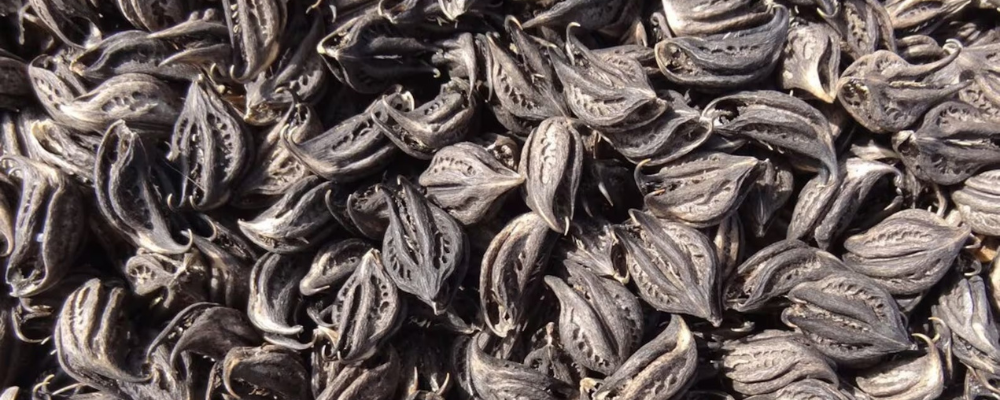
Bat Head is neither a root nor an animal part. It is the dried fruit of Martynia annua, a dark capsule whose two long points curve back like claws and whose central relief suggests a small bat’s face.
In contemporary ritual commerce, this distinctive form has given it several names: Bat Head Root, Cat’s Claws, or Devil’s Claw. The plant first acts through its morphology. Its hooks seize, retain, and transport the seeds; the ritual object draws on this ability to hold a request, catch good fortune, or divert whatever seeks to take hold.
Its magical role belongs to the curios practices of the 20th and 21st centuries. Using it appropriately therefore requires looking at the actual object: a hard, spiky capsule designed to attach itself to a passing animal.
The hooked fruit of Martynia annua
Martynia annua L. belongs to the Martyniaceae family. This annual plant bears broad, sticky leaves and bell-shaped flowers, white to pink, marked with red and yellow in the throat. Its fruit begins beneath a green, fleshy covering; as it dries, this releases a very hard black capsule extended by two curved beaks.
Kew places the species’ native range from Mexico to Central America and the Caribbean. It was later introduced to several tropical regions, notably in Asia and Australia. Kew, Martynia annua.
The object sold under the name “Bat Head Root” is therefore a fruit capsule. The seeds remain enclosed in this shell. Recognizing the correct plant part helps explain its magical symbolism without inventing an animal or underground origin for it.

What the claws really do
The fruit’s points are not merely decorative. They catch on fur, hooves, clothing, tires, and machinery. The movement of the animal or traveler then carries the capsule away and disperses the plant farther afield.
The Government of Australia’s Northern Territory describes this adaptation and notes that the capsules can injure livestock’s mouths or feet. It also states that the seeds can remain viable for several years inside the old capsule. Northern Territory Government, Devil’s claw.
The magic of Bat’s Head Root arises from this action: grasping what passes by, traveling with it, and preserving a seed until the right moment. Its natural domains are therefore anchoring, carrying a request, persistence, and defense through attachment.
From botanical capsule to ritual curio
In contemporary occult catalogs, the capsule is sold under the English name Bat’s Head Root. It is kept on the altar, placed in a sachet, or associated with a request. Some shops present it as a wish and protection curio: the term “curio” is fitting here, because the object is chosen as much for its striking shape as for its botanical origin. Example of a contemporary ritual catalog, Bat’s Head Root.
The bat-like face suggests nocturnal vigilance, while the horns defend and hold. These images do not replace the botanical function: they extend it. The capsule becomes a small guardian that grips a piece of paper between its points and preserves the request until it is fulfilled.
In this modern context, the most coherent approach is to entrust it with a single task. A capsule that “grabs” everything at once loses the precision of its symbolism. Protection, a wish, or anchoring a commitment: the choice must remain clear.
Entrust a wish to the two claws
Write a brief request on a narrow piece of paper, fold it toward you, and place it between the two claws without forcing the capsule. Tie a piece of natural-fiber thread loosely around the fruit to hold the paper in place. The object should then remain in a stable bowl, with the points turned inward toward the setup rather than toward the passageway.
For a protection working, write down what the place must retain: integrity, discretion, boundaries, or safety. For a wish, formulate an observable outcome and add the action you will take yourself. The capsule holds the full commitment, not a passive expectation.
The claws hold what is entrusted to them. This fruit’s power is not to create without cause. It seizes, carries, and preserves. A wish placed under its sign must therefore be accompanied by a path through which it can truly move.
Closing and preserving the work
When the petition has been fulfilled, remove the paper with tweezers or gloves. Keep the capsule if it is meant to guard a place, or wrap it carefully before disposing of it with household waste if you wish to close the work completely.
Do not bury it or leave it in nature. Martynia annua can become invasive outside its native range, and the seeds sometimes remain viable in the dried fruit. Responsible containment prevents the symbol of dispersal from becoming actual biological dispersal.
The capsule can be reused for a task of the same nature after all threads and papers have been removed. Its longevity is part of its presence: a hard, dark, silent guardian, to be handled without haste.
Historical correspondences
| Reference | Correspondence |
|---|---|
| Botanical name | Martynia annua L. |
| Part used | Dried seed capsule; this is not a root |
| Commercial names | Bat Head, Cat’s Claws, Bat Head Root, Devil’s Claw |
| Magical uses | Binding, keeping a wish, persistence, protection by hanging |
| Historical context | Curio of contemporary occult shops and practices |
| Ritual forms | Whole capsule, petition paper, thread; without burning or burying |





)