Sorghum withstands conditions where other cereals succumb to a lack of water. Kew calls it the “camel of crops.” In southern Africa, Sorghum beer served in Zulu pots accompanies births, marriages, and funerals; the dark vessels are described as welcoming places for ancestors. The plant connects agricultural endurance, communal fermentation, hospitality, and family continuity in clearly situated contexts.
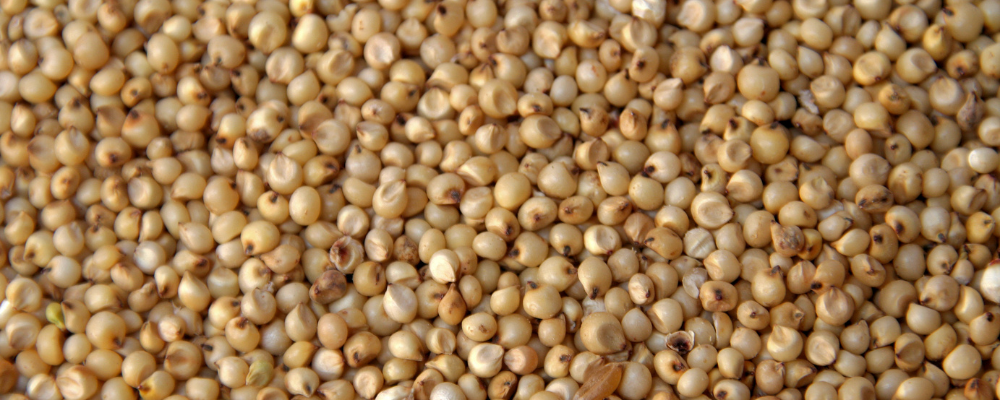
Cultivated Sorghum is Sorghum bicolor (L.) Moench, a large annual Poaceae. Its panicle bears grains ranging in colour from white to dark red. Some varieties are used for grain, others for fodder, syrup, beer, dye, or broom making.
The magical uses of Sorghum vary among the peoples, religions, and histories of the African continent. Zulu Sorghum beer vessels preserved at the Metropolitan Museum provide a precise case study here, situated within the cereal’s biology and economy.
The Camel of Crops
Sorghum bicolor can exceed two metres. Its solid stems bear long leaves with a prominent central vein. At the top, the panicle ranges from loose to compact depending on the variety. Each fertile spikelet can produce a rounded caryopsis.
Kew accepts the species and places its range across much of Africa and the Indian subcontinent. Kew, Sorghum bicolor. The page highlights its drought resistance and the variety of its uses.
The plant can slow its activity during water stress and then resume when water returns. This endurance does not mean invulnerability. It depends on adapted varieties, soils, seeds, and agricultural work. Its magic is suited to continuity under constraint, not to denying limits.
Sorghum Beer for Major Transitions
Among the Zulu, ukhamba pots are used to brew, preserve, and share a mild Sorghum beer during major life events. The vessel passes between people and gives the gathering a material form.
The Metropolitan Museum describes a pot by Siphiwe Nala used during births, weddings, and deaths. Metropolitan Museum, ukhamba by Siphiwe Nala. Its dark surface and contents were considered welcoming to the ancestors.
Another vase by Nesta Nala was displayed on the umsamo, the family altar, and served Sorghum beer when the amadlozi were invoked. Metropolitan Museum, vase by Nesta Nala. The object, the drink, and kinship form an inseparable whole.
Ceremonial Sorghum is not a generic powder: it becomes a relationship within a vessel, a family, and a passage in life.
The pot that calls forth presence
Zulu women potters polish and smoke the surface of the vessels, then decorate them with reliefs or incisions. The round shape, opening, and color are not mere ornaments: they contribute to social and ceremonial use.
The vessel receives, holds, and pours. It gives fermentation a protected interior and the gathering a shared center. The magic of Sorghum therefore passes through a mastered household technology, transmitted within potters’ lineages.
Imitating this ceremony outside its context would reduce a living relationship to mere decoration. A personal practice can retain a more modest lesson: every act of sharing requires a vessel, someone to prepare it, a rule for circulation, and a return to those who made the resource possible.
The mystery of storage in a dry climate
The FAO highlights the importance of Sorghum and millets for millions of people in the semi-arid tropical regions of Africa and Asia. FAO, Sorghum in Human Nutrition. The cereal supports households where other crops yield little.
This reality forbids treating the grain as an exotic accessory. Its resilience is linked to food security, farmer-saved seeds, and agricultural choices. A ritual handful therefore represents labor, scarce water, and a share of the family reserve.
Sorghum supports work involving endurance, community, and the memory of resources. It does not promise to make what lacks water fertile. It invites you to organize reserves, choose a suitable variety, and preserve the ties that make recovery possible.
Draw the continuity pot
Draw a large pot closed by a line at the neck. Divide its body into four areas: water, food, money, and human support. In each, write the available reserve and its estimated duration.
On the rim, write the rules for distribution: who may request it, who decides, how much is taken out, and how the reserves are replenished. Add a repeated motif for each person who contributed.
Under the pot, note the next life transition that these reserves are meant to support. The drawing does not copy an ukhamba or a Zulu altar. It translates the logic of a shared container without brewing, drinking, scattering, or burning the Sorghum.
Historical correspondences
| Reference | Correspondence |
|---|---|
| Botanical name | Sorghum bicolor (L.) Moench |
| Family | Poaceae |
| Cultural context studied | Zulu Sorghum beer vessels |
| Historical motifs | Life transitions, ancestors, and sharing |
| Magical domains | Endurance, reserves, family, and continuity |
| Safe form | Drawn continuity pot |