















































































































































































































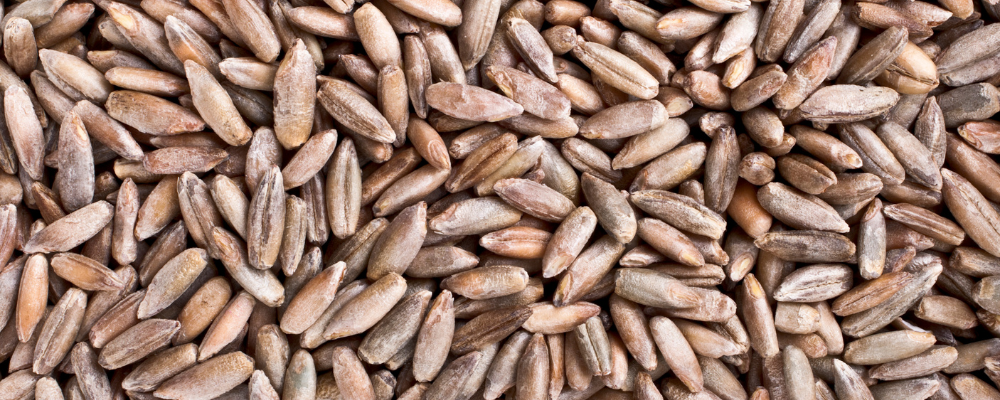
Rye long fed regions with cold climates and soils where wheat did poorly. Yet a disease of its ear, ergot, created a persistent modern narrative: contaminated bread supposedly caused the witchcraft accusations in Salem. The hypothesis, proposed in 1976, was strongly contested by historians. This story makes Rye an ideal plant for examining how an appealing explanation can take root and conceal human conflicts.
Cultivated Rye is Secale cereale L., an annual Poaceae. Its narrow ears bear elongated grains and awns. More resistant to cold and certain poor soils than wheat, it became a major cereal in central, eastern, and northern Europe.
Rye ergot is not part of the plant. It is the sclerotium of the fungus Claviceps purpurea, which replaces a grain with a dark mass rich in toxic alkaloids. The subsistence cereal and the dangerous fungus are two organisms carrying two distinct histories.
The cereal of cold lands
Secale cereale grows in clumps of hollow stems. Its leaves have a short ligule, and its ear remains thinner than that of many wheats. Wind pollination encourages exchanges between plants.
Kew accepts the species as a cultigen originating in southern Turkey. Kew, Secale cereale. The plant is thought to have first accompanied other crops as a weed before being selected.
This origin story of a companion turned crop gives Rye a magical significance of reversal. What grew amid a more prestigious cereal claimed its own place in difficult climates. The plant speaks of survival, adaptation, and belatedly recognized value.
When the fungus replaces the grain
Claviceps purpurea infects the flowers of grasses. A hard, elongated, violet-black sclerotium forms in place of the grain. Its alkaloids can cause convulsions, hallucinations, vascular disorders, and gangrene.
The resemblance of this sclerotium to a deformed grain fueled an image of a corrupted harvest. Yet the danger does not come from malevolent Rye. It comes from a fungus and contamination that sorting, crop inspections, and food safety standards seek to prevent.
The mystery of the black ear teaches us to identify the real agent behind a transformation. A disturbing appearance may signal a specific material risk. Magic must not replace botanical, agricultural, or medical investigation when health is at stake.
Ergot resembles a Rye grain, but it belongs to the fungus that has taken its place.
Did Rye Bewitch Salem?
In 1976, Linnda Caporael proposed that ergotism had contributed to the symptoms observed in Salem in 1692. The idea linked humidity, the Rye harvest, and convulsive behavior. It became widely popular in the media and popular narratives.
Nicholas Spanos and Jack Gottlieb argued that the chronology, geographical distribution of the cases, and symptoms did not correspond to a collective poisoning. Spanos and Gottlieb, critique of the ergot hypothesis.
The Salem Witch Museum also summarizes the reasons for rejecting it. Salem Witch Museum, moldy bread, and the trials. Reducing the accusations to a fungus erases rivalries, religion, law, gender, and the accusers’ choices.
The mystery of the explanation that is too perfect
The ergot hypothesis is appealing because it transforms a social tragedy into a natural accident. A contaminated grain seems to offer a simple, visible cause that is morally external to the inhabitants. That simplicity is precisely what calls for vigilance.
Rye becomes here a tool for historical discernment. A sound explanation must cover the dates, places, symptoms, and human decisions. If it addresses only the strangeness of the behavior, it leaves the mechanics of the accusations intact.
In magic, the black grain can represent the false cause that occupies the place of a more difficult cause. The work consists of separating what is biological, what is narrated, and what concerns responsibility. None of these levels should absorb the others.
Sorting the ear of causes
Draw an ear of Rye with eight clear grains and one dark sclerotium. In the sclerotium, write the explanation that seems to resolve a complex situation too quickly.
Among the eight grains, distribute the facts: date, place, actors, interest, source, symptom, decision, and consequence. Link each fact to a verifiable piece of evidence. Leave blank anything that has not yet been established.
Under the ear, write two causes that can coexist without canceling each other out. Then decide which question to ask or which archive to consult. The rite transforms Rye into an instrument for intellectual sorting, without using either real grain or contaminated material.
Historical correspondences
| Reference | Correspondence |
|---|---|
| Botanical name | Secale cereale L. |
| Family | Poaceae |
| Distinct hazard | Ergot produced by Claviceps purpurea |
| Historical debate | Ergot hypothesis at Salem |
| Magical domains | Survival, sorting, cause, and discernment |
| Safe form | Ear of causes on paper |










