






















































































































































































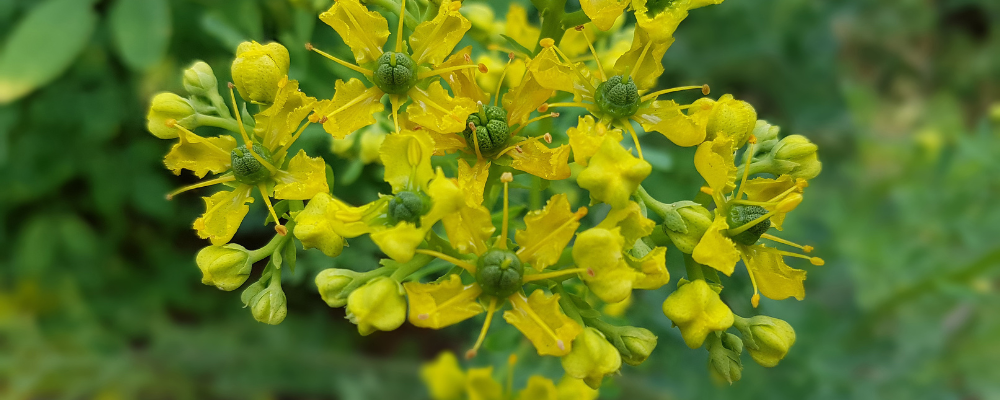
Fetid Rue is the same species as Garden Rue: Ruta graveolens. Its second name emphasizes the acrid smell that remains on the fingers and that, in Christian Europe, accompanied an almost opposite reputation: the “herb of grace.” Between repulsion, sprinkling, theater, and astrological medicine, this plant reveals how a strong smell can become a sign of protection.
Aeternum already has a general page dedicated to Rue. This page serves as a supplementary dossier: it explains the name Fetid, the Christian names, the Sunday sprig, and the traces left in Shakespeare and Culpeper.
Rue contains phototoxic substances and can cause serious harm. The plant remains in its packaging. The practice uses a label, a drawing, and a cautionary sentence, with no ingestion, smoke, infusion, actual sprinkling, or skin contact.
Identifying Ruta graveolens
Ruta graveolens L. belongs to the Rutaceae, the citrus family. This subshrub forms branched stems and bears blue-green leaves divided into rounded segments. The yellow flowers have four or five concave petals, then give way to lobed capsules.
Kew places Rue’s native range in southeastern Europe and recognizes its establishment in many territories following cultivation. Kew, Ruta graveolens.
The visible glands in the leaves contain a fragrant oil. The Latin graveolens means “strong-smelling.” The qualifier fetid therefore does not indicate any distinct species: Rue, Common Rue, Stinking Rue, and Fetid Rue may all refer to the same plant.
This clarification avoids a misleading duplicate in the grimoire. Two trade names may open two narratives, but they must refer back to the same taxon, the same risks, and the same type of identification.
From the strong smell to the herb of grace
Christian Europe gave Rue the names herb of grace and herb of grace. The sprigs were associated with the sprinkling of holy water, a gesture that turns the bouquet into a small instrument of blessing. The divided shape of the leaf was also compared to the cross.
The contrast with graveolens fuels its apotropaic power. A scent judged harsh marks the boundary between ordinary space and protected space. The plant does not enchant through sweetness: it draws a tangible and memorable boundary.
In Mediterranean customs and their American extensions, Rue has accompanied protection against the evil eye. A sprig, a small sachet, prepared water, or a plant cultivated near the home has served this function. Each region connects these practices to its prayers and religious figures.
Shakespeare's Sunday Rue
In Hamlet, Ophelia distributes the plants in her famous scene and says: “there’s rue for you; and here’s some for me”. She adds that her rue may carry a difference and calls it “herb-grace o’ Sundays”.
The passage brings together repentance, grief, and the language of flowers. The English word rue also means to regret. Shakespeare plays on this sonic proximity, while Sunday and the herb of grace place the plant within a Christian framework. Shakespeare, Hamlet, Project Gutenberg text.
One plant carries two regrets. The Rue given by Ophelia is at once plant matter, a play on words, and a sign of a wounded conscience.
This passage is not a magical recipe. It shows how the theater used a plant code that the audience could understand: the plant spoke through its name, its religious use, and its reputation.
The Sun and Leo in Culpeper
In the 17th century, Nicholas Culpeper places Rue under the dominion of the Sun and in the sign of Leo. His system connects herbs with planets, parts of the body, and diseases. This attribution is a precise historical source for the plant's solar correspondences.
The English Physitian also describes Rue as a remedy for poison and bites, in the medical language of its time. Nicholas Culpeper, The English Physitian.
Culpeper's medical uses must not be reproduced. Their value for the grimoire lies in the astrological chart they convey: Sun, Leo, heat, protection against venom. This chart belongs to 17th-century England and does not sum up the Rue's other Mediterranean histories.
Fetid Rue thus has several clearly situated centers of meaning: Christian sprinkling, the Mediterranean evil eye, the theatrical play on regret, and Culpeper’s solar correspondence.
Labeling the plant and the protection
Draw a Rue leaf without touching the product. Under the drawing, write its four names: Rue, Common Rue, Fetid Rue, and Ruta graveolens. Link them with a circle to recall that they designate the same taxon.
On the back, copy a short protective sentence that commits you to your own action: “I see the threshold and hold it.” Add the date and the relevant location. Keep the sealed sachet beside the drawing while writing.
Then place the leaf in a botanical folder with a reproduction of Culpeper’s page or the scene from Hamlet. The work combines identification, textual memory, and threshold protection without handling the plant.
Historical correspondences
| Reference point | Correspondence |
|---|---|
| Botanical name | Ruta graveolens L. |
| Equivalence | Rue, Common Rue, Stinking Rue, and Fetid Rue |
| Religious names | Herb of grace and herb of grace |
| Literary source | Hamlet, Sunday rue, and regret |
| Astrological source | Sun and Leo in Nicholas Culpeper |
| Safe form | Drawing, botanical label, and sealed sachet |