


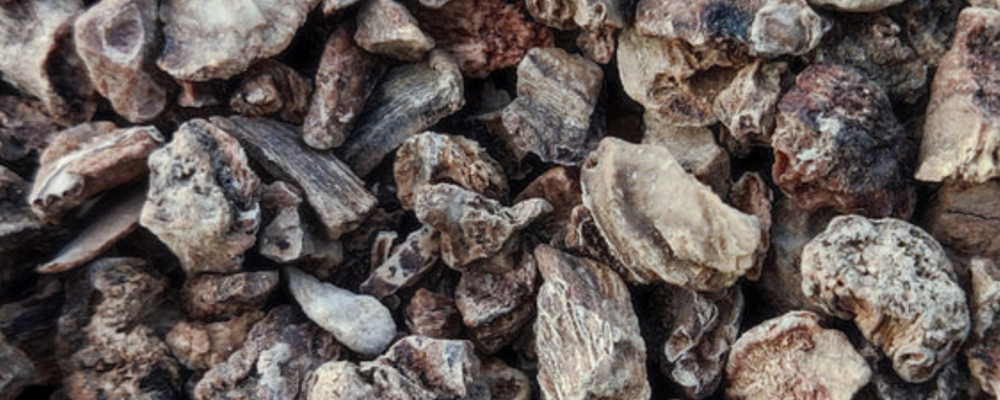
Devil’s Claw bears a misleading twofold name. The “claws” belong to the hook-covered fruit, while the material sold consists of secondary tubers. The devil is not that of an old European grimoire: the commercial name translates the image of the fruit and accompanies the entry of a medicinal plant from the Kalahari into Western markets in the 20th century.
Harpagophytum procumbens (Burch.) DC. is a Pedaliaceae species from the dry regions of southern Africa. Its stems creep along the ground, its flowers are purplish pink, and its fruits develop curved arms armed with spines. Underground, a main root bears fleshy secondary tubers that are harvested and dried.
Its history requires separating ethnobotany, herbal medicine, and recent commercial magic. The protective or banishing uses promoted today mostly arise from Western interpretations of the name and the hooks. The actual plant speaks of attachment, harvesting, and responsibility toward a wild resource.
The hook is on the fruit
The plant develops trailing stems that can reach several meters. The opposite leaves are lobed. The tubular flowers have a pale yellow center. After flowering, the hard fruit forms several rows of arms equipped with curved hooks.
Kew accepts the species and places it in southern Africa. Kew, Harpagophytum procumbens.
The hooks catch on animals’ fur or hooves and contribute to seed dispersal. The name Harpagophytum refers to a grappling hook. “Claw” therefore describes the fruit’s mechanics, not the shape of the tuber sold.

Tubers, the Kalahari, and local knowledge
The peoples of the Kalahari have long used tubers in their medicinal practices. Kew mentions uses related to digestion, wounds, and pain, followed by the development of a Western herbal medicine market.
The harvested part is the secondary tuber, called a “baby” in some guides, connected to a longer main root. Harvesting that preserves the plant leaves the mother root and some of the tubers in place.
This difference transforms the magical reading. The resource is not a claw torn from the devil: it is an underground reserve harvested in a dry environment, through knowledge of its location and regeneration.
How the devil entered the name
The name “Devil’s claw” belongs to several plants around the world. For Harpagophytum, it describes fruits that can injure or hinder animals. The striking word facilitated imagery of capture, defense, and return.
Recent magical catalogs attribute protection, the removal of obstacles, or amplified desire to it. These uses do not descend from Solomonic grimoires or medieval demonology. They are a modern reinterpretation of the English name and the hooked shape.
The mystery lies in this transfer: a dispersal mechanism becomes a metaphor for a trap, then a tool of protection. The history remains legible without disguising itself as an age-old tradition.
The botanical claw disperses a seed; the magical claw arises from a more recent reading of its shape.
Harvesting, trade, and responsibility
Global demand has increased pressure on wild populations. Kew indicates that the tubers provide income for rural communities and that poorly managed collection can make the resource scarce.
The species is protected in several countries in southern Africa. In Namibia, harvesting, trade, and export are subject to a registration and permit system. Namibia Trade Portal, rules on Devil’s Claw. Sustainable harvesting requires replacing the sand, preserving the mother root, and allowing regrowth.
Magical protection begins here with protecting the plant and the gatherers. A responsible purchase looks for the species, country of origin, part sold, and a supply chain that fairly compensates local knowledge.
Unraveling the trap without fumigation
Draw the hooked fruit in the center of a page. On each hook, write an obligation, debt, or habit that holds back your own action. Do not write the name of a person to be compelled.
Draw an exit line from each hook. Next to it, place a concrete means: schedule, refusal, mediation, refund, written request, or end of commitment.
Under the drawing, depict a tuber left in the soil and note the resource to preserve during the exit. Keep the dry root in its sealed pouch. The practice relies on the diagram, without burning or bodily preparation.
Historical correspondences
| Reference | Correspondence |
|---|---|
| Botanical name | Harpagophytum procumbens (Burch.) DC. |
| Family | Pedaliaceae |
| Hooked part | Armed fruit used for dispersal |
| Part sold | Dried secondary tubers |
| Current magical uses | Unraveling, limits, protection, and responsibility |
| Safe form | Map of the trap and exits on paper |