


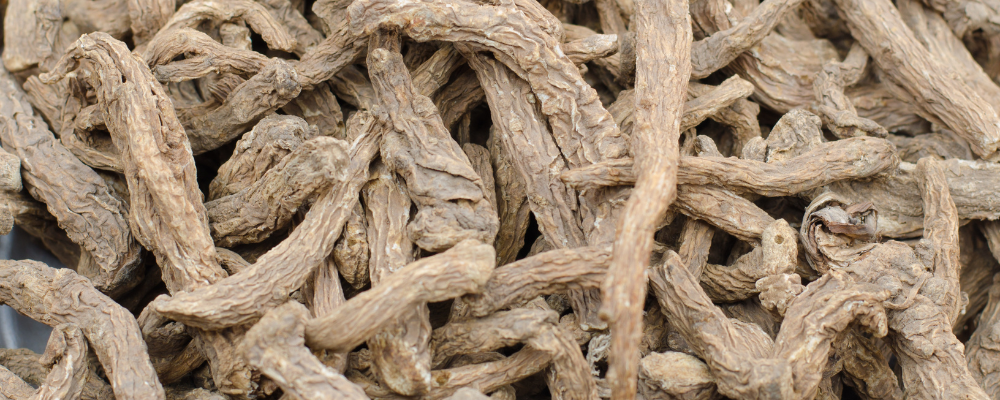
Angelica Root descends from a plant that bears the archangel in its name and the fear of epidemics in its history. In the 17th century, Nicholas Culpeper placed it under the Sun in Leo and presented it as a bulwark of the heart against the plague. The sources make this root a vertical guardian: a raised umbel, hollow stem, thick rootstock, and a name from the heavens. Its magic protects by making the threshold’s order visible.
True Angelica is Angelica archangelica L., a large aromatic Apiaceae species from cold, damp regions. The dried root sold on its own is not enough to identify the whole plant. It should remain accompanied by its botanical name and labeling.
The archangel’s story and the recipes against the plague belong to Europe’s medical and religious history. They offer no current treatment. They illuminate a protective magic in which the name, the celestial calendar, and the preparation of the remedy correspond with one another.
A Great Northern Umbellifer
Angelica archangelica belongs to the Apiaceae family. The plant can reach two metres. It has a hollow stem, large divided leaves, and almost spherical umbels of small greenish or white flowers.
Kew places its native range from Greenland and Europe to western Siberia. The species grows in damp places, near rivers, along shores, and in certain mountainous areas. Kew, Angelica archangelica.
The thick root accumulates reserves and has an aromatic scent. The plant flowers after several years, produces its fruit, and then completes its life cycle. This delayed growth creates an image of patient reserve followed by complete expansion.
The family demands great caution. Hemlock, water dropwort, and hogweed can share the silhouettes of umbels. A root separated from its leaves, stem, and flowers loses the features that would allow identification in the field.

The Name Revealed by an Archangel
Kew reports a story in which the plant was revealed to the physician Mattheus Sylvaticus in the 14th century by an archangel. This motif explains the name “archangelic,” later adopted by Linnaeus in the epithet archangelica.
Culpeper still understood the power of the name. He wrote that some called the plant the herb of the Holy Spirit, while others named it Angelica because of its angelic virtues. The passage blends polemical humor, religion, and materia medica.
A celestial revelation gives the plant an authority that exceeds observation. The name functions as a verbal consecration: it announces protection before any recipe. This structure appears in herbals where etymology, the holy figure, and the virtue reinforce one another.
Modern magic can retain the name’s function without reenacting an apparition. Writing “Angelica” above a boundary amounts to placing protection under a named and responsible authority.
The Sun in Leo according to Culpeper
In The Complete Herbal, Culpeper assigns Angelica to the Sun in Leo. He recommends harvesting it when the Sun occupies this sign, with a favorable Moon, during the hour of the Sun or Jupiter.
This detail belongs to 17th-century English astrological medicine. The Sun governs the heart and vitality in his system, while Leo forms its zodiacal domicile. Nicholas Culpeper, “Angelica” entry.
Culpeper presents the root as protection against epidemic diseases attributed to Saturn. He also describes a preparation made with Angelica, intended to strengthen the heart and resist infection and pestilential air.
The heavens command the harvest; the root guards the heart. In Culpeper’s system, protection arises from the agreement between plant, celestial body, hour, and organ.
The root carried against the plague
The plague shaped Angelica’s European reputation. Kew notes that its root was believed to protect against the plague and other infectious diseases. The fragrance, the warmth attributed to the plant, and its celestial name formed a reassuring whole.
Historical preparations sought to protect the heart, induce sweating, and correct air considered corrupt. They belonged to a medicine of humors and qualities. Their magical significance came from ordering an invisible threat.
The root concentrates what remains underground while the umbel rises. It can therefore represent a reserve of protection that supports the exposed part. The work focuses on resources, contacts, and the access rule.
Solar protection according to Culpeper does not require multiplying symbols. A circle, a center, and a boundary are enough. Leo adds the ability to hold the position: remain visible, guard the entrance, and respond without confusion.
Establishing solar guardianship
Draw a circle in the center of a page and place the word “guardianship” inside it. Around it, draw eight short rays like an umbel seen from above.
On four rays, write the resources that support the protection. On the other four, note the actions that close access: password, schedule, refusal, distance, advice, or call.
Place the sealed product to the left of the page. Write the name of the protected place or situation beneath the circle, followed by a review date. Read each action together with its responsible person.
Store the sheet inside the area concerned. On the scheduled date, check the eight rays. Reinforce those that were used and remove those that rested only on an intention. The guardianship remains solar because it stays visible.
Historical correspondences
| Reference point | Correspondence |
|---|---|
| Botanical name | Angelica archangelica L. |
| Family | Apiaceae |
| Story of the name | Revelation by an archangel to Mattheus Sylvaticus, 14th century |
| Correspondence according to Culpeper | Sun in Leo, 17th century |
| Magical domains | Protection, guardianship, threshold order, and reserve |
| Safe form | Solar design and sealed product |