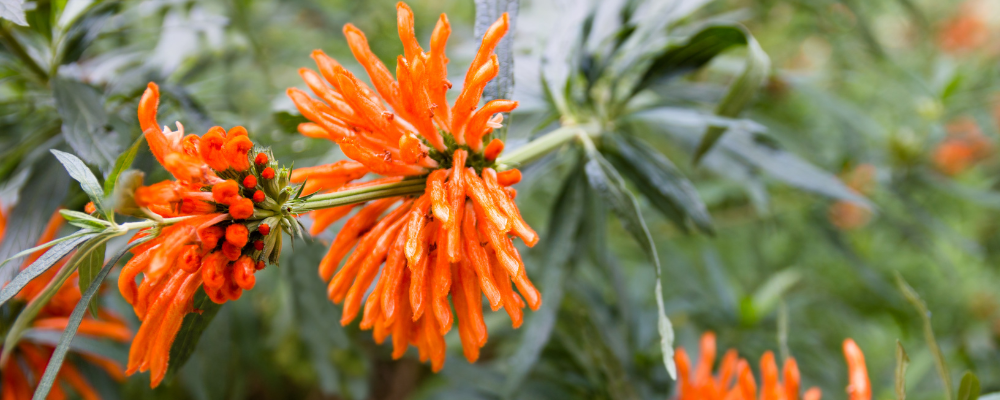
Along the margins and slopes of Southern Africa, Lion’s Tail raises great crowns of orange flowers around its stems. Its layered whorls gave the plant its Latin name, “lion’s ear,” followed by a rich series of vernacular names. The flower resembles a flame, but its magical history is first read through Khoikhoi practices, charms against snakes, and the species’ arrival in European gardens in the 17th century.
The plant is Leonotis leonurus (L.) R.Br., a shrub in the Lamiaceae family. The commercial name “Lion’s Tail” brings it closer to Leonotis nepetifolia and motherwort, called motherwort in English. The botanical label remains essential.
Smoke and infusions belong to historical uses that today expose people to poorly understood pharmacological effects. The practice adopted here is based on the circular form of the inflorescence, guarding the threshold, and the image of the serpent, with the plant kept closed.
The orange crowns of the veld
Leonotis leonurus forms an upright shrub that can exceed two meters. Its square stems recall its membership in the Lamiaceae family. The opposite, narrow, slightly toothed leaves release an aromatic scent when crushed. The tubular flowers emerge from spiny whorls spaced along the stem.
The South African National Biodiversity Institute describes a natural range extending from the southern Cape to eastern Southern Africa. The plant occupies grasslands, rocky slopes, and forest margins. SANBI, Leonotis leonurus. Kew confirms the accepted status of the species and its South African range. Kew, taxonomic profile of Leonotis leonurus.
Bright orange, white in some cultivars, the corolla attracts nectar-feeding birds. The dry whorl persists after flowering and forms a bristling wheel. This architecture matters more for magical interpretation than the solar correspondences added by recent catalogs: the stem bears a succession of circles that close and guard.
The name of the genus comes from the Greek leon, lion, and otos, ear. Leonurus refers to a lion’s tail. These two images are comparisons of form. They establish no connection with a lion cult, a zodiac sign, or an element of fire.
Wild dagga and names passed down through tradition
In South Africa, the plant is known by the names wild dagga, lion’s ear, umfincafincane, and other names linked to languages and regions. The term dagga has also been used for cannabis. This similarity in vocabulary encouraged contemporary commerce to present the two plants as equivalent.
The Khoikhoi used the leaves and dried flowers, particularly as smoke. Other medicinal uses concern the skin, fever, coughs, or bites. Colonial botanical archives grouped practices belonging to several peoples under a few English names. Reading these names therefore requires preserving their provenance.
Lion’s Tail was cultivated in Europe as early as 1673. In gardens, its spectacular appearance preceded precise knowledge of its African uses. An exotic plant could then acquire a second biography, shaped by ornament, curiosity, and associations with plants already known to apothecaries.
The charm that keeps snakes at bay
SANBI reports that the plant was regarded as a charm capable of keeping snakes away. This function belongs to domestic protection: the plant’s presence signals an enclosure that the feared animal must not cross.
Here, the serpent represents an immediate reality before becoming a symbol. In an environment where encounters with venomous species are part of rural life, keeping snakes away protects the home, children, and animals. The plant charm accompanies this vigilance without replacing maintenance of the surrounding area or emergency measures.
The plant crown forms a guard. The successive rings on the stem provide a visible image of the protective boundary associated with the plant.
This history sheds light on threshold magic based on form and attributed function. It gives no reason to invent a mandatory correspondence with the Sun, Sunday, or the sign of Leo. The lion lives in the botanical name; the serpent belongs to the transmitted charm.
From African charm to garden plant
The long flowering period and drought resistance have made Lion’s Tail a sought-after horticultural plant. It has naturalized outside its native range and can become invasive in some climates. A responsible ritual practice therefore disperses neither seeds nor fragments.
In herb shops, the name wild dagga emphasizes a promise of a psychotropic effect. This presentation shifts attention from the whole plant toward the pursuit of a sensation. It obscures the difference between a situated Khoikhoi practice, a garden plant, and a smoking product sold online.
The truest mystery remains that of form: a stem passes through several crowns without breaking. Each ring marks a stage, and each space lets growth continue. The plant thus becomes a model of protection that does not imprison life.
Forming a paper guard
Draw six orange circles on a strip of paper, leaving a regular gap between them. Write one place to be guarded in the center of each circle: door, window, sleep, speech, journey, and garden.
Roll the strip around a pencil to give it the shape of a stem, then remove the pencil. Place this paper guard near the sealed sachet. Orient the first circle toward the room’s entrance.
After six days, unroll the strip and note the concrete measures taken for each place: lock checked, passage cleared, boundary expressed, or emergency number recorded. The rite unites the threshold charm with real protection. The plant is neither burned, drunk, nor worn on the skin.
Historical correspondences
| Reference point | Correspondence |
|---|---|
| Botanical name | Leonotis leonurus (L.) R.Br. |
| Native range | Southern Africa, grasslands, slopes, and woodland edges |
| Names | Lion’s Tail, lion’s ear, wild dagga |
| Attested magical use | Charm intended to keep snakes at a distance |
| Symbolic interpretation | Crown, ring, guard, and stem continuity |
| Safe form | Sealed sachet and paper guard |