















































































































































































































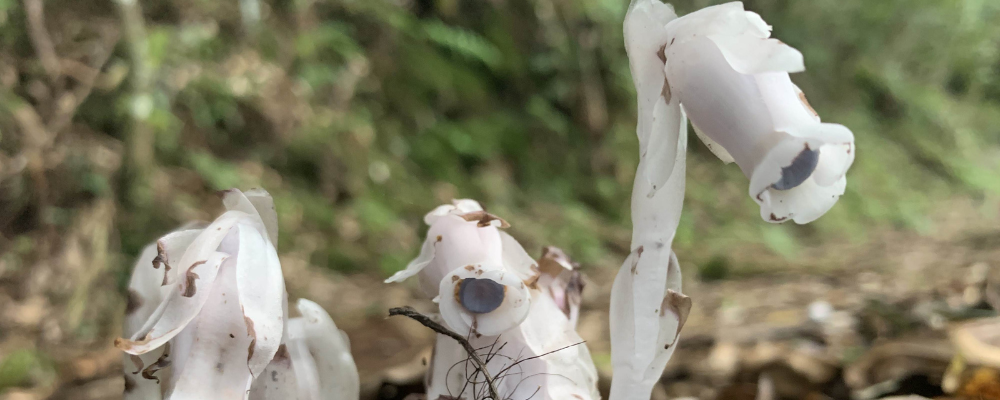
Ghost Plant emerges from the soil without green leaves and appears to be made of wax. Yet it is neither a fungus nor a plant revenant. Monotropa uniflora lives through an underground relationship with fungi that are themselves associated with trees. Its true strangeness surpasses fabricated legends: for a few days, a white flower reveals a forest network that is almost entirely invisible.
Ghost Plant belongs to the Ericaceae family. It lacks chlorophyll, does not produce its sugars through photosynthesis, and depends on mycorrhizal fungi to receive carbon from nearby trees. Its pale stem bears a single inclined flower that straightens after fertilization.
Its biology, North American common names, and fragility compose the full force of its symbolism. The encounter imposes a simple ethic: contemplate a plant that cannot be transplanted outside its network, then leave without possessing it.
An Ericaceae Without Chlorophyll
Monotropa uniflora produces white, pinkish, or waxy stems covered with scales instead of fully developed leaves. Each stem ends in a solitary flower that initially bends toward the ground. After pollination, it straightens and forms a capsule.
Kew accepts the species and describes a range extending from temperate Asia to North America and Mexico. Kew, Monotropa uniflora.
Its lack of green is not a disease. It defines another way of receiving carbon. The plant invests little in visible organs and appears aboveground at flowering, like the brief part of an existence spent mostly underground.
The Debt to the Fungus and the Tree
The National Park Service explains that Ghost Plant receives carbon from photosynthetic trees through fungi. National Park Service, Ghost Plant and Forest.
This three-way relationship rules out the image of an independent plant. The visible flower depends on a specific fungus, and that fungus itself participates in exchanges involving a tree’s roots. Extracting the stem means detaching the sign from the system that makes it possible.
The true mystery lies beneath the leaf litter: fungal filaments, roots, and carbon flows. Its whiteness signifies neither purity nor the realm of the dead. It signals the absence of photosynthetic pigments and a plant economy founded on interdependence.
The visible flower is not the network; it is its fleeting apparition.
Ghost, Pipe, and Pendulous Flower
The English names “ghost pipe” and “Indian pipe” come from the paleness and curvature of the flowering stem. These names describe a visual impression, but the latter belongs to a colonial history of vocabulary and deserves to be situated rather than repeated without critical reflection.
The plant turns black as it ages or after an injury. This change reinforces its theater of disappearance: white emerges after the rain, it straightens, bears fruit, and then takes on a dark color.
The drooping flower evokes a bowed head, then its straightening accompanies the transition to the capsule. Symbolic work can read this movement as an observation of plant time, without attributing to it the power to speak with the dead.
The mystery of an encounter without collection
The Ghost Plant cannot be cultivated like a potted herb. Its relationship with the fungus and tree makes collection destructive and transplantation likely to fail in most cases.
Park organizations recommend not picking it and warn of possible toxicity. Murphys Point Park, encounter with the Ghost Plant.
Its present-day magic therefore begins with the absence of possession. Photographing without touching, noting the neighboring tree, and leaving without a trace becomes a gesture consistent with the real plant. The encounter remains connected to the place that produced it.
Mapping the invisible network
On a page, draw three connected circles: tree, fungus, and Ghost Plant. In each circle, write what it gives, what it receives, and what happens if the link is broken.
Add the conditions of the place around it: recent rain, leaf litter, shade, season, and type of forest. If you observe the plant outdoors, stay on the trail and record only what you see.
Finish with your own network of material dependencies. Name one person, one environment, and one tool that make your work possible. The drawing preserves the botanical lesson of relationship.
Historical correspondences
| Reference | Correspondence |
|---|---|
| Botanical name | Monotropa uniflora L. |
| Family | Ericaceae |
| Nutrition | Mycoheterotrophy linked to fungi and trees |
| Visible part | Pale stem with a solitary flower |
| Magical reading | Interdependence, emergence, and respect for the place |
| Safe form | Observation and paper mapping |










