


Pepper carries a heat that the body recognizes before it even knows its name. Native to the Americas, it crossed the Atlantic after the 15th century and became established in cuisines, pharmacopoeias, and several magical practices. In African American conjure, red pepper appears as a material of expulsion and movement. Its historical power does not come from an abstract element: it comes from a physical sensation, immediate and difficult to ignore.
This profile uses Capsicum annuum L. as its reference species, encompassing many sweet and hot peppers. The word “pepper” also covers other species of the genus Capsicum, including C. chinense and C. frutescens. Red powder alone cannot determine the species or its capsaicinoid content.
The magical reading here rests on a precise history: that of red pepper in African American conjure practices documented in the 20th century. The proposed modern gesture preserves the ideas of boundaries, departure, and decision, while keeping the irritant material in its container.
An American berry that became global
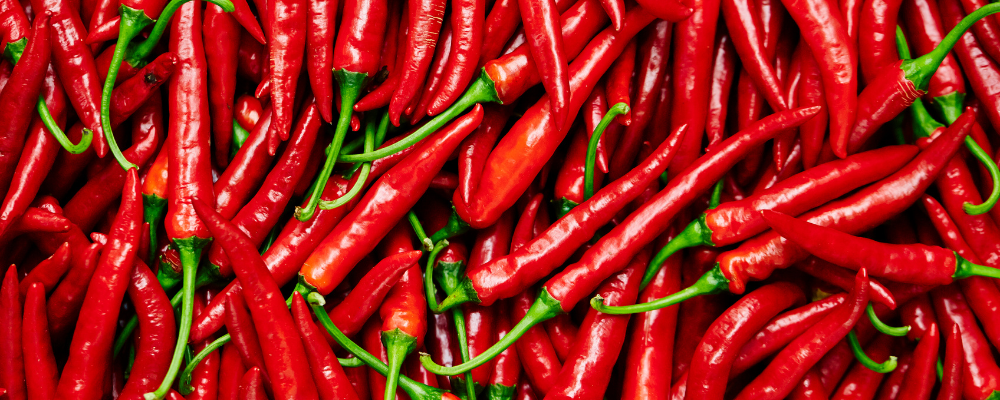
Capsicum annuum belongs to the Solanaceae family, like tomato, eggplant, and tobacco. The plant bears drooping white flowers, followed by berries whose shape, color, and heat vary according to the cultivated lineages. The green fruits change color as they ripen and may become yellow, orange, red, brown, or purple.
Kew accepts the species and places its native range from the southern United States to Brazil, including the Caribbean. Wild forms predated agriculture, and humans have been selecting Pepper for at least 6,100 years. Kew, Capsicum annuum.
The pungent part is concentrated in the internal tissues that bear the seeds. Capsaicin activates receptors associated with pain and heat. The mouth, skin, and eyes therefore react as if faced with a burn, even without a comparable rise in temperature.
This concrete action explains much of the Pepper’s magical vocabulary. It heats, presses, drives away, and makes contact unbearable. The plant offers less an image than a bodily experience, which calls for a practice without scattering powder.
From the Americas to the Atlantic routes
The peoples of the Americas cultivated several Capsicum species long before the arrival of Europeans. Kew highlights the richness of the varieties known in Aztec Mexico. The fruit already had its own languages, selections, cuisines, and social uses.
After Christopher Columbus’s voyages, seeds reached Europe. Portuguese networks then carried the plant to Africa and Asia. Within a few generations, Chili Pepper found a place in cuisines that transformed its use and selected new forms.
The European name comes from a confusion with pepper, Piper nigrum, an Asian spice sought along trade routes. The two plants belong to distant families. The word thus preserves the trace of a colonial perspective that classified a new flavor within an already familiar category.
For magic, this history makes it impossible to present Chili Pepper as a universally identical “fire” plant. Its meanings are formed in particular places and communities. Physiological heat crosses cultures, while prayers, recipes, and intentions remain situated.
Red Pepper in Conjure
In the southern United States, collections devoted to African American conjure show red pepper in operations intended to make someone leave, stir up a situation, or defend a boundary. The burning substance then acts through symbolic contact with a passage, a footprint, or a place.
In 1937, Harry Middleton Hyatt recorded a recipe in North Carolina in which a footprint, cemetery dirt, red pepper, and gunpowder were placed on a railroad track to drive someone away. Another 1939 collection associates a footprint, pepper, and salt. Hyatt’s archives on railroad magic.
These accounts belong to the history of hoodoo and the magic of traces. They also speak of a society marked by violence, forced displacement, and the need to protect a space with whatever means were available. The railroad becomes direction, speed, and irreversible departure.
Heat drives the step toward the exit. In these collections, Chili Pepper promises neither harmony nor soothing: it gives material form to separation.
Heat, Threshold, and Decision
A boundary becomes effective when it names what must stop and the act that follows its violation. Chili Pepper suits this direct grammar. Its flavor does not negotiate with the body: it triggers a response.
The threshold is its clearest magical setting. In conjure sources, the powder meets a footprint or passage. In a safe contemporary practice, the door can remain entirely symbolic: two lines drawn on a page are enough to distinguish the protected space from what must leave it.
Red adds visibility and alertness. It allows you to write a decision that cannot be confused with a vague wish. A sentence such as “I am closing this access as of such-and-such a date” contains a condition, a time, and an action.
Heat also carries the risk of escalation. Before working on a departure, distinguish protection, rupture, and revenge. The first protects a boundary, the second ends a relationship, and the third seeks to hurt. Chili Pepper calls for a brief, sustained intention.
Drawing a boundary without scattering powder
Place a landscape-format sheet of paper in front of you. Draw a vertical line with a red pencil to represent the threshold. On the left, write what you are protecting: a room, time, an exchange, or a decision.
On the right, state factually the behavior that is no longer acceptable. Avoid defining an entire person. Then write below the line the actual action planned if the boundary is crossed: close an access point, end a conversation, ask for help, or preserve evidence.
Draw three small chevrons pointing outward. The first bears the date, the second the action verb, and the third the support available. Read the sentence only once, in a clear voice.
Fold the page from left to right, then store it near the relevant place. Do not handle any Chili Pepper. The next day, carry out the written action or rephrase it to make it applicable. The power of the gesture lies in maintaining the boundary.
Historical correspondences
| Reference | Correspondence |
|---|---|
| Botanical reference | Capsicum annuum L. |
| Family | Solanaceae |
| Origin | The Americas, then widespread worldwide after the 15th century |
| Magical framework | African American conjure and footprint magic |
| Magical fields | Expulsion, separation, alert, and limit |
| Safe form | Write with a red pencil, without contact with the powder |