























































































































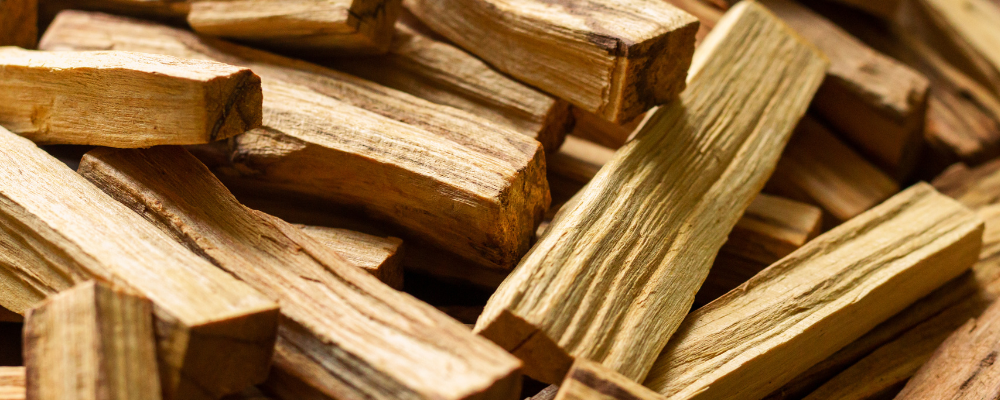
Palo Santo’s Spanish name attributes holiness to the wood. In the dry forests of the Pacific coast, Bursera graveolens loses its leaves during the arid season and retains aromatic resins in its wood. Its current ritual use comes from communities in Ecuador and Peru, followed by global circulation that may have separated the stick from its territory.
“Palo Santo” can refer to several trees. This profile concerns Bursera graveolens, a member of the same botanical family as Frankincense and Myrrh. The species grows from Mexico to northwestern South America.
Smoke does not sum up its magic. Provenance, harvesting, the wood’s waiting period, ritual healing, and dry-forest conservation give Palo Santo a more accurate history. The practice proposed here remains combustion-free.
The tree of tropical dry forests
Bursera graveolens (Kunth) Triana & Planch. belongs to the Burseraceae family. The tree has gray bark, compound leaves, and small fruits that open when mature. During the long dry season, it may lose its foliage.
Kew places its native range from Mexico to Peru and northwestern Venezuela. Kew, Bursera graveolens.
The wood’s fragrance depends on the species, location, age, and drying process. The trade name therefore cannot replace a traceability chain. A stick should be linked to its country, supplier, and the legal framework governing its harvest.
From holy wood to global trade
The Spanish name palo santo, “holy wood,” has been applied to several aromatic or medicinal tree species. For Bursera graveolens, it accompanies domestic and ritual practices along the Ecuadorian and Peruvian coast.
At the turn of the 21st century, the wood became a global incense sold in wellness and occult shops. This spread simplified its history into a formula of “universal purification,” even though local practices belong to specific healing traditions and territories.
The word holy invites us to question who attributes holiness. The answer does not lie in a planet or an element added afterward, but in the relationship between tree, healer, patient, forest, and community.
Palo Santo in Saraguro mesas
A survey of Saraguro yachakkuna from southern Ecuador describes Palo Santo among the materials used in ritual medicine. It is included in preparations and accompanies healing mesas with other plants and objects.
The study shows that the ceremony varies according to the practitioner, the place, and the diagnosis. Ethnobotanical study of the yachakkuna Saraguros.
A ritual material never travels alone. It comes with a language, an authorized practitioner, a way of diagnosing, and a territory of relationships.
Deadwood, traceability, and conservation
International demand puts pressure on dry forests, already fragmented by agriculture, livestock farming, and urbanization. The global status of a species does not guarantee the health of every local population or the legality of a batch.
Ecuadorian projects distill dry wood or add value to fruit through local associations. A study by the University of Guayaquil examines Palo Santo biocommerce as an activity linked to biodiversity and the community economy. University of Guayaquil, Palo Santo biocommerce.
Before any purchase, ask for the species, country, legal status of the wood, harvesting community or company, and export documents. Traceability becomes part of the ritual act.
Consecrating provenance without smoke
Write four pieces of information related to the batch on a card: species, country, supplier, and harvesting method. If any information is missing, leave the field blank and direct the question to the seller.
Place a photograph of a dry forest and a small empty container near this card. Place four paper strips bearing the words tree, soil, community, and trade in the container.
Read the provenance sheet aloud, then store everything with the invoice. No stick is lit. The work transforms origin verification into a commitment to practice.
Historical correspondences
| Reference point | Correspondence |
|---|---|
| Botanical name | Bursera graveolens (Kunth) Triana & Planch. |
| Environment | Tropical dry-season forests |
| Ritual context | Mesas and healing practices in Ecuador and Peru |
| Issue | Traceability, legality, local pressure, and value sharing |
| Magical domains | Purification, ritual care, relationship with the land, and transition |
| Safe form | Provenance card, photograph, and paper strips |