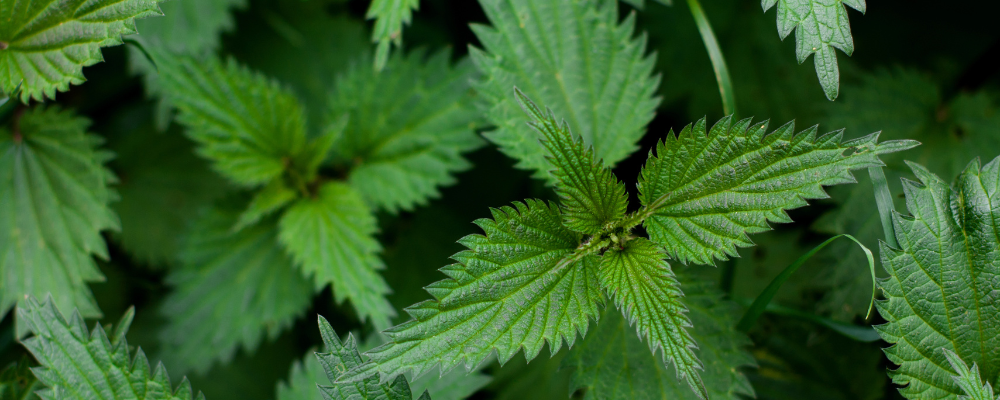
The Nettle defends every leaf with hairs that become needles on contact. It grows in colonies, yields strong fibers, and returns from its rhizomes. Culpeper assigned it to Mars in the 17th century. In Andersen’s The Wild Swans, a young woman gathers, treads, and weaves Nettles in silence to restore her brothers to human form. Its magic unites defense, endurance, transformation, and work carried through to the very last thread.
The Stinging Nettle is Urtica dioica L., a perennial of the Urticaceae family. Its opposite leaves bear pronounced teeth and stinging hairs. Its underground stems allow it to quickly occupy rich soil.
The sting gave the Nettle a martial reputation. Its fiber tells another story, however: after retting, separation, and spinning, a plant that burns the skin becomes fabric. Andersen’s tale brings these two sides together in a trial of protection.
A defense made of plant glass
Urtica dioica bears stiff hairs whose mineralized tips break upon contact. The hair becomes a fine needle that injects an irritant mixture into the skin. Burning and small welts appear quickly.
Kew places the species’ native range from Europe to Siberia and western China, with a presence in North Africa. It grows as a rhizomatous perennial in temperate regions. Kew, Urtica dioica.
Male and female flowers are generally found on separate individuals, as recalled by the name dioica. The seeds are small, while the visible colony owes much to its underground stems.
The defense does not form a thick wall. It relies on a multitude of almost invisible points. This economy gives the Nettle an effective boundary magic: the body learns the edge on first contact.
Mars under Culpeper’s pen
Culpeper opens his chapter with a vivid sentence: the Nettle is recognized by touch, even in the darkest night. He then places the plant under Mars, the hot and dry planet in his system.
The text associates young spring shoots with the body’s awakening after winter and describes numerous remedies. It also mentions rubbing the leaves on the limbs. Nicholas Culpeper, entry “Nettles”.
The martial correspondence comes from direct experience: heat, redness, a sharp point, and an immediate reaction. Nettle does not resemble a weapon because of its size. It becomes martial through the precision of its defense.
In magical practice, Mars serves to set a boundary, sustain an effort, and respond to an intrusion. The right action remains measured. A defense that pricks everything approaching it eventually isolates what it was meant to protect.
The Shirts of The Wild Swans
In Andersen’s tale, published in 1838, Elisa learns in a dream how to free her eleven brothers, who have been transformed into swans. She must gather Nettles, process them, draw out their fibers, and weave eleven long-sleeved shirts.
The task requires silence until its completion. The plants burn her hands, collecting them in the cemetery leads to accusations of witchcraft, and the last shirt remains incomplete at the moment of execution. Nevertheless, she throws it over her youngest brother, who retains a wing instead of an arm. Hans Christian Andersen, The Wild Swans.
Deliverance takes the form of a garment worked through pain. The charm does not fall from the sky: it is gathered, processed, spun, and finished under threat.
The tale gives Nettle a magic of transformation through work. The shirt protects because each fiber has passed through a sequence of actions. The final incompleteness also leaves its mark: saving does not mean restoring without remainder.
From Stem to Protective Thread
The Nettle stem contains bast fibers that can be separated, prepared, and spun. The stinging plant then becomes cord or textile. This transformation does not eliminate the raw material; it subjects it to technical discipline.
Thread connects distant points. Woven protection does not rely on a single knot, but on the repetition of crossings. Nettle suits commitments where small, regular actions form a lasting covering.
Elisa's silence provides an additional rule. Some tasks lose their force when announced before they exist. Keeping a project out of public discussion can protect its development.
This restraint does not mean hiding a danger or suffering. In the tale, Elisa's silence exposes her to condemnation. The current practice therefore chooses limited discretion, never isolation in a situation that requires help.
Weaving protection without touching the plant
Cut six paper strips. On three vertical strips, write what you are protecting. On three horizontal strips, note the actions that form the defense.
Weave the strips by alternating over and under. At each crossing, check that the action truly protects the subject written down. Remove a strip if it creates more constraint than safety.
Place the sealed product to the left of the weaving. Keep the work silent until the first action is completed, then inform the people concerned when their participation becomes necessary.
Secure the paper square near the protected place. One week later, mark the crossings that held. Replace missing actions with feasible, dated steps.
Historical correspondences
| Reference point | Correspondence |
|---|---|
| Botanical name | Urtica dioica L. |
| Family | Urticaceae |
| Ancient correspondence | Mars according to Nicholas Culpeper |
| Literary account | The Wild Swans by Hans Christian Andersen, 1838 |
| Magical domains | Defense, endurance, transformation, silence, and protection |
| Safe form | Paper weaving and sealed product |