















































































































































































































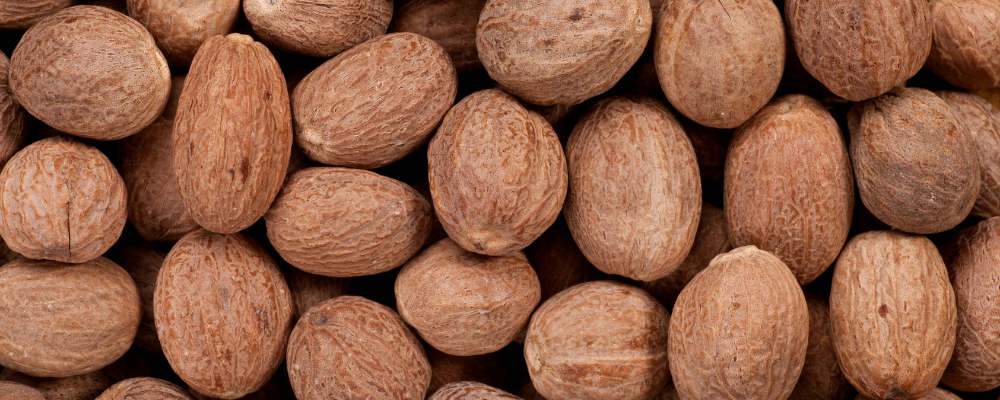
Nutmeg crossed the seas with such value that it armed companies, displaced populations, and redrew empires. In the Key of Solomon, it joins incense, aloe, benzoin, and musk to create a fragrance offered to benevolent spirits. Its scent therefore belongs both to global trade and to the ceremonial practice of the grimoire.
Nutmeg is the seed of Myristica fragrans. The same fruit also produces mace, the red aril surrounding the seed before drying. Both materials circulated through Asian and later European networks, but nutmeg retains a whole form that made it suitable for pocket charms.
In cooking, a small amount enhances the flavor. The doses sought to alter perception expose users to prolonged and distressing poisoning. Current magical practice keeps the seed whole, without ritual ingestion, concentrated aromatic extract, or fumigation.
The Seed of the Banda Islands
Myristica fragrans Houtt. is an evergreen tree in the Myristicaceae family. Its fleshy fruit splits open when ripe, revealing a red aril, mace, encasing a dark shell. Inside is the aromatic seed called nutmeg.
Kew recognizes the species as native to the Banda Islands, in the Moluccan archipelago. Kew, Myristica fragrans.
This restricted geography explains the spice’s extraordinary historical value. Before it was transplanted to other tropical regions, the world of commerce had to reach these few volcanic islands to obtain nutmeg and mace.
The Price of Fragrance and the Violence of Monopoly
In the 17th century, the Dutch East India Company imposed its control over nutmeg production. The conquest of the Banda Islands led to massacres, deportations, slavery, and the flight of a large part of the Bandanese population.
The historical landscape of the islands preserves plantations, forts, and a colonial town. UNESCO describes this production and defense system built to maintain the spice monopoly. UNESCO, historical landscape of the Banda Islands.
Speaking of prosperity with Nutmeg requires keeping this history in the foreground. The spice’s European wealth was tied to dispossession and colonial violence. The grimoire does not turn this reality into exotic decoration.
Nutmeg in the Key of Solomon
Book 2, Chapter 10 of Mathers’s edition of the Key of Solomon discusses incense, suffumigations, and fragrances. For a scent intended for benevolent spirits, it lists incense, aloe, Nutmeg, benzoin, musk, and other fragrant spices.
The prayer that follows asks that the fragrance attract benevolent spirits and drive away hostile apparitions. Key of Solomon, Book 2, Chapter 10. The manuscript variants cited by the editor do not all contain Nutmeg: the composition depends on the version.
The scent must be read before it is produced. The text shows the ceremonial role of fragrance, the blessing of the material, and the diversity of manuscripts. A sealed seed is enough to preserve its memory.
The nut carried as a charm
In the 19th and 20th centuries, surveys of folk traditions in Great Britain and the United States recorded Nutmegs worn around the neck or carried in a pocket against pain, rheumatism, boils, and other ailments. The whole seed then acted as an amulet, without being consumed.
German love charms and luck practices also used Nutmeg. The University of California, Davis summarizes several of these collections, with their references to Gerarde and regional surveys. UC Davis, cultural history of Nutmeg.
The compact form and lasting scent explain this talismanic use. The nut is kept, passed on, and develops a patina through contact with fabric or a box.
The sealed sachet of good scents
Place one whole Nutmeg in a small, sealed transparent sachet, without piercing or grating it. Add a label bearing “Banda,” the botanical name, and the chapter of the Key.
Arrange five cards around the sachet bearing the other materials on the list: incense, aloe, benzoin, musk, and fragrant spices. Read the historical prayer softly without lighting charcoal or producing smoke.
For a luck working, associate the nut with a measurable decision and a remembrance of the Bandanese people. A coin placed near the sachet may later be donated to a cultural or environmental organization connected to Indonesia.
Historical correspondences
| Reference point | Correspondence |
|---|---|
| Botanical name | Myristica fragrans Houtt. |
| Origin | Banda Islands, Moluccas archipelago |
| Grimoire | Key of Solomon, book 2, chapter 10 |
| Magical areas | Ceremonial fragrance, luck, talismanic carrying, and memory |
| Historical significance | Spice trade and the violence of the colonial monopoly |
| Safe form | Sealed whole seed, cards, and reading |










