














































































































































































































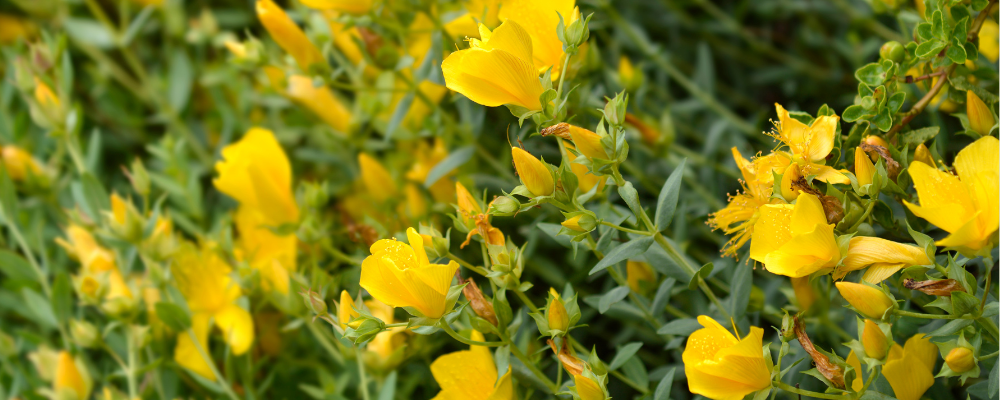
When its leaves are held up to the daylight, St. John’s wort appears to be pierced by a multitude of windows. Yet its yellow flowers, gathered around St. John’s Day, acquired another role: defending doors, dispelling nocturnal apparitions, and inquiring into romantic prospects when the sun’s course reaches its peak.
The name fuga daemonum, “the flight of demons,” sums up its European reputation. At doors and windows, the plant formed a barrier against spirits, enchantments, storms, and thunder. Its other name, Sol terrestris, the “earthly sun,” associated its luminous corolla with the power to drive away whatever belongs to the night.
This identity does not come from a contemporary correspondence imposed on a yellow flower. It is constructed through the calendar of St. John’s Day, bouquets hung from houses, and the plant astrology of the 17th century. Nicholas Culpeper places St. John’s wort under Leo and the Sun; June customs give it a precise time, a defensive function, and a place of action: the threshold.
The leaf pierced by light
Perforated St. John’s wort, Hypericum perforatum L., is a perennial plant in the Hypericaceae family. Its upright stems bear opposite leaves in which small translucent glands create the impression of perforations when viewed against the light. The five-petaled yellow flowers are dotted with darker glands and release a red coloration when crushed.
Kew places its native range from Europe to central China, as well as in North Africa and certain areas of the Near East. The plant subsequently spread far beyond this range. Its identification matters, because the genus Hypericum comprises several hundred species whose appearance and composition are not interchangeable. Kew, Hypericum perforatum.
The luminous “holes” and the red sap inspired two complementary symbolic interpretations. The leaf lets daylight through; the flower bears a red color associated with the blood of Saint John the Baptist. The plant thus unites sunlight and the memory of a martyr in the same substance.
The plant of the solstice and St. John’s Day
The feast of Saint John the Baptist, on June 24, falls near the summer solstice. In several European regions, plants gathered during this period were given a special status. St. John’s wort held the highest place: it was harvested on the eve of the feast, before sunrise or while covered in dew, and then incorporated into St. John’s bouquets.
Richard Folkard reports that species of Hypericum were hung on doors and windows alongside lilies, fennel, and mugwort. The bouquet did not merely decorate the house. It placed the home under the saint’s protection during a night considered full of encounters, omens, and dangers. Richard Folkard, Plant Lore, Legends, and Lyrics, “Saint John’s Wort”.
This date gives the plant its guiding principle. St. John’s wort does not represent an abstract sun: it is the light carried to the threshold when the year turns after its longest day. Gathering, tying, and hanging it create a calendar magic governed by a festival, a time, and a location.
Fuga daemonum, the Flight of Demons
The names fuga daemonum and Sol terrestris reveal the magical core of St. John’s wort. The first attributes to it the power to drive away demons; the second compares the flower to the earthly sun, before which nocturnal forces disappear. Texts compiled in the 19th century extend much earlier practices of carrying, hanging, and protecting the home.
In France, Germany, Italy, Scotland, and Wales, sprigs were worn on the person or fixed above openings to ward off witchcraft, specters, and feared bad weather. The gesture is remarkable for its simplicity: the plant remains whole and visible. It stands guard without the need for smoke or a drink.
Culpeper gives this reputation an astrological framework. In his Complete Herbal, published in the 17th century, he places the plant under the sign of Leo and the governance of the Sun. His description already emphasizes the perforated leaves and the red juice of the flowers. Nicholas Culpeper, The Complete Herbal, “St. John’s Wort”.
The Sun Above the Door. St. John’s wort acts in these accounts as a light placed where the outside world can enter. The threshold transforms the sun-colored flower into a guardian of the home.
Bouquets of Nine Flowers and Omens
Midsummer’s Day also marked the beginning of a period of love divination. In Sweden and Switzerland, young women made a bouquet of nine flowers gathered from nine places. St. John’s wort had to occupy a prominent place in it. The bouquet was then placed under the pillow so that sleep might reveal the future husband.
In Lower Saxony, a sprig fixed near the bed offered another omen: if it remained fresh in the morning, a marriage was expected within the year; if it withered, hope was deferred. The plant therefore did not produce the marriage. It served as a basis for interpretation, linking the condition of the plant, dreams, and expectation.
Folkard also preserves the instruction attributed to Visontius: pick the plant on a Friday, at Jupiter’s hour, around July’s full moon, then wear it at the neck against melancholy and fantastical spirits. This testimony brings together St. John’s wort’s solar identity and a Jovian timing chosen for a specific operation.
Guarding a threshold with St. John’s wort
On the eve of St. John’s Day, place a few dried flowering tops in a small closed container above a door or near a window. Write beneath it what this boundary protects: rest, peace in the home, a project, or the right not to be disturbed. The gesture reprises its protective function without turning the plant into a remedy.
For solar work, observe a leaf against the light, then draw its network of dots on paper. In the center, write what must be made visible. Keep the drawing until the next solstice. This practice draws on a real botanical characteristic and the historical image of Sol terrestris.
A bouquet of nine flowers can be arranged as a remembrance object for St. John’s Day customs. Place it near the bed, without touching the pillow, and record the dream images upon waking before interpreting them. The ritual remains a form of personal reflection; it commands neither a meeting nor another person’s will.
Historical correspondences
| Reference | Correspondence |
|---|---|
| Botanical name | Hypericum perforatum L. |
| Ritual names | St. John’s wort; fuga daemonum; Sol terrestris |
| Planet and sign | Sun and Leo, according to Nicholas Culpeper |
| Ritual timing | Eve and day of St. John’s Day, around the summer solstice |
| Magical domains | Threshold protection, defense against spirits and storms, romantic omens |
| Historical forms | Worn sprig, bouquet of nine flowers, plant hung by doors and windows |










