





















































































































Lemon balm carries the memory of the bee in its Greek name. Ancient authors call it the bees’ leaf and report that it was placed near beehives or rubbed on their walls to call the swarm back. In the 17th century, Culpeper placed it under Jupiter and Cancer, then associated it with joy of the heart. Between the hive and the planet, its mystery becomes one of gathering: calling back what has been scattered, restoring a shared space, and making hospitality gentle enough for a return.
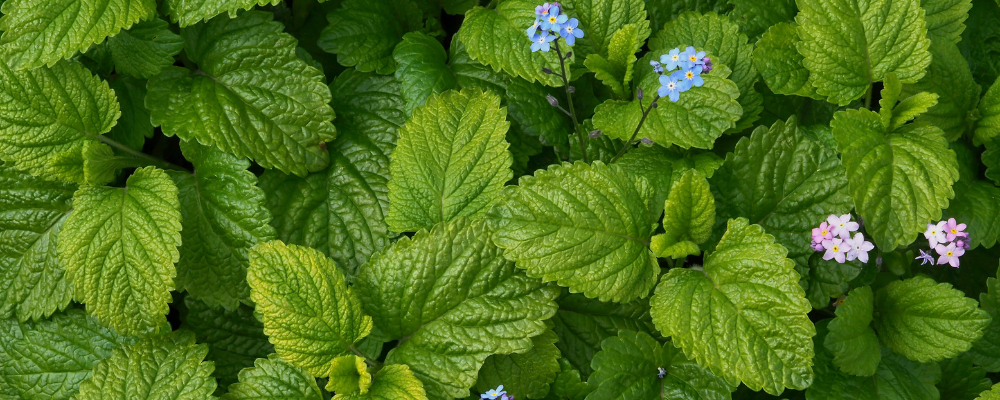
Lemon balm is Melissa officinalis L., a perennial plant in the Lamiaceae family. Its square stems bear opposite, crinkled, toothed leaves whose lemon scent emerges when they are crushed. The small, pale flowers attract pollinators.
Its historical magic is rooted in the hive, recall, and hospitable joy. It is not used to command a swarm or a person. The proposed practice establishes a plan for return and harmony on paper, without ritual infusion, fumigation, or concentrated oil.
The lemon-scented leaf of the Lamiaceae
Melissa officinalis forms a branched clump arising from a perennial rootstock. The oval leaves have a wrinkled surface, a crenate margin, and a distinct petiole. The flowers appear in the leaf axils.
Kew accepts the species and places its native range from the Mediterranean region to Central Asia. Kew, Melissa officinalis.
Its lemon scent does not make it a citrus fruit. It comes from aromatic compounds present in the leaf. This distinction reminds us that olfactory resemblance and botanical relatedness are not the same thing.
The inconspicuous flowers become a place for insects to visit. The plant thus supports the image of an active home: unremarkable from a distance, but recognizable to those who know where to return.
Melissa, the name of the bee
The name Melissa comes from the Greek word associated with the bee. Dioscorides describes the plant as a leaf cherished by bees, while Pliny calls it apiastrum.
A botanical synthesis by the BSBI recalls the ancient advice to plant or rub lemon balm on hives to attract or call back bees. Botanical Society of Britain and Ireland, Lemon Balm and Bees.
This historical practice belongs to the beekeeping of its time. For the grimoire, it gives the act of calling back a clear form: prepare a recognizable place, leave a trace, and open a path of return.
The mystery does not lie in exerting control over the swarm. It lies in the relationship between scent, orientation, and dwelling, and then in the way humans transformed this relationship into a symbol.
To call someone or something back is to prepare a place where the return can truly settle.
Jupiter, Cancer, and Joy of the Heart
In The Complete Herbal, Culpeper places lemon balm under Jupiter and Cancer. His entry also conveys the words of Arab authors who linked it to joy and relief from melancholy.
The text belongs to 17th-century astrological medicine. Nicholas Culpeper, entry “Balm”.
Jupiter corresponds to generous expansion, support, and the open table. Cancer adds the home, protection, and the memory of loved ones.
Lemon balm thus receives a magic of domestic harmony. The joy mentioned by the text is not an order to be happy: it becomes the space made for rest, meals, and shared conversation.
The Mystery of the Rediscovered Hive
A hive is not reducible to its entrance. It brings together foraging paths, reserves, brood care, and exchanged signals. Lemon balm placed at the threshold becomes an image of this invisible organization.
In a return practice, the central question concerns the place: does it still exist, is it safe, and will the returning person find a place there different from the one they left?
The reminder may concern a habit, a team, or scattered attention. It does not aim to force the return of a loved one. Consent and freedom remain the limits of correspondence.
The lemon-scented leaf finally marks the resumption with a clear sign. A brief scent is enough to recognize the plant, just as a simple rule is enough to find the way back to working together.
Drawing the beehive of return
Draw six hexagonal cells around a central cell. In the center, write the place, project, or habit to return to.
Arrange the six conditions for return around it: access, safety, time, support, a shared rule, and a sign of welcome. Replace every abstract word with a verifiable action.
Draw a line from the edge of the page to the central cell. Mark three stopping points where you can check agreement, fatigue, and resources.
Date the chart and perform the first welcoming gesture. Keep the dried lemon balm in its closed packaging, to the left of the page, as a reminder of the beehive and not as material for consumption.
Historical correspondences
| Reference | Correspondence |
|---|---|
| Botanical name | Melissa officinalis L. |
| Family | Lamiaceae |
| Historical image | Bees’ leaf and threshold of the beehive |
| Rulership according to Culpeper | Jupiter and Cancer |
| Magical properties | Reunion, return, homecoming, harmony, and joy |
| Safe form | Beehive drawn with seven cells |