














































































































































































































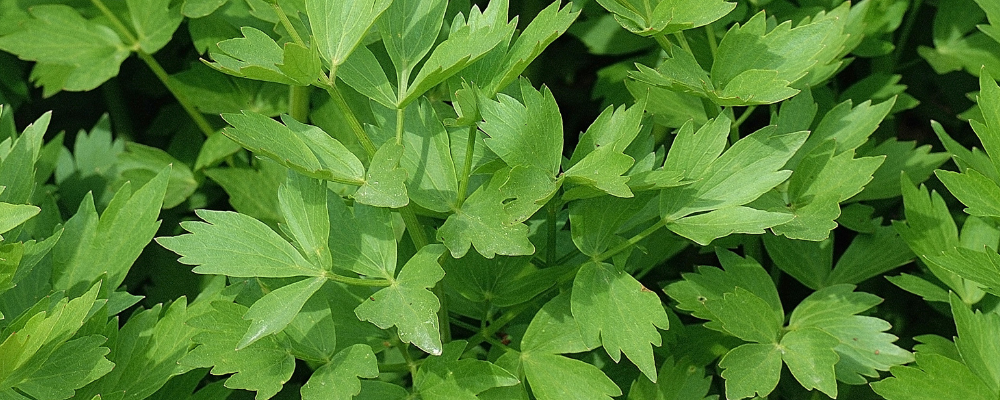
Lovage grows tall, opens broad umbels, and fills the garden with the scent of celery. Its French name comes from a long journey through Liguria, Latin, and the medieval languages. In the England of the herbals, a shift in sound brought it closer to love. Culpeper places it under the Sun and in Taurus: the plant then unites fragrance, attraction, warmth, and presence at the threshold.
The plant is Levisticum officinale W.D.J.Koch, a large perennial in the Apiaceae family. Its divided leaves, hollow stems, and yellow umbels bring it close to celery, angelica, and parsley. Its powerful fragrance makes it recognizable in a garden, but it never replaces rigorous botanical identification among umbellifers.
The magic of Lovage lies in two stories that meet. The first comes from Nicholas Culpeper’s 17th-century astrological book. The second comes from the English word lovage, brought closer to love through medieval reinterpretation. The desire attributed to the plant thus arises as much from a living language as from its aromatic nature.
A Large Aromatic Umbellifer
Levisticum officinale forms a perennial rootstock from which large, glossy leaves emerge, divided into toothed leaflets. The flowering stems can exceed a person’s height. They bear umbels composed of small yellow flowers, followed by flattened, veined dry fruits.
Kew accepts the species and places its native range from southern Iran to Afghanistan. Cultivation established it in Europe, where it has occupied herb gardens and kitchen gardens for centuries. Kew, Levisticum officinale.
The whole plant gives off a distinct scent. The leaf recalls celery, the seed concentrates a spicy note, and the root develops a darker fragrance. This olfactory continuity between leaf, stem, seed, and root gives Lovage a presence that runs through the plant’s different levels.
For magical practice, its tall stem provides the axis, the umbel radiates outward, and the root provides the reserve. These forms make it possible to construct an attraction working without reducing the plant to a simple love charm.
The Name That Turned Toward Love
The French word “livèche” and the English lovage both derive from Late Latin levisticum, itself from ligusticum, “plant of Liguria.” The name therefore initially referred to a geographical origin.
In medieval English, the foreign word took the form loveache. The element ache referred to a plant related to celery, while the English ear heard love. The Merriam-Webster dictionary traces this lineage between the French luvasche, Latin, and Liguria. Merriam-Webster, history of the word lovage.
This shift is not an ancient origin of the love charm. It shows how a name becomes active in the imagination. A plant whose name seems to contain love enters more easily into attraction recipes, gifts, and gestures intended to bring people closer.
The word changed the plant without changing its scent. Liguria faded behind love, and then this new way of hearing opened a magical path.
Culpeper’s Sun and Taurus
In The Complete Herbal, Nicholas Culpeper describes an imposing plant cultivated in gardens, every part of which has a strong smell and a warm flavor. He assigns Lovage to the Sun under the sign of Taurus.
This correspondence belongs to 17th-century English astrological medicine. The Sun governs warmth, vitality, and visibility. Taurus brings the reading back to the throat, taste, matter, and permanence. Nicholas Culpeper, “Lovage” entry.
Culpeper associates the root and herb with warming, opening, and the movement of the humors. These claims belong to his medical system. Their magical interest lies in the architecture of thought: a solar plant acts through expansion, while Taurus gives it weight and continuity.
Lovage is therefore suited to commitments that call for a visible and lasting presence. It speaks less of love at first sight than of an attraction nourished by constancy, voice, and the care given to what must remain alive.
Scent, threshold, and presence
A strong smell crosses the boundary before the body does. It announces a kitchen, a garden, or a person. Lovage transforms this concrete phenomenon into magical language: what arrives already bears a signature.
At the threshold, the plant can represent a clearly defined invitation. The umbel radiates in several directions, but the stem remains straight. The welcome thus retains a center and a rule. The door opens to a named relationship, not to every indistinct influence.
In love work, Lovage calls for reciprocal wording. Write what you offer, what you ask for, and the boundary that protects both people. Attraction then ceases to be a hold over someone else; it becomes a way of making an intention clear.
The scent also evokes the memory of places. A rediscovered smell reopens an entire scene. Lovage can accompany the return to a home, a habit, or a part of oneself, with a date and an action that give the return substance.
Building consensual attraction
Draw a vertical stem in the center of a page. At the top, draw an umbel made of seven rays. Write your intention on the stem in a sentence that depends on your own actions.
On three rays, write what you make visible. On three others, note the conditions for reciprocity. Leave the last ray blank: it represents a free response, including refusal or silence.
Place the closed product to the left of the drawing. Read aloud only the central sentence. Then choose an action compatible with each condition: send an honest message, prepare a space, set a boundary, or allow time.
Keep the page near the entrance for seven days. At the end, reread the actions completed. If the intention has changed, fold the drawing toward you and keep only the sentence that still feels right.
Historical correspondences
| Reference | Correspondence |
|---|---|
| Botanical name | Levisticum officinale W.D.J.Koch |
| Family | Apiaceae |
| Historical source | The Complete Herbal by Nicholas Culpeper, 17th century |
| Astrological correspondence | Sun and Taurus according to Culpeper |
| Magical areas | Attraction, presence, voice, welcome, and return |
| Safe form | Writing, umbel drawing, and closed product |










