















































































































































































































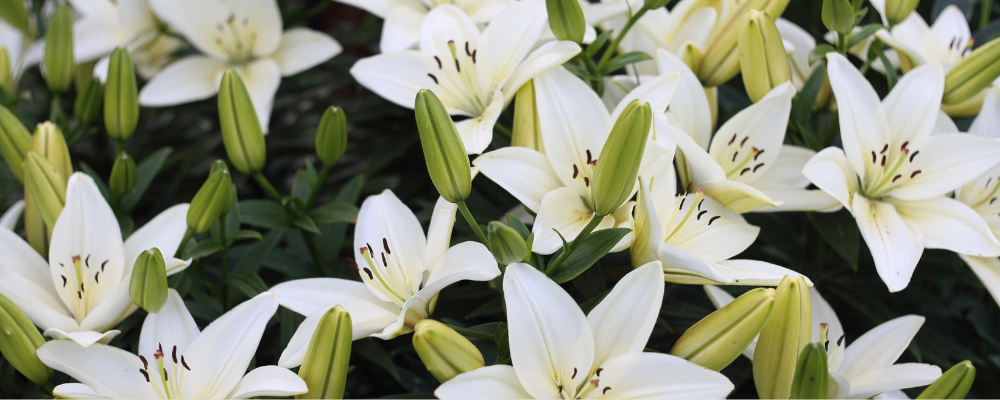
The white lily opens a trumpet-shaped corolla around stamens laden with golden pollen. Cultivated for millennia around the Mediterranean, it has entered gardens, herbals, and Christian images. In the Annunciation, a vase of lilies accompanies Gabriel’s words and Mary’s response. Its magic speaks of openness, integrity, and announcement, but its beauty demands absolute caution around cats.
The word “lily” covers many plants. This entry uses Lilium candidum L., the white lily or Madonna lily, as its reference point—the species most closely associated with European iconography. Daylilies, arums, lily of the valley, and “peace lilies” belong to other genera and have different toxicities.
European books associate the Lily with the Moon and medicinal preparations, while Christian art makes it a sign of virginity, chastity, and paradise. The grimoire follows these historical uses without reducing the flower to a purity imposed on the body. Chosen integrity, the received word, and the threshold of the announcement occupy the center.
The Mediterranean White Lily
Lilium candidum belongs to the Liliaceae family. The plant grows from a scaly bulb, forms a rosette of leaves during the cool season, then raises a stem bearing several white flowers. The recurved tepals surround six stamens and a long style.
Kew places its native range from the eastern Mediterranean to northwestern Iran. Cultivation has introduced it throughout much of Europe and the Mediterranean Basin. Kew, Lilium candidum.
The bulb does not have an onion’s dry tunic: its fleshy scales remain visible. Each year, the stem emerges from this underground reserve. The flower’s whiteness contrasts with the soil and the orange pollen that marks fabric at the slightest contact.
This contrast creates a richer image than whiteness alone. Integrity is not the absence of matter: the flower has a scent, pollen, reproduction, and a stem emerging from the soil.
The Lily in the Annunciation
From the Middle Ages onward, artists placed a white lily in scenes of the Annunciation. The flower may appear in Gabriel’s hand, in a vase between the angel and Mary, or near the open book.
The Metropolitan Museum explains that Christian writers compared Mary to the White Lily, and that painters then used the flower in scenes from her life. A stained-glass window from the early 16th century shows a vase of Lilies as an allusion to the purity of her breast. Metropolitan Museum, botanical imagery in European painting.
The flower stands between the word and the response. It marks the space where an announcement upends a life and acceptance takes visible form.
The meaning belongs to Christian iconography. A current practice may retain attention to the message, but it must not turn Mary's virginity into a judgment on the body or sexuality.
Enclosed Garden, Paradise, and Saints
The White Lily appears in painted and woven enclosed gardens, alongside the rose, violet, and other plants charged with Christian meaning. It may signify paradise, chastity, the Virgin, or a saint whose story receives the flower as an attribute.
The enclosed garden is not an empty space. It contains an order, a gate, and recognized species. The Lily draws its strength there because it grows alongside other plants and under a theological gaze.
The Metropolitan Museum recalls that Lilium candidum was among the great flowers of medieval gardens and appears alongside the Virgin, paradise, and several saints. The Met Cloisters, Lilium candidum.
In the grimoire, the enclosed garden becomes an image of integrity. It has a boundary, but also a gate. Protection does not mean condemning every passage: it means choosing the time, the visitor, and the way of entering.
The Lunar Lily in Herbals
Nicholas Culpeper places the White Lily under the Moon in his 17th-century herbal. He describes remedies made from the root, leaves, flowers, and oil according to the medicine of his time.
Its chart also associates white flowers with preparations that soften or bring inflammations to a head. Culpeper, The Complete Herbal, “White Lilies”.
The lunar correspondence comes from the whiteness, the moisture attributed to the bulb, and a humorist system. It forms a historical trace, not a measurable property of the plant.
For magic, the Moon connects the Lily to withdrawal, welcome, and the cycle of emergence from the bulb. The book’s bodily recipes remain within the story: the card retains their symbolic map without making an ointment.
Preparing the space for the announcement
Draw a vase in the center of a page and place three White Lilies inside it. In the first flower, write the expected message. In the second, write the response you can give without betraying yourself. In the third, write the question that remains open.
Around the vase, draw an enclosed garden with a gate. Near the gate, indicate the conditions of the exchange: place, time, confidentiality, witness, or time for reflection. The boundary protects the response before it becomes public.
Use a drawing or photograph, never a real flower in a household with a cat. Review the page before the conversation, then note what has changed. The ritual draws on the setting of the Annunciation and the enclosed garden without imposing a religious model on the person.
Historical correspondences
| Reference | Correspondence |
|---|---|
| Reference species | Lilium candidum L. |
| Family | Liliaceae |
| Central image | White Lily in Annunciation scenes |
| Literary source | Culpeper, White Lily placed under the Moon |
| Magical correspondences | Announcement, integrity, welcome, boundary, and response |
| Safe form | Drawing or photograph, with no real flower near cats |










