Lavender first cleanses through action: it perfumes baths, laundry, the floors of houses, and those of churches. Its scent signals that a space has been washed, prepared, and made worthy of welcoming a celebration, sleep, or protection.
Mediterranean customs nevertheless give it a more vivid depth than the modern image of a simple soothing plant. In Spain and Portugal, it is scattered across floors on feast days and fuels Saint John’s fires. In Tuscany, it turns away the evil eye from children. Among Kabyle women, it is invoked against marital cruelty.
Nicholas Culpeper places it under Mercury. This attribution recalls that Lavender also acts through air, voice, circulating fragrance, and the protective boundary established around a person.
True Lavender and its relatives
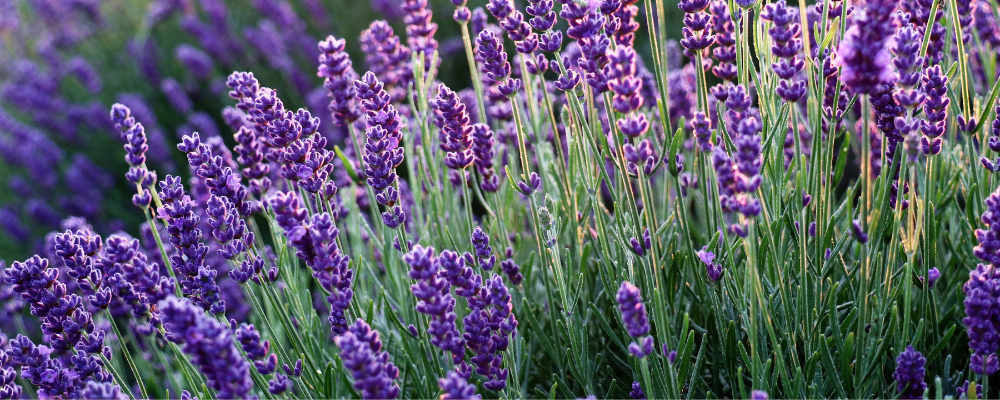
True Lavender, Lavandula angustifolia Mill., belongs to the Lamiaceae family. It is a small shrub with narrow, gray-green leaves and spikes of violet flowers held above the foliage. Kew places its native range from northeastern Spain to Italy. Kew, Lavandula angustifolia.
Other species bear the same common name, notably Lavandula stoechas, Spanish Lavender, and Lavandula latifolia, Spike Lavender. Ancient authors do not always distinguish these plants according to current nomenclature. A text devoted to Lavender may therefore concern a group of Mediterranean species.
The flowers and leaves bear aromatic glands. Their fragrance persists after drying and easily transfers to laundry, water, or air. This diffusion gives the plant its essential ritual function: making the preparation of a place perceptible.
Wash, perfume, and prepare
The name Lavender is traditionally linked to the Latin lavare, “to wash,” because the plant was associated with baths and clean laundry. The etymology remains debated, but the cultural link between fragrance and washing is ancient.
Richard Folkard recalls the use of Lavender in baths and linen cupboards. In Spain and Portugal, it was scattered across the floors of houses and churches on feast days. Visitors’ footsteps lightly crushed the stems and released their scent: the entire community activated the fragrance as it entered. Richard Folkard, Plant Lore, Legends, and Lyrics, “Lavender”.
Lavender’s purification is therefore not a vague idea. It results from a concrete sequence: washing, drying, scattering, walking, breathing. The clean space becomes a space ready for use.
Saint John’s Eve and the Evil Eye
The same collection mentions Lavender in the bonfires of Saint John’s Eve in Spain and Portugal. The fragrant plant then joins the great solar threshold at the beginning of summer. Its scent rises with the smoke and marks the communal night.
In Tuscany, Lavender is used to counter the evil eye on young children. Among Kabyle women, it is invoked for protection from marital cruelty. These two uses give the plant a role in intimate defense: it envelops those whose vulnerability requires a boundary.
The mystery of Lavender lies in this defensive gentleness. A substance associated with linen, bathing, and the cradle also becomes the herb that refuses the hold of a gaze or an act of violence. Its fragrance does not conceal danger: it asserts around the body a space that must remain safe.
Lavender under Mercury
Nicholas Culpeper places Lavender under Mercury and attributes uses related to the head, brain, and voice in the medical language of his time. The correspondence suits a plant whose primary action spreads through the air and whose fragrance accompanies speech, study, and wakefulness. Nicholas Culpeper, The Complete Herbal, “Lavender”.
Under Mercury, Lavender prepares a conversation, clarifies a workspace, and protects the flow of speech. It is particularly suited to moments when one must clear away what obscures a message without silencing the other person.
Scent makes the boundary perceptible. Lavender does not build a wall. It signals that a body, a cloth, or a house has been prepared and now possesses its own atmosphere.
Prepare a Space with Lavender
Before ritual work, sweep and actually clean the room. Then place a few dried flowers in a closed sachet near the entrance or under the worktable. Lavender completes the preparation; it does not replace the material care of the space.
To protect sleep, hang the sachet away from the pillow, out of reach of children and animals. For a difficult conversation, place it between the participants with a simple intention: that speech may flow without violence and that everyone may maintain their boundaries.
At Saint John’s Day, the flowers may be offered without burning in a bowl exposed to the evening light, then returned to the compost. The rite preserves the solar threshold and the fragrance while avoiding smoke. On Wednesday, a small amount of Lavender may accompany Mercurian work involving writing, study, or messages.
Historical correspondences
| Reference | Correspondence |
|---|---|
| Main botanical name | Lavandula angustifolia Mill. |
| Planet | Mercury, according to Nicholas Culpeper |
| Ritual times | Festive days, Saint John’s Day, evening preparation, Mercurian Wednesday |
| Traditions | Baths and linens, floors of homes and churches, protection against the evil eye and violence |
| Magical domains | Purification, preparation, safe speech, protection of the home and sleep |
| Ritual forms | Dried flowers in a closed sachet, bowl, or cloth; no ingestion or burning |