















































































































































































































The yew remains green among the graves. In British cemeteries, its branches accompanied funeral processions, covered the bodies, and marked the expectation of resurrection. Its longevity made it a sign of immortality; yet its toxicity and bow wood always keep death close.
There are multiple explanations for its presence in cemeteries: a funerary tree inherited from antiquity, a Christian emblem of enduring life, a consecrated tree, a source of wood, or a planting protected from livestock. The sources do not allow all church yews to be reduced to a Celtic origin.
This ambiguity is part of its richness. The tree lives for a very long time, sends up new growth from the trunk, and retains its needles in winter, while its taxines can cause fatal cardiac poisoning. It unites continuity and limitation.
The Dark Tree with Red Arils
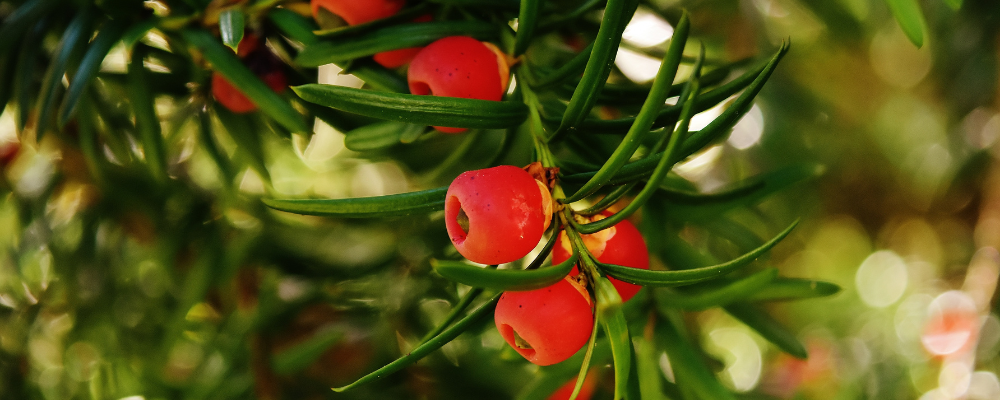
Taxus baccata L. is an evergreen conifer of the Taxaceae family. Its flat, dark needles are arranged on either side of the branches. Female individuals bear seeds surrounded by a red, fleshy covering, the aril, which is open at the top.
Kew describes a range extending from Europe to western Asia and North Africa. The tree can reach a remarkable lifespan, and some European specimens are estimated to be more than two millennia old. Kew, Taxus baccata.
The needles, bark, and seeds are highly toxic. Although the red flesh of the aril does not contain the same poisons, the seed it surrounds makes any consumption dangerous.
The Cemetery Yew
Folkard traces a long funerary association transmitted from the Egyptians to the Greeks and Romans, and then to the Britons. The branches were carried in procession, placed beside the dead, or thrown into the grave. The tree became an ornament of consecrated ground.
Its evergreen foliage allowed a Christian interpretation of resurrection and immortality. Welsh laws granted greater value to consecrated yew, a sign that the churchyard tree possessed a status of its own. Richard Folkard, Plant Lore, Legends, and Lyrics, “Yew”.
Its proximity to the dead generated a darker image: the yew that supposedly feeds on bodies beneath its roots. Poetry then transforms biological continuity into an unsettling intimacy with bones.
Palm branches, relics, and the consecrated tree
Yew branches replaced palm leaves on Palm Sunday and decorated churches or homes in winter. The same tree therefore serves to honor Christ’s entry into Jerusalem, accompany the dead, and signify enduring life.
At Vreton, in Brittany, a yew is said to have grown from Saint Martin’s staff. Breton princes prayed beneath its branches before entering the church. The legend emphasizes the prohibition against picking its leaves; men who cut the wood are punished by a fatal fall.
That which endures cannot be possessed. The consecrated yew offers its shade and longevity, but the story punishes anyone who turns this presence into material taken without permission.
The bow, war, and poison
Yew wood, flexible and durable, produced famous bows. Virgil, Chaucer, and other authors associate it with archery and war. The funerary tree thus produces the instrument that delivers death from a distance.
Greek and Roman authors also knew of its toxicity. Caesar recounts the death of Catuvolcos, king of the Eburones, by means of yew. These political accounts reinforce its association with last resort, sovereignty, and refusal of capture.
Kew confirms that taxines are present in the leaves, seeds, and bark, and is also studying their presence in the wood. Kew, analysis of yew wood. The bow’s material history provides no justification for any ritual handling.
Keeping memory beneath a drawn tree
Draw a yew whose trunk surrounds an empty space. In that space, write the name of a missing person or a lineage. On the branches, place what is still passed down: a phrase, a gesture, a recipe, a place, or a responsibility.
To mark a transition, tie a green ribbon around a photograph of a yew, never around a living tree without permission. Remove the ribbon at the end of the reading and keep it in the book of the dead.
If you visit a cemetery yew, stay on the paths, pick nothing, and do not carve the bark. Note the name of the place, the date, and local stories. Respect for the site is part of the work.
Historical correspondences
| Reference point | Correspondence |
|---|---|
| Botanical name | Taxus baccata L. |
| Places | Cemetery, church, grave, woods, and consecrated place |
| Times | Funerals, Palm Sunday, and winter |
| Objects | Funerary branch, bow, saint’s staff, and consecrated tree |
| Magical domains | Memory of the dead, immortality, limits, sovereignty, and duration |
| Safe support | Photography, drawing, and visiting without collecting |










