


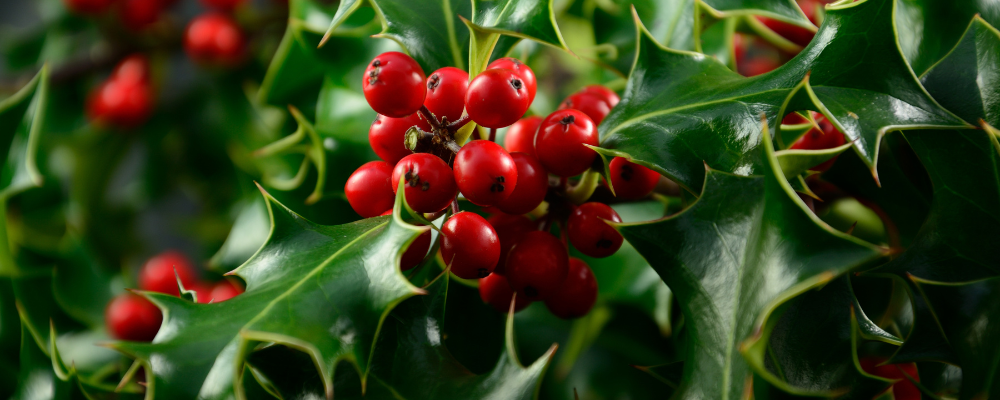
Holly keeps its leaves when winter strips the neighboring trees bare. Its red fruits, borne by female plants, feed birds but can make humans ill. In ancient Rome, Pliny wrote that a Holly planted near the house keeps veneficia away, a word that can refer to poisons, drugs, or evil practices. The mystery arises from this boundary of language: a house tree, defensive foliage, and a Latin formula have produced centuries of protective interpretations.
Common Holly is Ilex aquifolium L., an evergreen tree or shrub in the Aquifoliaceae family. Its lower leaves bear sharp spines, the higher leaves may become almost smooth, and only fertilized female plants produce red fruits.
The entry follows three attested threads: the house tree in Pliny, the Christianization of Holly in Christmas songs and images, and its ecological function as a winter refuge. These threads support a magic of boundaries, continuity, and vigilance. The practice is designed to avoid toxic berries, prickly leaves, and cutting branches.
An evergreen with variable leaves
Ilex aquifolium retains dark, leathery foliage for several years. Young lower branches bear leaves armed with spines, while the crown of mature trees develops less prickly edges.
Kew accepts the species and places its native range in Europe and northwestern Africa. Kew, Ilex aquifolium.
Holly is dioecious: male and female flowers occur on separate individuals. Red fruits appear on a female plant when compatible pollen has enabled fertilization.
This biology shifts the correspondence of fertility toward relationship. The branch laden with fruit attests to proximity, pollinating insects, and a completed season.
Veneficia kept away from the house
Pliny attributes to holly planted near a house or villa the ability to ward off veneficia. The Latin sentence is short, and its final word has received several translations.
An analysis from the University of Reading herbarium recalls the exact wording and examines the shift from “poisoning” to “magical influences” or “witchcraft” in translations. Herbarium RNG, Pliny’s Holly and the word veneficia.
The historical mystery lies in this polysemy. Poison, preparation, and witchcraft intersect in a word linked to the power of substances.
Protection begins at the threshold of vocabulary. Translation requires keeping several meanings visible rather than choosing one that turns holly into a universal guarantee.
The Christianized Holly of Christmas
In the Middle Ages, holly and ivy became part of the decorations, images, and songs of the Christmas season. Their evergreen foliage made it possible to inscribe vegetal continuity in the midst of winter.
The Metropolitan Museum explains that holly’s red berries were associated with the blood of Christ, and that songs opposing or pairing holly and ivy give voice to these meanings. Metropolitan Museum, Holly and Ivy in the Middle Ages.
Christian symbolism does not replace botany: green leaves, thorns, and fruits make the image memorable, then song places them within a religious narrative.
Holly becomes a seasonal book. Its color, point, and fruiting serve as legible signs during a celebration that recalls birth, suffering, and continuity.
Thorns, fruits, and winter refuge
The prickly leaves on the lower branches limit browsing and form cover where small birds can find refuge. Higher up, beyond the reach of many herbivores, the leaves may lose some of their spines.
The fruits ripen in autumn and persist through winter. They provide a resource for birds when other fruits become scarce, while remaining toxic to people and several domestic animals.
Holly’s defense is therefore not uniform. It appears where pressure is greatest and eases with height. This variation inspires a boundary proportionate to the risk.
The winter magic of holly unites continuity and shelter. Staying green does not mean remaining unchanged: the tree adjusts its leaves, shares its fruits with certain species, and maintains a place in the cold season.
Drawing a threshold with variable thorns
Draw a door surrounded by four holly leaves. Give each leaf a number of thorns corresponding to the risk level of an access point: low, limited, sensitive, or prohibited.
On the door, write what must remain accessible to keep the home alive: help, an exit, communication, or an essential resource.
Above it, draw three red fruits without using real material. Name the people or services that can sustain the place during a difficult period.
Under the threshold, copy the three meanings “poison,” “preparation,” and “curse.” They remind us that a threat must be named before it can be given a boundary. Date and display the rule near the relevant access point.
Historical correspondences
| Reference | Correspondence |
|---|---|
| Botanical name | Ilex aquifolium L. |
| Family | Aquifoliaceae |
| Botanical signs | Evergreen foliage, thorny leaves, and female red fruits |
| Sources | Pliny and medieval Christian symbolism |
| Magical domains | Threshold, defense, continuity, vigilance, and refuge |
| Safe form | Door and drawn leaves |