








































































































































































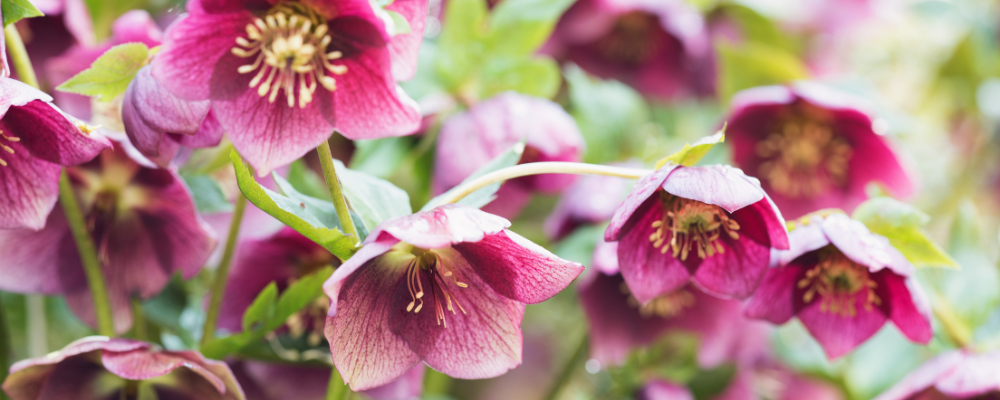
Black Hellebore flowers while winter still holds the garden. Its name does not come from a dark corolla, but from its black root. Greek texts associate it with Melampus and the cure of madness; herbals attribute to it the power to purify the house, drive away spirits, and herald the coming year.
One difficulty runs through its entire history: “Black Hellebore” and “White Hellebore” do not refer to the same plant. The former refers to Helleborus, including Helleborus niger. The latter corresponds to Veratrum album, a different genus and family that is also highly toxic.
The reputation as a remedy for madness comes from medical and mythical accounts in which purgation, defilement, and possession echo one another. It provides no current treatment. The plant is reserved for image and text.
The Winter Rose with the Black Root
Helleborus niger L. is a perennial of the Ranunculaceae family. Its evergreen, leathery, divided leaves form a low clump. The large white flowers appear in winter or early spring, then take on pinkish or greenish hues. The dark rhizome explains the name Black Hellebore.
Kew places its native range in the Alps and the Apennines. The name Christmas rose comes from its winter flowering and a Christian legend in which a flower appears in the snow as a gift to the infant Jesus. Kew, Helleborus niger.
The leaves, stems, flowers, and especially the underground parts contain irritant or cardiotoxic substances. Flowering in the heart of winter does not permit any ritual gathering.
Melampus and the Madness of Proetus’s Daughters
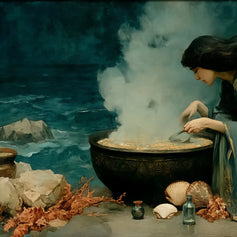
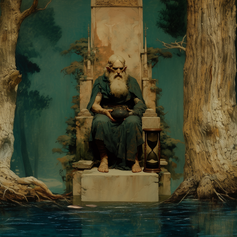
The seer Melampus was said to have cured the daughters of King Proetus, who had been stricken with madness and were running through the countryside. Accounts vary as to the cause of the illness and the remedy. Hellebore enters the tradition as a purgative plant associated with the restoration of mental order.
The name Melampodium given to black Hellebore preserves this association. Folkard brings together the myth, harvesting practices, and purification uses under his entry devoted to the plant. Richard Folkard, “Hellebore”.
The mythical cure does not translate into a prescription. It recounts a conception in which expelling a substance from the body was also meant to expel derangement or defilement.
Purifying the home and driving away spirits
Texts attribute a role in domestic purification to black Hellebore. The plant was said to have been used to consecrate the home, protect livestock, and drive away spirits. Robert Turner called it Fuga daemonum in the 17th century, “flight of the demons.”
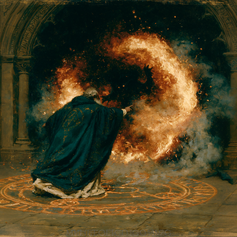
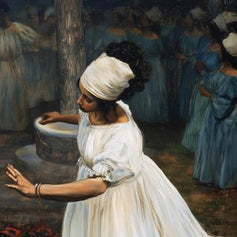
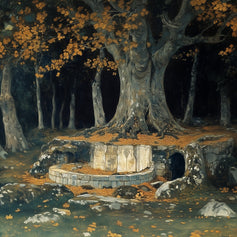
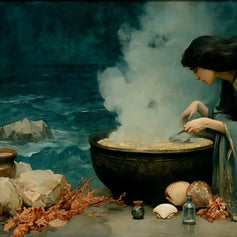
The harvest involved an impressive ceremony: a circle traced with a sword, orientation toward the east, prayer to Apollo and Aesculapius, and observation of the eagle as an omen. The gatherer even had to protect themself from the feared emanations by means described in the texts.
This harvesting rite bears witness to the fear inspired by the plant. It is not to be reenacted. Its form may be studied as a liturgy of danger in which prayer, orientation, and omen frame an act deemed risky.
The flower on the edge of winter. Hellebore brings together purification and peril. Its whiteness does not deny the black root; it is born above it.
Twelve buds for the year
A rural custom placed twelve Hellebore buds in water before Christmas, each representing a month of the coming year. Whether each bud opened or remained closed foretold favorable or difficult weather.
In Tuscany, the number of clumps observed or harvested was also associated with the abundance of the harvest. These gestures transform winter flowering into a living calendar: what opens in the cold season speaks of spring and the crops.
The principle can be adapted without toxic vegetation by using twelve paper flowers. The oracle becomes a way of organizing expectations, without claiming to provide reliable meteorological predictions.
The Oracle of the Twelve Paper Flowers
Make twelve white paper buds and write a month on each one. Before the winter solstice, open each bud to write a concrete focus: sow, repair, wait, travel, harvest. Arrange them in a circle around an image of hellebore.
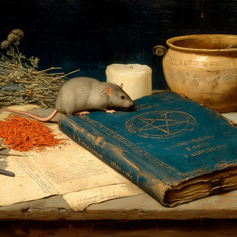
For a house purification, draw a circle on the floor with a ribbon, without a plant or powder. Place the names Apollo, Asclepius, Melampus, and Fuga daemonum at the four directions, then read the sources explaining each one. The rite becomes a historical journey.
Finish by putting the image in an envelope that is black on the inside and white on the outside. This envelope echoes the dark root and the winter flower.
Historical correspondences
| Reference | Correspondence |
|---|---|
| Botanical name | Helleborus niger L. |
| Name to distinguish | White hellebore: Veratrum album, a different genus |
| Figures | Melampus, Apollo, and Asclepius |
| Historical attribution | Saturn, in Folkard’s compilation |
| Magical domains | Purification, expulsion, agricultural omen, and winter calendar |
| Safe support | Image, two-tone envelope, and twelve paper flowers |