


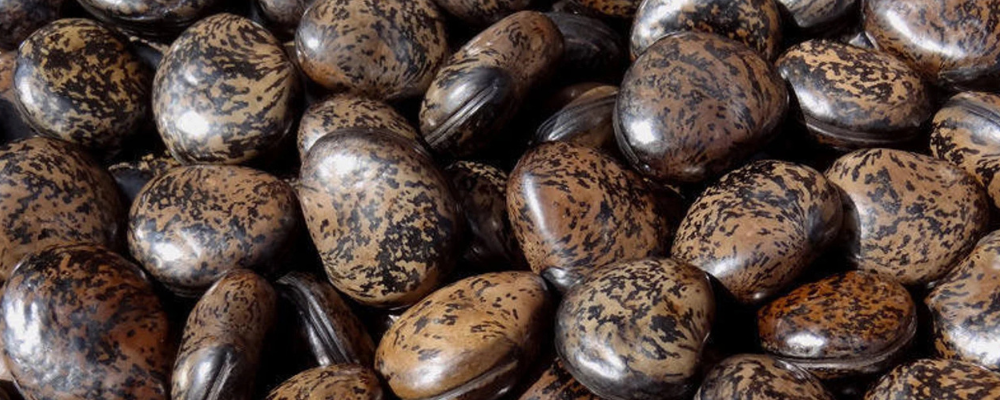
The Ox-Eye Seed bears a gaze in its form: a dark disk, a light-colored hilum, and a surface polished by water. Mucuna seeds crossed the Atlantic before being collected on European shores, pierced, and kept as amulets. In the territories of the Oyapock, other practices connect the same name with protection against the evil eye.
This entry concerns Mucuna sloanei Fawc. & Rendle, a tropical vine whose seed is carried by the Aeternum product. The French name “ox-eye” does not, however, designate a single species. It can also apply to Mucuna urens, Mucuna pruriens, or the red and black seeds of Ormosia. Botanical identity must remain attached to the label.
The seed brings together three striking traits: it resembles an eye, it floats long enough to cross the sea, and its hard shell preserves the mark of its journey. These characteristics have inspired amulets of sight, luck, and passage. The grimoire places them in their proper settings without merging peoples and plants under one sweeping formula.
Identify Mucuna sloanei
Mucuna sloanei belongs to the Fabaceae family. This woody vine climbs through humid tropical forests. Its large leaves have three leaflets, its flowers have the characteristic form of legumes, and its pods contain large, flattened seeds.
Kew places the species from southern Mexico and Florida through tropical America, as well as from tropical West Africa to Angola. This range on both sides of the Atlantic explains the presence of distinct names and uses. Kew, Mucuna sloanei.
The hilum forms a broad, light-colored area that surrounds part of the seed. Against the brown or black background, it draws an iris or an eyelid. The dense surface withstands prolonged immersion in water, allowing some seeds that fall into waterways to reach the sea.
This entry follows a simple rule: the common name describes an appearance, while the Latin name identifies the plant. The former opens the magical language of the gaze; the latter guards against confusion.
A Name Shared by Several Seeds
“Ox-eye,” ox-eye, horse-eye bean, or ojo de buey can refer to several species depending on the language and region. Its resemblance to an eye is enough to make the name travel from one seed to another. Color, size, and hilum shape then help distinguish them.
This circulation creates a difficulty for magical history. A use associated with Mucuna urens does not automatically transfer to M. sloanei, even if the two seeds share an appearance and a kinship. The account must name the plant supplied by its source.
The Museu do Índio portal dedicated to the peoples of the Oyapock presents a seed called olho-de-boi, identified as Mucuna urens. It is used in handicrafts and in protections against the evil eye. Museu do Índio, ox-eye seed in the Oyapock.
The resemblance sheds light on the theme of the gaze, but it does not change the product label. The Aeternum seed remains Mucuna sloanei; the Oyapock source remains identified as M. urens.
Amulets from the sea
Tropical seeds capable of floating arrive on the beaches of the Azores, Ireland, Great Britain, and Scandinavia, carried by the North Atlantic currents. Their distant origin was long invisible to those who collected them. They seemed to be born from the sea or to arrive from a world beyond the horizon.
The Museum of Witchcraft and Magic preserves four pierced and linked Mucuna seeds. The description notes that “sea beans” found on Scottish coasts were kept as prosperity amulets from the late 17th century onward. Museum of Witchcraft and Magic, sea-seed amulet.
The sea transforms the seed into a message. Its arrival without a visible tree makes the journey tangible: a shore object bears proof of a route the eye cannot follow.
This story supports workings of passage, return, and found luck. Luck does not fall outside the world: it arrives through currents, withstands salt, and calls for an attentive hand on the beach.
Gaze, protection, and reciprocity
An eye-shaped amulet first acts like a returned gaze. It makes the attention focused on a person visible and responds with a surface that seems to look back in turn. The motif spans many cultures, but each object receives its own language, material, and rules.
The Ox-Eye Seed adds hardness and the sea to this language. Its hilum does not represent a painted eye: it belongs to the structure of the seed. Protection therefore relies on a resemblance discovered in the plant, then reinforced by wearing it.
For a contemporary practice, the gaze should remain reciprocal. Ask what you want to keep from entering, then what you are willing to see in yourself. Protection that watches others without examining its own conduct becomes mere suspicion.
The motif also suits vigilance during travel. It reminds you to look at the actual conditions: route, weather, companion, exit, and return. The seed carried by the current teaches that a crossing depends on concrete forces.
Draw the eye and the route
Draw a dark oval in the center of a page and surround it with a light hilum. In the oval, write what you keep out of your space. On the light outline, write what helps you see clearly: verified information, a trusted person, a stated boundary, or an accessible exit.
From the eye, draw a wavy line to the edge of the page. Place three dots along this route: departure, passage, arrival. Under each dot, indicate the action that makes the journey safer. This map turns the seed’s journey into a vigilance plan.
Place the closed product to the left of the sheet. Do not pierce the seed. Reread the card before the intended journey or conversation, then put it away upon returning. The practice preserves the gaze, the current, and the threshold without claiming to reproduce an Indigenous amulet.
Historical correspondences
| Marker | Correspondence |
|---|---|
| Product species | Mucuna sloanei Fawc. & Rendle |
| Family | Fabaceae |
| Shared names | Ox-eye, sea bean, horse-eye bean |
| Historical traces | Shore amulets in Scotland, Oyapock practices |
| Magical domains | Protection, vigilance, travel, and found luck |
| Safe form | Drawn card and closed product |