












































































































































































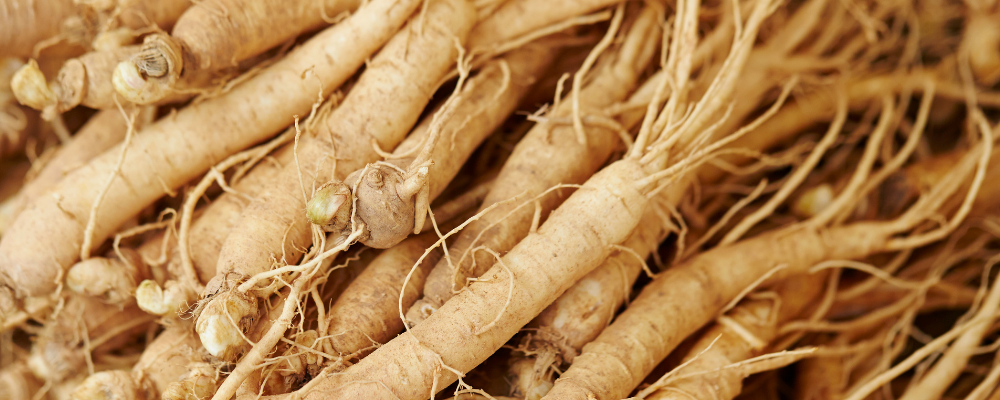
Ginseng derives part of its prestige from its forked root, certain forms of which evoke a human body. In a Chinese materia medica published in the 17th century, roots resembling the human form were considered the best. The Chinese name renshen, “person-root,” condenses this view. Its historical magic lies in a resemblance judged, preserved, and transmitted: a root becomes a portrait of the body, without transforming into a warrior, lightning, or a promise of invincibility.
Asian Ginseng is Panax ginseng C.A.Mey., a perennial plant in the Araliaceae family. An aerial stem bears compound leaves arranged in a whorl, followed by an umbel of small flowers and red fruits. The sought-after part is the fleshy root.
Chinese materia medica described its form, habitat, and properties in the medical language of their time. This entry receives these texts as a history of classification and bodily analogy. Current practice uses a drawing of the root to distribute effort and rest, without ingestion, application, or therapeutic claims.
A slow-growing perennial of the forest understory
Panax ginseng develops a stem each year above a perennial root. The compound leaves divide into toothed leaflets. The central umbel produces red fruits when mature.
Kew accepts the species and places its native range from the Russian Far East to the Korean Peninsula. It grows in the temperate biome. Kew, Panax ginseng.
The root bears a collar marked by the successive cycles of the stem. Its slow growth and branching produce highly variable forms, which commerce has assessed according to age, integrity, and appearance.
A human silhouette may appear in this material without becoming an identity. Magical interpretation preserves the resemblance as a tool for reflection and refuses to treat it as evidence of biological power.
The person-root of materia medica
The Wellcome Collection preserves an image of Ginseng taken from Li Zhongli’s Bencao yuanshi, a work published in 1612 and later reproduced in an engraved edition in 1638.
The entry describes a plant from cold, damp mountains whose shoots bear five leaves. It also states that roots resembling a human form are considered the best. Wellcome Collection, 17th-century Chinese image of Ginseng.
The illustration names the root’s head, sides, and parts. The vocabulary of the body organizes the reader’s gaze and makes it possible to compare specimens.
The root becomes a figure to be read. Its historical value arises from the connection between plant form, the human body, and the medical system.
The mystery of human resemblance
Two branches may recall legs, rootlets arms, and the neck a head. This resemblance varies with the soil, injuries, harvest, and the eye of the person choosing the root.
The mystery lies in the moment when a plant form acquires a face. The merchant selects it, the illustrator emphasizes lines, the reader recognizes a body, and then a reputation takes shape around the specimen.
In magical work, Ginseng helps represent the whole person. Root, trunk, and branches correspond to connected needs: sustenance, action, relationships, sleep, and boundaries.
This figure is not a substitute for care or diagnosis. It helps verify that a project does not ask a single part of the body or life to carry all the effort.
The root’s age, integrity, and value
Ginseng root accumulates years of growth underground before harvest. Its neck retains annual marks, while its fragile branches may be lost during extraction and transport.
The genus name Panax evokes the universal remedy in scholarly Greek. This botanical name reinforced the image of a panacea in commerce, but a plant does not become universal through its name.
The magic of value here rests on three concrete criteria: time invested, integrity preserved, and traceable provenance. A high price alone is not enough to bring these qualities together.
The human-shaped root ultimately reminds us that sustained effort leaves marks. They can be read without being erased and can guide a fairer distribution of the next burden.
Drawing the root of a just effort
Draw a simplified human root. In the neck, write the project’s duration. In the central body, write its verifiable objective.
Assign four branches to sleep, food, support, and free time. In each one, note the resource already available and the missing resource.
Then draw two lines like arms. One carries what you can accomplish yourself. The other receives what must be delegated, shared, or refused.
Circle any root whose burden exceeds its resources. Reduce the goal or add support before setting the next step. Date the drawing and review it after one work cycle.
Historical correspondences
| Reference | Correspondence |
|---|---|
| Botanical name | Panax ginseng C.A.Mey. |
| Family | Araliaceae |
| Part sought | Fleshy, branched, perennial root |
| Historical source | Bencao yuanshi, 17th-century image and description |
| Magical correspondences | Integrity, endurance, value, effort, and rest |
| Safe form | Drawn human-shaped root |