


In Exodus, manna takes the form of a coriander seed. Each morning, the people discover an unfamiliar food, and then a measure of it is placed in a jar before the Ark so that future generations can see what sustained the journey. The small aromatic sphere becomes a standard of memory: gather what is sufficient today and keep part of it as a witness, without confusing reserve with accumulation.
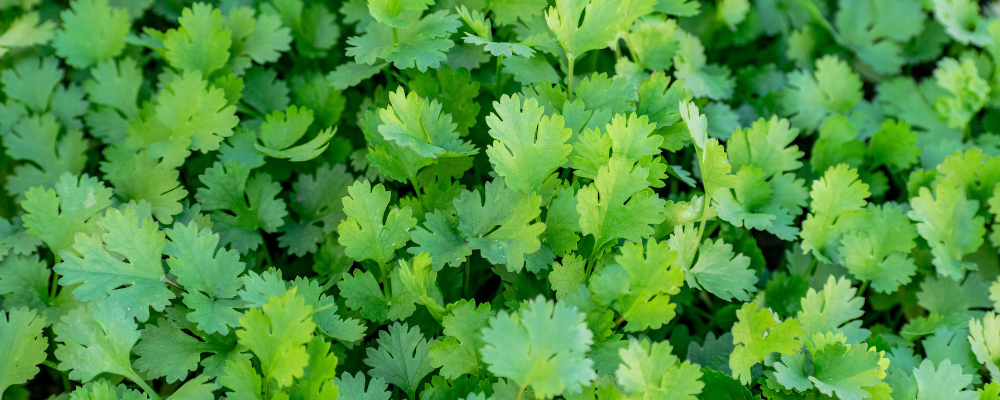
Coriander is Coriandrum sativum L., an annual plant in the Apiaceae family. Its lower leaves are broad and divided, the upper leaves become fine, and its round fruits split into two units at maturity.
Seeds found in an Egyptian archaeological context and the biblical account show a plant familiar in the ancient Near East. They attribute to it neither clairvoyance, nor automatic love powers, nor a planet. Current practice is based on the measure of manna and on the witness function entrusted to the jar.
A round fruit that keeps two parts together
Coriandrum sativum is an annual herb with branched stems. The umbels bear small white or pinkish flowers. What culinary usage calls a “seed” is the dry, round fruit, formed by two united mericarps.
Kew accepts the species and describes a cultigen origin in the eastern Mediterranean basin. The plant spread with the cultivation and trade of aromatic plants. Kew, Coriandrum sativum.
Fresh leaves and ripe fruits do not have the same aromatic profile. Aldehydes strongly mark the foliage, while linalool contributes to the gentler fragrance of the dried fruits.
This transformation invites us to distinguish the stages of a single intention. What seems harsh at the beginning can mature into a transmissible form, provided we respect the timing and do not force the transition.
The seed that gives manna its form
Exodus 16 describes a fine substance found around the camp in the morning. The Israelites ask, “What is it?”, and Moses gives them a collection rule suited to the number of people.
The text compares manna to a Coriander seed and describes it as white, with a taste like honey cake. A measure must be preserved so that descendants can see the food received in the wilderness. Exodus 16, manna and Coriander seed.
The seed provides a familiar form for an unknown substance. It does not reveal its nature: it makes it possible to describe, measure, and pass on its memory.
The small sphere becomes a unit of remembrance. Manna nourishes the present day, while a measure kept in reserve bears witness for those who will come.
Seeds preserved in Egypt
The British Museum preserves a linen bag discovered at Antinoupolis. It contains cumin seeds, fragments of Coriander seeds, papyrus remains, and tiny particles of date-palm leaf.
The object, attributed to the period between the Roman era and Late Antiquity, gives material presence to spices preserved together. The notice recalls that cumin and Coriander are attested in Egypt since the New Kingdom. British Museum, linen bag and plant remains EA53928.
The container holds several species without erasing their differences. Their proximity does not make them interchangeable. Each fragment calls for a gaze capable of naming its form and origin.
Here, the magic of Coriander meets the archive. A small substance can bear the trace of a journey, a meal, storage, and excavation. Keeping does not consist solely in possessing: the object must also be made readable.
The day's portion and the witness portion
The story of manna contrasts two actions. The day's portion addresses the present need. The witness portion is removed from consumption in order to pass on a story. Each has a distinct purpose.
A reserve without a purpose can become accumulation. A specimen without a label loses its voice. Coriander teaches us to give each portion a name, a quantity, and a review date.
This correspondence serves memory, fair sharing, and sustenance work. It does not promise to multiply money. It helps reveal what truly sustains a journey and what deserves to be kept as evidence.
The round fruit, composed of two halves, offers a suitable seal: one half for use, the other for memory. The two remain connected until the story is complete.
Preparing a memory jar
Draw a jar in the center of a page. Divide it vertically into two spaces. On the left, write what supports the present day. On the right, note the witness that will make it possible to tell the story of this journey later.
Give each entry a concrete measure: time, amount, frequency, quantity, or person responsible. Remove any formula that is impossible to count or identify.
Above the jar, draw a small round fruit divided in two. Write “use” in one half and “memory” in the other. Add the date on which these two parts will be reviewed.
Close the drawn jar with a lid and sign it. Place the page with the project documents. On the chosen date, review what sustained the journey and what can now become a story.
Historical correspondences
| Reference point | Correspondence |
|---|---|
| Botanical name | Coriandrum sativum L. |
| Family | Apiaceae |
| Nature of the “seed” | Spherical dry fruit formed from two mericarps |
| Biblical source | Exodus 16, the form of manna and the preserved measure |
| Magical domains | Sustenance, sharing, archive, and memory |
| Safe form | Jar drawn in two parts |