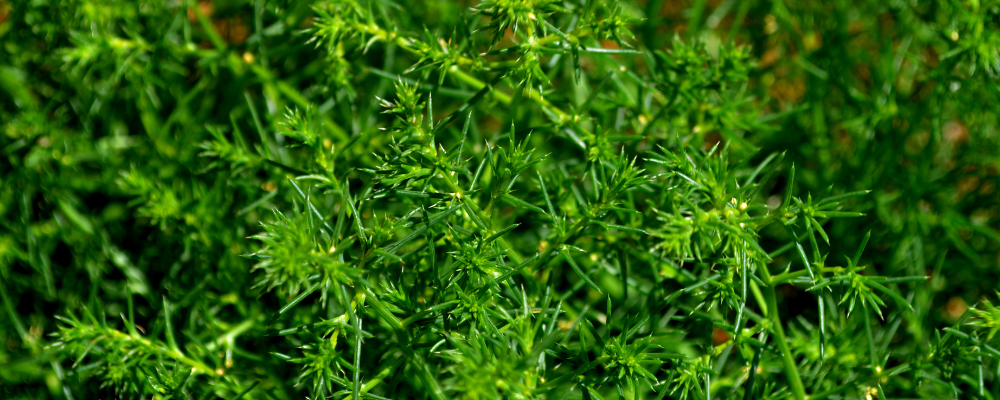
Couch grass disappears beneath the spade and then returns from a fragment of rhizome. Gardeners fight it, dogs seek it out, and Culpeper places it under Jupiter. Its magic does not come from an old exotic prestige: it comes from an ordinary plant that knows how to remain, move beneath the soil, and reclaim its place.
The species selected is Elymus repens (L.) Gould. Old herbals call it Agropyron repens, Triticum repens, Dog’s-grass, or Couch grass. These synonyms explain the dispersal of the sources.
Couch grass does not occupy a prominent place in ceremonial grimoires. Its magical interest rests on a precise account by Culpeper, the attention paid to dogs, and its underground biology. It accompanies workings of persistence, networking, and regrowth.
The underground network of Elymus repens
Elymus repens belongs to the Poaceae family. This perennial grass develops long, pale, segmented rhizomes capable of producing new shoots at each node. The stems bear a narrow spike whose spikelets line up along the axis.
Kew recognizes the species as native to the temperate regions of Eurasia and North Africa. Kew, Elymus repens.
A fragment of rhizome left in the soil can produce a new plant. Ploughing or cutting can therefore multiply the points of regrowth instead of eliminating the network. This property explains its reputation as a tenacious weed.
The magic of persistence begins here with a visible botanical fact. It promises no invulnerability: it shows that a distributed system survives better than an isolated stem.
The grass indicated by dogs
The names Couch grass, Dog’s-grass, and dog grass come from observing animals chewing certain grasses. Culpeper even invites readers who do not recognize the plant to watch sick dogs, as they will show it to them.
This sentence describes a way of learning: humans read animal behavior to identify a plant. The dog becomes a guide to the field, and knowledge begins with attention to the living world nearby.
This observation should not be turned into veterinary advice. Dogs eat grass for several reasons, and grass awns can injure the mouth, skin, or respiratory tract. The value of the account is historical and symbolic.
In magical practice, the dog here represents detecting and returning to a discreet resource. It does not serve as a universal supernatural mediator.
Jupiter among the Weeds
Culpeper describes the white roots intertwining underground and the difficulty cultivators have removing couch grass. He places the plant under Jupiter and calls it the most medicinal of creeping herbs. Nicholas Culpeper, “Dog’s-Grass”.
Jupiter brings expansion, continuity, and the ability to occupy space. The correspondence seems almost drawn by the rhizomes: the plant expands its territory and connects several shoots.
What the gardener calls an invasion becomes, under Jupiter, a lesson in expansion. Meaning changes with the position of the observer.
The source also reminds us that an herb considered troublesome could be valued by the practitioner. Couch grass crosses the boundary between garden waste and material preserved in the herbarium.
Fragments, network, and resumption
The rhizome offers a fitting image for interrupted projects. A visible part may disappear while resources remain elsewhere: notes, relationships, skills, tools, or habits. Resuming requires finding the nodes that are still alive.
This reading avoids the abstract worship of resilience. Couch grass pays for its expansion through constant conflict with the gardener and neighboring crops. Persisting without limits can become invasive.
The Jupiter correspondence therefore calls for a measure: where should the network expand, where should it be contained, and which fragment deserves a new shoot? The plant teaches a strategy of recovery, not an obligation to remain everywhere.
Its mystery is underground and mechanical. A repeated action on the surface fails when no one looks at the structure connecting the returns.
Mapping the nodes that are still alive
Draw an irregular horizontal line to represent a rhizome. Add five nodes and write beside each one a resource that remains after an interruption.
From the most accessible node, draw a shoot upward. At the top, write the smallest action capable of getting the project moving again. Place the closed sachet beside the line.
After the action, add the date to the shoot. The work draws on the real network of couch grass and Jupiter’s expansion, without uprooting any plant, ingestion, or smoke.
Historical correspondences
| Reference point | Correspondence |
|---|---|
| Accepted name | Elymus repens (L.) Gould |
| Historical synonyms | Agropyron repens and Triticum repens |
| Common names | Couch grass, dog grass, and Dog’s-grass |
| Astrological source | Jupiter according to Nicholas Culpeper |
| Magical domains | Network, recovery, expansion, and measurement |
| Safe form | Five-knot card and closed sachet |