















































































































































































































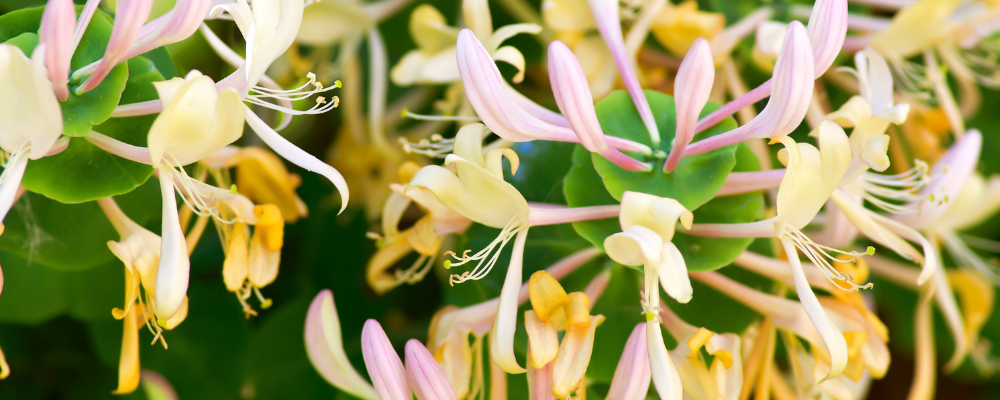
Honeysuckle climbs by twining around its support. In the 12th century, Marie de France chose this vegetal embrace to express the love of Tristan and Iseult: separated, the hazel and the vine wither. Later, Culpeper placed honeysuckle under Mercury in Cancer. The plant becomes a bond, a hidden message, and the memory of an encounter.
The entry uses Lonicera caprifolium L., garden honeysuckle, as its reference point. The commercial name “honeysuckle” can refer to many Lonicera species, with different berries and toxicological profiles.
Its best-established magical history comes from a medieval literary work, the lay of the Honeysuckle. It is not a grimoire, but a text that makes the plant an operative image of union. The present-day practice works with consensual connection and addressed speech.
A vine among the Lonicera
Lonicera caprifolium belongs to the Caprifoliaceae family. Its twining stems wind around shrubs and supports. The upper leaves fuse around the stem, while the tubular flowers, cream-colored and then pinkish, give off a pronounced fragrance.
Kew places the species from central and southeastern Europe to the Caucasus. Kew, Lonicera caprifolium.
The genus also includes hedge honeysuckle, Lonicera periclymenum, Japanese honeysuckle, Lonicera japonica, and shrubs with red, black, or blue berries. A dried flower does not always make it possible to identify the species.
The vine has no tendrils: its entire stem twines around its support. This way of growing offers an exact image of a relationship: moving forward requires support, but the twining can also constrict.
Marie de France and the Lay of the Honeysuckle
In the second half of the 12th century, Marie de France composed the lai Chevrefoil. Tristan, banished from King Mark’s court, carves a hazel branch and engraves a sign on it for Iseult. The queen recognizes the message and meets her lover in the woods.
The text compares the lovers to honeysuckle entwined around hazel. As long as they remain united, both live; separated, they wither. Marie de France, The Lay of the Honeysuckle, 1911 translation.
The plant is not used as an ingredient. It is a poetic structure that makes the union visible. The carved branch carries the message, honeysuckle provides the comparison, and the forest protects the meeting.
The mystery lies in two plants, not one. The vine and the hazel together form the image of love that cannot live apart.
The embrace, support, and risk
The lai makes the union absolute, but botany adds a nuance. A vine receives support, climbs toward the light, and can exert pressure on the branch that bears it. This observation makes it possible to work with the bond without celebrating blind dependence.
Love magic inspired by the text benefits from asking three questions: who supports, who winds around whom, and how does each person preserve their growth? The love of Tristan and Iseult belongs to a story of desire, banishment, and death, not a recipe for domestic happiness.
Honeysuckle is therefore suited to mutual commitments, reunions, and messages recognized by a specific person. It justifies neither control nor surveillance nor coercion of another’s desire.
Mercury in Cancer according to Culpeper
Culpeper describes Woodbine, another English name for honeysuckle, and places it under Mercury in the sign of Cancer. Nicholas Culpeper, The English Physitian.
Mercury brings the message, movement, and hidden writing. Cancer adds the home, memory, and protection. This astrological correspondence aptly echoes the branch carved by Tristan and the meeting in the woods.
The pulmonary uses described by Culpeper belong to 17th-century medicine and must not be replicated. Their presence recalls that the same herbal compendium combines botanical description, remedy, and planetary governance.
Two distinct sources thus respond to each other without merging: Marie de France provides the image of the connection, while Culpeper supplies a later astrological correspondence.
Writing a connection in two voices
Draw two separate vertical lines. On the first, write what you bring to a connection; on the second, what the other person brings with their consent.
Connect the lines with three loops. In each loop, write a shared rule: ask, respond, allow time. If the other person does not participate, leave the second line blank.
Fold the sheet around a drawn twig, without using a real plant. The working re-creates Tristan’s message and the entwining of the lai while leaving a visible place for each person. No flower, berry, or leaf is ingested.
Historical correspondences
| Reference | Correspondence |
|---|---|
| Botanical reference | Lonicera caprifolium L. |
| Genus | Lonicera, multiple species |
| Literary source | Chevrefoil by Marie de France, 12th century |
| Astrological source | Mercury in Cancer according to Culpeper |
| Magical domains | Connection, message, meeting, and reciprocity |
| Safe form | Two written lines and a drawn plant |










