















































































































































































































The Chestnut has fed entire regions when cereals were scarce. Its fruit can be dried, preserved, and made into flour: before being a symbol of abundance, it is a real reserve against hunger and food shared with the living as well as the dead.
This nourishing function gives its magic a particular gravity. The Chestnut does not promise sudden wealth: it speaks of provisions, seasonal work, a household prepared for winter, and food that carries people through difficult months.
In several Italian customs recorded in the 19th century, chestnuts accompany days dedicated to the dead. They are eaten in silence, left on the table, and through them people acknowledge that the meal unites those who are present with those whose place remains empty.
The bread tree of the mountains
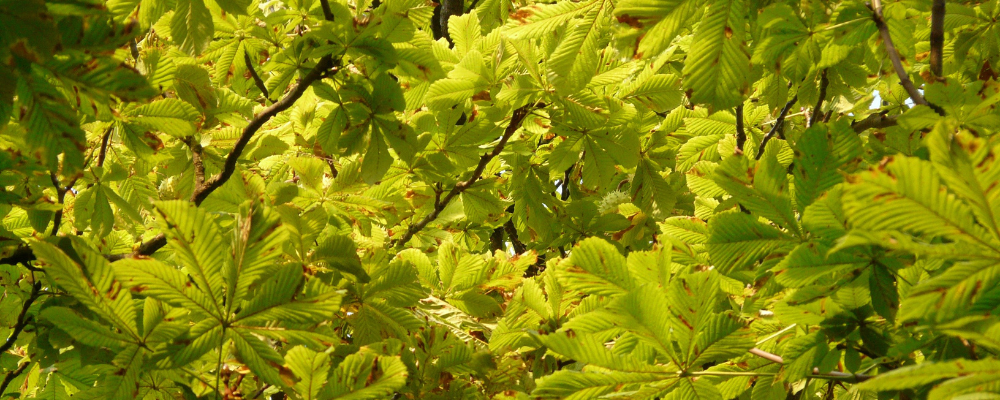
The sweet chestnut, Castanea sativa Mill., belongs to the Fagaceae family. It is a large tree with long, toothed leaves, summer catkins, and spiny burrs that generally contain several fruits. Kew places its ancient range around southeastern Europe and Asia Minor, while centuries of cultivation have greatly extended its presence. Kew, Castanea sativa.
In regions where wheat was scarce, dried and ground chestnuts provided a lasting flour. The harvest brought together the household, the drying shed, and the mill; it required anticipating winter. The nickname “bread tree” expresses this subsistence economy.
The burr protects the fruit until it ripens. Its opening marks the moment when the reserve becomes available. This natural form suggests a simple correspondence: protect a resource, wait until its time, then share what has been kept.
The true measure of abundance
The Chestnut’s prosperity does not come from a decorative association with gold or Jupiter. It rests on sacks of fruit, drying racks, and flour capable of feeding a family. Its abundance is measured in future meals.
In magical work, it is therefore suited to intentions of material stability: building up a reserve, making a home less vulnerable, paying a debt, passing on a skill, or supporting a project whose benefits will not appear until several seasons have passed.
The fruit enclosed in the burr reminds us that protection makes sense only if it safeguards something living and useful. Accumulating without opening or sharing would contradict the tree’s own cycle.
Chestnuts and the meal of the dead
Richard Folkard classifies the Chestnut among funerary trees and describes several Italian customs. In Tuscany, Chestnuts were eaten solemnly on Saint Simon’s Day. In Piedmont, they accompanied the eve of All Saints’ Day and could be left on the table for the “poor dead.” Richard Folkard, Plant Lore, Legends, and Lyrics, “Chestnut-tree”.
The meal does not seek to compel the dead to appear. It keeps their portion within the household. The hot, nourishing winter food becomes an offering of continuity: those who fed the household are not excluded from its table.
Tradition assigns the Chestnut a precise ancestral function. It preserves memory through a domestic gesture, not a funerary decoration. Cooking, sharing, setting aside a portion: each of these acts makes absence visible without turning it into a spectacle.
The burr, the fruit, and the threshold
The spiny burr keeps things at a distance while the fruit is unripe. It offers an image of proportionate defense: spikes on the outside, nourishment within. Placed dry near a storehouse or an account box, it recalls what must be protected until the right moment.
The fruit, by contrast, belongs to sharing. Transforming it by fire removes the tough shell and makes the food available. This passage from closure to openness suits workings in which a guarded resource must finally circulate: savings invested prudently, knowledge passed on, an inheritance distributed.
The Chestnut protects in order to nourish. Its burr is not an eternal fortress. It guards the fruit until it ripens, then opens. Any protection placed under its sign must retain this purpose.
Preparing, sharing, and remembering with the chestnut tree
At the beginning of autumn, place three edible chestnuts in a bowl reserved for the household. The first represents what will be consumed, the second what must be preserved, and the third what may be given away. Write the three concrete decisions corresponding to this division beneath the bowl.
To honor the dead on All Saints’ Day, serve cooked chestnuts and leave a symbolic place at the table during the meal. The portion intended for the deceased should not be left outdoors if it might attract or poison animals: it may be eaten the next day in their memory or composted under suitable conditions.
A completely dry, empty bur placed in a stable container can hold a list of resources to protect. Once the situation has stabilized, remove the list and return the bur to the compost. The rite thus follows the tree through to its opening, rather than freezing the defense in place.
Historical correspondences
| Reference point | Correspondence |
|---|---|
| Botanical name | Castanea sativa Mill. |
| Ritual times | Autumn harvest, Saint Simon, All Saints’ Day, and All Souls’ Day |
| Magical domains | Provision, household stability, protection of resources, sharing, ancestral memory |
| Central mystery | Food kept for winter and shared with the dead |
| Ritual forms | Edible chestnut, flour, empty and dry bur, commemorative meal |
| Central gesture | Keep until ripe, then open and share |










