















































































































































































































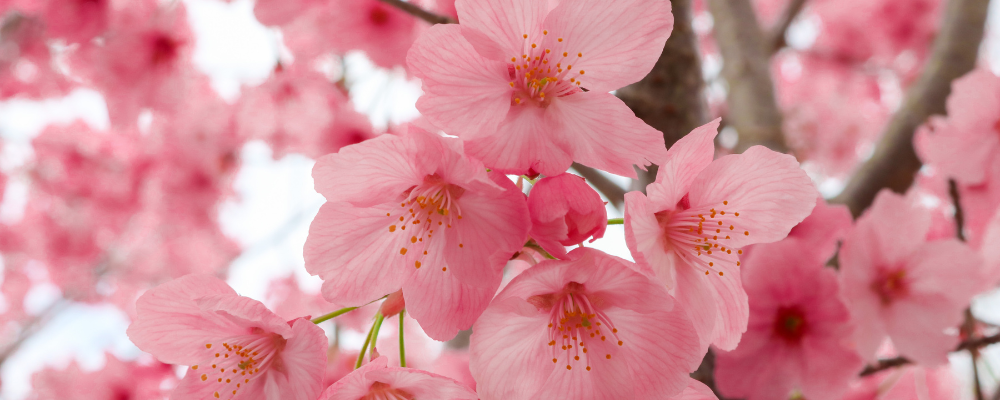
The Cherry Tree ushers in spring beneath a cloud of flowers, then transforms that fragile whiteness into red fruit. This metamorphosis explains its place in traditions of forced flowering, marriage omens, Christian stories, and seasonal household rites.
Its magic is reduced neither to love nor to beauty. It follows a complete cycle: an apparently sleeping branch awakens inside the house, the flower announces what may bear fruit, and then the pit holds at its center a substance that calls for caution. The Cherry Tree thus unites promise, fulfillment, and proper measure.
The European traditions presented here mainly concern fruit-bearing cherry trees, particularly Prunus avium and Prunus cerasus. Japanese symbolism surrounding sakura belongs to different species, different stories, and different ritual forms.
Identifying the Fruit-Bearing Cherry Tree
The Wild Cherry or Bird Cherry, Prunus avium (L.) L., belongs to the Rosaceae family. Its smooth bark bears horizontal lenticels, its five-petaled white flowers appear in small clusters before or alongside the leaves, and its fleshy fruits contain a hard pit. Kew places its native range from Europe to western Asia and northern Africa. Kew, Prunus avium.
The Sour Cherry, Prunus cerasus L., is another species cultivated since ancient times for its acidic fruit. The same custom may use either one, depending on the local orchard. This diversity invites us to name the species when it is known, rather than grouping all flowering trees of the genus Prunus under the single word “Cherry.” Kew, Prunus cerasus.
Early flowering gives the branch its main symbolic power. Cut while dormant and placed in water, it can flower before the garden tree. This natural phenomenon becomes a small oracle: in winter, the house receives a visible sign of the spring to come.
The Saint Barbara Branch
On December 4, the feast of Saint Barbara, families in Central Europe cut a cherry branch and place it in water near a source of heat. When the flowers open at Christmas, they announce good fortune for the household. In some versions, a young woman tends the branch and reads in its flowering the promise of a happy marriage.
This custom transforms waiting into observation. For three weeks, the branch requires fresh water, a measured temperature, and daily attention. The omen does not fall from the sky: it slowly takes shape before the household’s eyes. University of Vermont, Sour Cherry Symbolic.
The mystery lies in this out-of-season flowering. A bare branch already bears the future season. It does not foretell through an abstract sign, but by revealing a possibility enclosed within the dormant wood.
The Tree That Bends Before Mary
An old English sung legend tells that Mary, pregnant, asks Joseph to pick cherries. Joseph harshly replies that the child’s father need only offer them to her. At that moment, the Cherry tree bends its branches down to Mary so that she can take the fruit.
The story, known through the ballad of the Cherry-Tree Carol, makes the tree a witness who recognizes what man still refuses to see. It bends before motherhood and corrects pride with a gesture of abundance. Richard Folkard connects this legend to the Cherry tree in his great collection devoted to plant lore. Richard Folkard, Plant Lore, Legends, and Lyrics, “Cherry-tree”.
The branch laden with fruit becomes here a gentle authority. It does not threaten: it descends, nourishes, and reveals. This image gives the Cherry tree a place in works of recognition, reconciliation, and welcoming a birth.
Winter Fires and Fertile Ashes
Folkard also reports an Albanian custom recorded in the 19th century: Cherry branches were burned during several pivotal nights around Christmas, New Year’s, and Epiphany. The ashes were then kept to fertilize the vineyards.
The act connects two plants and two seasons. The Cherry tree burned during the darkest nights returns its substance to the Vine, whose harvest still belongs to the future. The ash is not merely a remnant: it transfers the branch’s strength to a nourishing crop.
A promise must bear fruit. The Cherry Tree does not speak of a desire without follow-through. From flower to fruit, and then from ash to vine, its customs always ask what a promise becomes when it enters time.
Making an intention blossom with the Cherry Tree
The St. Barbara’s branch offers a simple, ancient practice. On December 4, take a small branch left over from pruning a cultivated Cherry Tree, place it in water, and write down an intention whose fulfillment is set for the return of the light. Change the water regularly and let the flowering—or its absence—compel you to look at the project’s actual conditions.
In spring, a few fallen petals can surround a name, a photograph, or a promise of reconciliation. They suit what must be acknowledged gently: a birth, an affection, a talent that is still discreet. When edible and properly prepared, the fruit can be shared at the end of the work as a sign of fulfillment.
The Cherry Tree ultimately teaches us not to confuse beauty with possession. A flower can be admired without tearing off the branch; fruit is received when ripe. This restraint is fully part of its magic.
Historical correspondences
| Reference point | Correspondence |
|---|---|
| Botanical names | Prunus avium (L.) L.; Prunus cerasus L. |
| Ritual times | December 4, Christmas, New Year, Epiphany, spring flowering |
| Stories and customs | St. Barbara’s branch, Cherry-Tree Carol, Albanian winter fires |
| Magical domains | Omen, maturation, gratitude, birth, reconciliation, fulfillment |
| Ritual forms | Pruned branch placed in water, fallen petals, pitted edible fruit |
| Central practice | Bringing the promise of spring into the home |










