
























































































































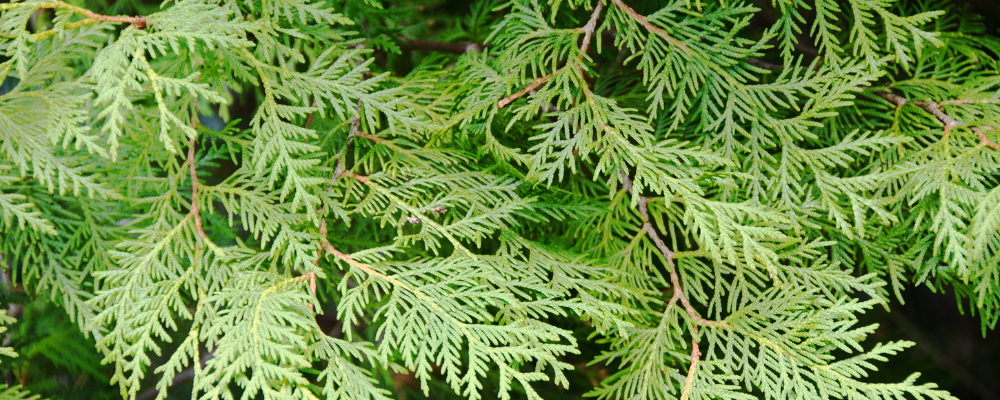
Cedar appears in the oldest stories as a wood reserved for palaces, temples, and the dead. Gilgamesh enters its guarded forest to win a name; Solomon has the trunks brought from Lebanon for the Temple; Egyptian embalmers use cedar products to preserve the body.
Its magic arises from height, fragrance, and endurance. Cedar separates what must resist corruption, builds sacred space, and gives royalty a material form. It also carries a warning: in the Mesopotamian epic, felling the divine forest requires confronting its guardian and brings consequences that extend beyond immediate victory.
Working with Cedar therefore means handling a power of consecration and permanence, while also acknowledging the sovereignty of the place from which the wood comes.
The True Lebanon Cedar
The Lebanon Cedar, Cedrus libani A.Rich., is a conifer in the Pinaceae family. It has evergreen needles grouped in rosettes on short shoots, upright cones that disintegrate on the tree, and a crown that broadens with age into large horizontal tiers.
Kew places its native range from southern Turkey to Lebanon and classifies the species as vulnerable. This detail matters: many products called “cedar” actually come from junipers or arborvitae, particularly oils known as American cedar oils. Their botanical history and composition are not those of Cedrus libani. Kew, Cedrus libani.
Its fragrant, durable, insect-resistant wood was sought throughout the Near East. These physical qualities form the foundation of its ritual values: preserving, building, elevating, and making worthy of lasting.
Gilgamesh’s Cedar Forest
In the Epic of Gilgamesh, the Cedar Forest belongs to the realm of the gods and remains under Humbaba’s guard. Gilgamesh and Enkidu go there to fell the trees and earn undying renown. The journey is heroic, but the wood is never a neutral resource: entering the forest means crossing a forbidden boundary.
Humbaba embodies the terror of the inviolate place. His death and the felling of the cedars grant the heroes the glory they seek, while also preparing the gods’ wrath and Enkidu’s eventual death. The story thus links precious wood with kingship, the surviving name, and the price of transgression.
The mystery of Cedar is therefore not merely protective. It asks who owns the place, who authorizes the felling, and what is sacrificed to obtain a sacred material. The tree’s power lies as much in the guarded forest as in the wood carried away. Electronic Text Corpus of Sumerian Literature, Gilgamesh and Huwawa.
The Wood of Solomon’s Temple
The First Book of Kings recounts that Solomon asks Hiram, king of Tyre, to have cedars from Lebanon cut down. The trunks are brought to the sea, assembled into rafts, and transported to the building site. The wood thus travels from the mountain to the sanctuary through a royal alliance. 1 Kings 5:6–18.
Inside the Temple, Cedar covers the walls and bears vegetal carvings. The biblical text emphasizes a space where stone disappears beneath worked wood. The forest material transforms the architecture into a fragrant, durable, and wholly consecrated enclosure.
In magical practice, this history connects Cedar with the sanctification of a place, authority, and the creation of a stable center. The prosperity sometimes attributed to it stems here from a specific context: royal wealth, exchanges between kingdoms, an abundance of materials, and the construction of a sanctuary.
Preserving the Body and Memory
Ancient texts mention products called kedros or cedrium in Egyptian embalming. Their botanical identity was long debated, since these terms may also have referred to junipers. However, chemical analyses of an embalming material from Deir el-Bahari identified tar derived from a true cedar, providing material evidence of this use. Koller et al., Analysis of a pharaonic embalming tar.
The preservation of the body gives Cedar a profound connection with incorruptibility. Its fragrance resists decomposition, its wood protects objects, and its tar contributes to the integrity of the deceased. Cedar thus becomes the material guardian of the body, the name, and memory.
The Cedar preserves what is meant to endure. Temple, heroic name, effigy, and embalmed body share the same aspiration: to resist time. The plant becomes the material guardian of memory.
Consecrating and preserving with Cedar
A small piece of wood whose species and origin are known may be placed at the center of an altar during its consecration. The gesture recalls the Temple’s cedar paneling: define a space, give it a boundary, and declare what is meant to remain there.
For memorial work, the Cedar accompanies a written name, photograph, or inherited object. It does not seek to hold on to the dead; it protects the trace left behind and affirms the lasting nature of the bond. A cedar box, when one already exists, is particularly suitable for this purpose.
For a long-term project, the wood can serve as a witness to a commitment. It is placed beneath the charter or plan until the work is completed. The practice follows the Cedar’s architectural logic: build in an orderly manner, accept the long timeframe, and take no more than is necessary.
Historical correspondences
| Reference point | Correspondence |
|---|---|
| Botanical name | Cedrus libani A.Rich. |
| Ancient texts | Gilgamesh and Huwawa; 1 Kings 5–7 |
| Ritual frameworks | Mesopotamian divine forest, Temple of Jerusalem, Egyptian embalming |
| Symbols | Sovereignty of the place, lasting glory, consecration, incorruptibility, memory |
| Ritual forms | Identified wood, box, inherited object; without improvised essential oil |
| Current practice | Dedicating a space, preserving a memory, supporting a long-term commitment |