


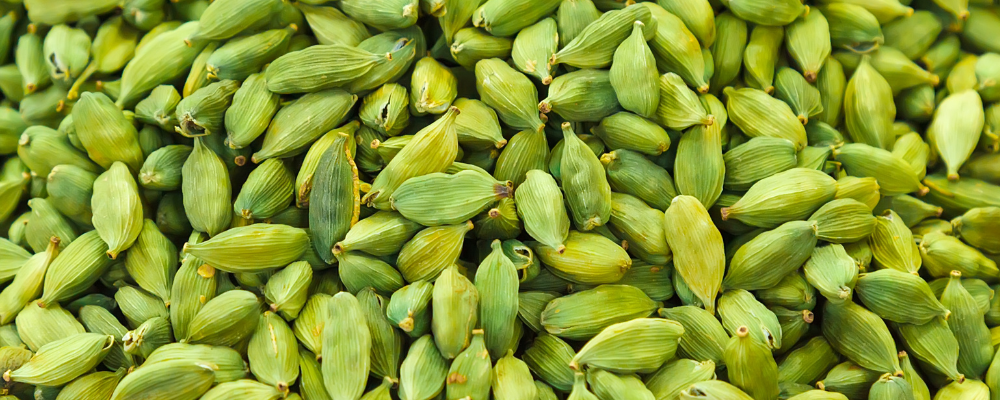
Cardamom travels in a green capsule whose opening releases dark seeds and a full-bodied fragrance. Pliny describes it among the costly aromatics brought along the routes from India and distinguishes its qualities by smell, weight, and color. In the 17th century, Nicholas Culpeper lists it among the hot seeds that comfort the stomach and resist poison. Its magic arises less from a planet added later than from a mystery of commerce: recognizing a distant substance, keeping its strength enclosed, and opening the capsule at the chosen moment.
The reference Green Cardamom is Elettaria cardamomum (L.) Maton, a perennial plant in the Zingiberaceae family. Leafy stems rise from a rhizome, while the inflorescences develop close to the ground. The three-chambered fruits contain the aromatic seeds.
The name cardamom has also encompassed other spices. Botanical identity, provenance, and the part used must therefore precede any correspondence. The texts of Pliny and Culpeper shed light on a reputation as a powerful aromatic, but their medical recipes remain witnesses to their time. The proposed practice retains the capsule as an image of a kept word, without ingestion or fumigation.
A three-chambered capsule
Elettaria cardamomum is a large rhizomatous herb. The leafy shoots can exceed a person's height. The pale flowers, marked with violet, appear on low stalks and then produce green or yellowish capsules.
Kew accepts the species and places its native range in the Western Ghats of India. The plant grows in the humid tropical biome. Cultivation has carried this spice far beyond its original range. Kew, Elettaria cardamomum.
The fruit is a capsule divided into three chambers. Its wall preserves a multitude of seeds whose aroma dissipates after grinding. The whole form therefore retains for longer what the powder exposes immediately to the air.
This structure establishes a simple correspondence: a word, an intention, or a reserve can remain enclosed until it reaches the right recipient. Opening is not destruction; it is passing a guarded substance toward a defined use.
The distant aromatic in Pliny
In Book 12 of Natural History, Pliny places cardamomum among the aromatic commodities arriving from regions Rome knows through intermediaries. He distinguishes several varieties and compares their color, density, fragrance, and price.
The finest quality should be well filled, difficult to break, and strongly fragrant. A light or weakly scented product loses value. The merchant and buyer thus read the outer covering before reaching the seed. Pliny, Natural History, Book 12, Chapter 29.
The text tells neither of an Egyptian love potion nor of an offering of cardamom to the gods. It reveals another mystery: the opacity of routes, the value produced by distance, and the art of judging a spice without seeing the plant that bore it.
The capsule becomes proof of provenance. Weight, fragrance, and integrity answer the seller’s account before the material is opened.
Culpeper’s Hot Seeds
In the compendium associated with The Complete Herbal, Culpeper classifies cardamoms among the hot and dry seeds. He attributes uses for the stomach to them and places them among substances that resist poison.
This passage belongs to 17th-century English astrological medicine. In this entry, the author does not give the Venusian correspondence adopted by more recent occult manuals. Nicholas Culpeper, compendium of seeds.
The hot quality can be read as setting in motion what had remained closed. The fragrance released after opening makes a decision perceptible, while the capsule imposes structure and measure.
Cardamom thus supports prepared speech, hospitality, and commercial exchange. It promises neither automatic seduction nor wealth. It invites you to verify what you offer, what you receive, and what each exchange entails.
The Mystery of the Name and the Routes
Ancient authors used names that do not always correspond to current botanical species. “Cardamom” may have referred to several aromatic seeds, and modern commerce still sells false cardamoms from other genera.
The magic of this spice therefore begins with an investigation. The Latin name, country of cultivation, shape of the fruit, and seller provide four reference points. A match without an identity quickly turns mystery into confusion.
The three-chamber capsule then makes it possible to share an intention in three parts: what can be said, what must wait, and what must remain confidential. Each receives a recipient and a date.
This discipline connects with ancient trade without imitating it. Distance attracts storytelling, but quality demands concrete signs. Cardamom becomes the guardian of the word that circulates with its origin intact.
Sealing a message in three chambers
Draw an elongated capsule and divide it into three chambers. In the first, write a message ready to be conveyed. In the second, place information that still requires verification. In the third, note what will remain confidential.
Under each chamber, write a recipient, a date, and a possible consequence. If any of these elements is missing, keep the chamber closed with a line.
Place four seals around the capsule bearing the words “name,” “origin,” “form,” and “source.” They recall the criteria that make an exchange worthy of trust.
Fold the page lengthwise and keep it with the relevant file. Open it on the chosen date, check the three chambers, then convey only the word that has reached maturity.
Historical correspondences
| Reference | Correspondence |
|---|---|
| Botanical name | Elettaria cardamomum (L.) Maton |
| Family | Zingiberaceae |
| Aromatic part | Seeds kept in a three-chamber capsule |
| Ancient source | Pliny, trade, qualities, and prices of cardamomum |
| Magical domains | Word kept, hospitality, provenance, and exchange |
| Safe form | Drawn capsule and three-chamber register |