















































































































































































































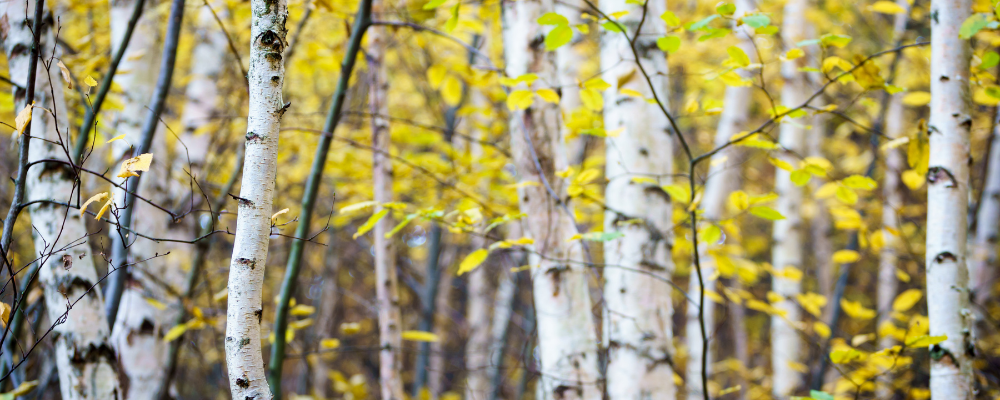
Birch is one of the first trees to illuminate open land with its white bark. In Northern customs, it heralds the return of the bright season, adorns houses at Pentecost, and receives ribbons intended to protect its growth.
Its magical language is rooted in very tangible actions: the branch broom that cleans, the green branch brought into the church, the bark that bears writing, and the tree around which a circle is formed. Nicholas Culpeper places it under Venus, not the Moon, and this attribution aligns with springtime customs, ornamentation, and romantic bonds.
Birch is therefore not merely the modern tree of “renewal.” It carries a denser history in which purification, the return of spring, protection from the evil eye, relationships with forest spirits, and remembrance of the dead come together.
The White Tree of Temperate Lands
Silver Birch, Betula pendula Roth, belongs to the Betulaceae family. It is identified by its white, papery bark, which becomes black and fissured at the base of older trees, its slender, often drooping branches, and its small, toothed triangular leaves. The flowers are grouped in catkins, and the lightweight seeds are dispersed by the wind.
Kew recognizes the species as native to a vast part of temperate Eurasia, North Africa, and boreal America. The tree rapidly colonizes open spaces, which explains its presence along woodland edges, in wastelands, and on recently disturbed land. Kew, Betula pendula.
Its bark, rich in hydrophobic substances, peels away in thin layers, while its young branches bend easily without breaking. These properties inspired its domestic uses: roofing, writing, torches, baskets, and above all brooms. Its magical cleansing function extends a daily use rather than merely serving as a metaphor.
Spring’s Return and Pentecost
In the 19th century, Richard Folkard brought together several Northern European customs centered on Birch. He presents it as a tree of spring’s return and reports that in Russia, young women decorated trees at Pentecost, tying a red ribbon around the trunks of birches to encourage their vigor and protect them from the evil eye.
In England, branches were used to decorate houses, streets, and banquet halls during spring processions. The poet Robert Herrick still associates Birch and fresh flowers with Pentecost decorations. In these practices, the tree brings the living season into human space. Richard Folkard, Plant Lore, Legends, and Lyrics, « Birch ».
The red ribbon expresses a form of protection that does not drive away an enemy by force: it supports growth and averts the harmful gaze. The green branch, meanwhile, renews the home and the community. Birch thus connects adornment, vitality, and safeguarding.
The Forest Circle and the Spirits
The same collection describes a Russian practice for evoking the Leshy, the spirit of the forest. Young birches are arranged in a circle, their tips turned toward the center; the operator enters this space and calls upon the wild master of the place. The account preserves a precise image of the vegetal circle as an enclosure for apparitions.
This passage reveals the more unsettling side of Birch. The spring tree can also serve as a boundary between human space and the forest realm. The circle does not “create” the spirit: it organizes the place where an encounter is supposed to become possible and recalls the feared price of pacts with wild powers.
In the Scottish ballads cited by Folkard, green birch also accompanies dreams foretelling the death of a beloved and apparitions of those believed to be alive even though they have disappeared. The tree therefore stands between two returns: that of vegetation in spring and the unsettling return of the dead in dreams.
Why does Culpeper place Birch under Venus?
In his Complete Herbal, Nicholas Culpeper describes Birch as a tall tree with thin, drooping branches. He assigns it, without hesitation, to the governance of Venus. This correspondence belongs to 17th-century medical astrology, not to a Celtic reconstruction. Nicholas Culpeper, The Complete Herbal, « The Birch Tree ».
Venus illuminates the customs in which Birch adorns, connects, and fosters life. Around Valenciennes, a branch of Birch or Hornbeam was hung on the beloved’s door. At Pentecost, fresh foliage beautified the houses. In Culpeper’s system, the planet thus governs a tree of youth, sap, beauty, and bonds.
Whiteness is not inherently lunar. Modern correspondences often place Birch under the Moon because of its pale bark. Culpeper, a precise historical source, assigns it to Venus. Practice benefits from following this testimony when it claims to draw on ancient plant astrology.
Cleansing, renewal, and connection with Birch
For ritual cleansing, a few slender twigs tied together can be used to symbolically sweep an altar or the threshold of a room, without striking the body. The movement goes from the back toward the exit: it gathers what must leave the space, and the gesture ends outdoors.
At Pentecost or in the heart of spring, a branch that has already fallen can be adorned with a red thread and placed near the entrance. The thread supports an intention of protected growth; it should be removed before returning the branch to the earth. This gesture draws on the logic of Russian customs without copying a religious ceremony that is not its own.
In a Venusian working, a leaf or small piece of fallen bark can accompany an effort toward reconciliation, beauty, or attachment. To honor the dead, Birch is suited to memories that come in dreams and to seasonal transitions: its twig marks the return of light without denying the presence of absence.
Historical correspondences
| Reference | Correspondence |
|---|---|
| Botanical name | Betula pendula Roth |
| Planet | Venus, according to Nicholas Culpeper |
| Ritual timing | Spring, Pentecost, processions of the bright season |
| Traditions | House decorations, a red ribbon against the evil eye, a circle for calling the forest spirit, funeral omens in ballads |
| Magical domains | Cleansing, protected growth, bonds, connection to the forest world, remembrance of the dead |
| Ritual forms | Twigs, leaf, naturally fallen bark; no burning |










