Belladonna brings beauty and the cutting of fate together in its name. Bella donna evokes the dilated pupils sought in Renaissance Italy; Atropa invokes Atropos, the Fate who cuts the thread of life. Between the two stands a black berry, glossy, alluring, and deadly.
European texts classified it among poisons, narcotics, and witchcraft herbs. Accounts of flying ointments should be read in the treatises, trials, and compilations that transmitted them: they constitute neither a stable recipe nor a shared European rite. Their significance comes from the encounter between anticholinergic substances, judicial imagination, and social fear.
The real plant remains dangerous in all its parts. Its magical history should therefore be explored through names, images, and visionary accounts. No contact with a berry, leaf, root, or extract is required.
The Solanaceous plant's black berry
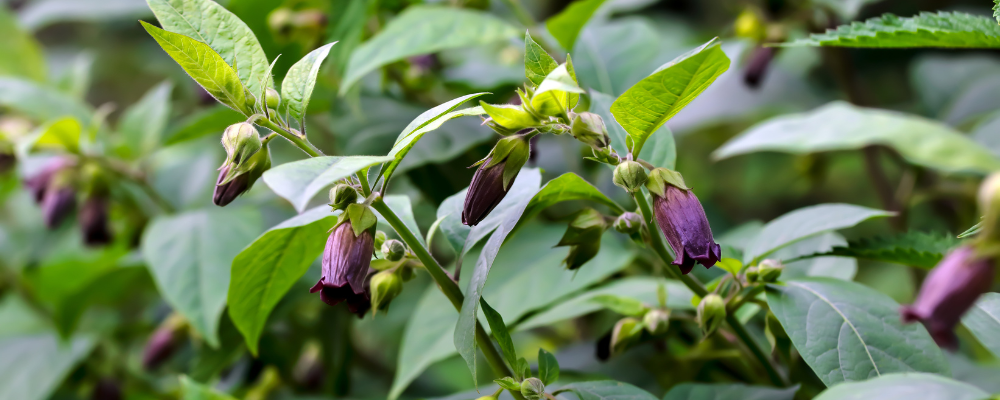
Atropa bella-donna L. is a perennial in the Solanaceae family. Its branched stems bear large oval leaves, brown-purple bell-shaped flowers, and glossy black berries set in a star-shaped calyx. This appearance may attract children and encourage confusion with edible fruit.
Kew places its native range from Europe to northern Iran, with a presence in northwestern Africa. The accepted name is written Atropa bella-donna. Kew, Atropa bella-donna.
Atropine, hyoscyamine, and scopolamine link the plant to dilated pupils, delirium, and severe bodily disorders. The enlarged gaze that gave it its name thus rests on the same chemistry as its stories of visions.
Atropos and the Beautiful Lady
Linnaeus published the name Atropa bella-donna in 1753. Atropos is the one of the three Fates who cuts the thread at the end of life. The botanical genus turns this figure into a permanent warning: death is inscribed in the scientific name.
The Italian epithet bella donna, “beautiful woman,” is linked to the cosmetic use of preparations intended to dilate the pupils. The Royal College of Physicians of Edinburgh traces this dual heritage, between beauty, poison, and pharmacology. RCPE, botanical biography of Belladonna.
The full name functions as a two-sided formula: attracting the gaze and reminding us of its end. This tension better explains its magical role than a modern list of keywords.
Ointments, flight, and testimonies
Belladonna appears in the history of ointments attributed to witches alongside Henbane, Mandrake, and certain Daturas. Substances capable of causing delirium, amnesia, and a sensation of displacement fueled the pharmacological interpretation of “flight.”
The sources nevertheless call for close reading. They come from medical texts, demonological works, literary accounts, and judicial proceedings shaped by coercion. They tell us what authors thought possible and what accused women were forced to confess, as much as they describe actual preparations.
Under the entry “Nightshade,” Folkard brings together the names herb of death, Gerarde’s warnings, an account of a Provençal vision reported by Gassendi, and the story that Scots allegedly poisoned the beer of Danish enemies. Richard Folkard, “Nightshade”.
Seeing without possessing. Belladonna enlarges the pupil and clouds judgment. Its mystery warns against any vision that presents itself as mastery.
The gaze, the seal, and the night
Folkard points to abbey seals bearing branches of Deadly Nightshade. The motif seems surprising in a Christian context, but it shows that a feared plant could also become a heraldic emblem, territorial marker, or local memory.
The black berry resembles a shining eye. The comparison remains a visual reading, not a correspondence drawn from a grimoire. The historical core remains the altered gaze: enlarged pupil, apparition, confusion between inner scene and real space.
In work on vision, Belladonna invites us to ask who is looking, under what conditions, and with what authority. The mirror, testimony, and trial are its objects; ingestion and ointment remain outside the rite.
Open a book, close the poison
Place a reproduction of Belladonna between two mirrors facing each other. On a separate sheet, write three columns: what was seen, what was recounted, and what was interpreted. This setup takes up the theme of vision without seeking to induce it.
For a reading of a witch trial, note the author, date, conditions of the interrogation, and the person speaking. Mark with a sign the passages where an outside voice reformulates the testimony. The rite becomes a discipline of discernment.
A berry can be represented by a black circle painted inside a star-shaped calyx. Keep this symbol in a closed notebook devoted to the limits of vision. Do not use any part of the plant.
Historical correspondences
| Marker | Correspondence |
|---|---|
| Botanical name | Atropa bella-donna L. |
| Figures | Atropos, judicial witch, Renaissance belle dame |
| Objects | Cut thread, mirror, seal, black berry, testimony |
| Historical domains | Poison, cosmetic, vision, ointments attributed to witches |
| Central mystery | The boundary between seeing, recounting, and interpreting |
| Safe medium | Reproduction, mirror, drawing, and source reading |