























































































































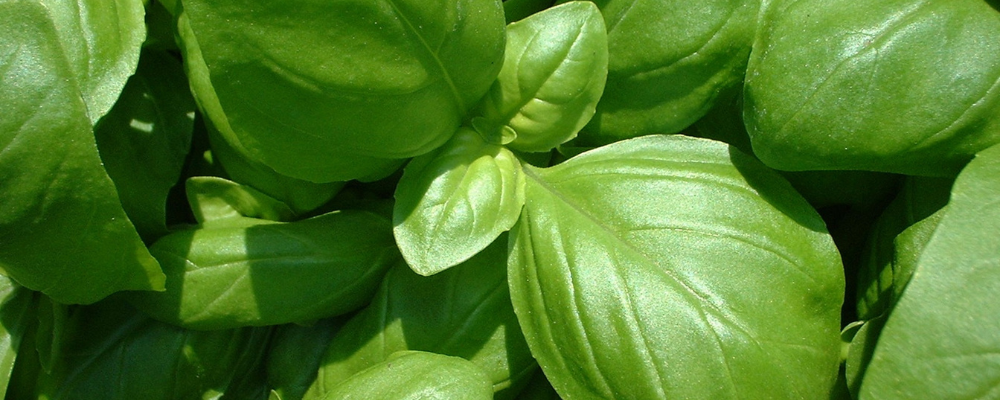
Basil is at once a culinary herb, a royal plant, and the protagonist of unsettling stories. Its familiar scent contrasts with the scorpions that Pliny and Culpeper make spring up around it. This tension between table and venom nourished a magic of authority, protection, and controlled speech.
This profile concerns Ocimum basilicum L. It describes neither Tulsi, Ocimum tenuiflorum, nor all the African and Asian basils grouped under the genus Ocimum. The religious uses of these species are not interchangeable.
The European history of basil brings together royal etymology, medical herbals, and Renaissance astrology. It contains contradictions: in books, the same plant nourishes, perfumes, and heals, then becomes suspect because of its name and animal legends.
Identify Ocimum basilicum
Ocimum basilicum belongs to the Lamiaceae family. Its square stem bears opposite, soft, aromatic leaves. Small white or pinkish flowers grow in whorls at the top. Cultivation has produced numerous cultivars with green, purple, smooth, crinkled, or very small leaves.
Kew recognizes a native range extending from tropical and subtropical Asia to northern Australia. Kew, Ocimum basilicum.
The scent varies according to the cultivar and the composition of linalool, eugenol, methyl chavicol, and other molecules. A concentrated aromatic oil called basil oil therefore does not have the same profile as a culinary leaf. The magical profile concerns the identified dried plant, not a concentrated oil.
Tulsi belongs to another species and to distinct Hindu traditions. Calling it sacred basil does not give O. basilicum the same stories, rites, or status.
The royal name and the shadow of basil
The word basil comes from the Greek basilikon, associated with what is royal. In French, it also encounters the fabulous basilisk, a serpent whose gaze kills. The proximity of the words encouraged accounts in which the herb and the monster share venom, power, and domination.
This linguistic encounter explains part of the European ambivalence. A table herb receives sovereign dignity, yet its name draws it toward the reptile and danger. Magic may read in it the authority that demands control and discernment.
Scent also marks presence. Crumpling a leaf immediately releases its fragrance; in a kitchen, it transforms the entire dish. This sensory capacity supports correspondences of command and declaration, without requiring a fabulous origin.
Scorpions and contradictions in Pliny
In book 20 of his Natural History, Pliny reports opposing opinions about ocimum. Chrysippus condemns it, while other authors attribute medicinal uses to it. The text also claims that a plant crushed beneath a stone gives birth to a scorpion and that a pounded bunch attracts nearby scorpions. Pliny, Natural History, book 20.
The passage describes no valid zoological observation. It preserves a learned world in which sympathies, antipathies, and spontaneous generation explained relationships between plants and animals.
Basil attracts the scorpion in the book before attracting it into magic. The account is an archive of thought, not a natural fact.
This mystery can support work on rumor and discernment: how does a repeated story come to resemble a property? Basil invites us to examine the path of the assertion.
Mars and Scorpio in Culpeper
In the 17th century, Culpeper repeats accounts of scorpions and places Basil under Mars in the sign of Scorpio. He cites authors who consider it dangerous, then discusses their contradictions. Nicholas Culpeper, The English Physitian.
This attribution provides a clear source for Martian correspondences: decision, conflict, defense, and the ability to make a firm ruling. Scorpio comes both from astrology and from the ancient story. The royal plant becomes a substance of power under supervision.
Occult catalogs have also associated Basil with love and prosperity. These uses may be linked to its culinary value, fragrance, and place in the household, but they must not obscure the harsher thread in Pliny and Culpeper.
The entry therefore retains a historical duality: welcome into the household and protection against abuse of authority.
Testing a word of authority
Write a decision in one short sentence. Beneath this sentence, draw three columns titled fact, rumor, and desire. Sort each reason supporting the decision into the column that corresponds to it.
Place the sealed Basil sachet above the “fact” column. Reread only the elements in that column, then rephrase the decision without threats or impossible promises.
Keep the page for three days before taking action. The work draws on the name’s royalty, discernment in the face of scorpion stories, and Martian firmness. It uses neither burning, ingestion, nor aromatic extract.
Historical correspondences
| Reference point | Correspondence |
|---|---|
| Botanical name | Ocimum basilicum L. |
| Distinct species | Ocimum tenuiflorum L., Tulsi |
| Figures | King, fabulous basil, and scorpion |
| Astrological source | Mars in Scorpio according to Culpeper |
| Magical domains | Authority, decision, safeguarding, and discernment |
| Safe form | Writing, sorting reasons, and sealed sachet |