


Sweet woodruff carpets beech forests with whorls of leaves. When fresh, its fragrance remains subtle; as it begins to wilt, a smell of hay and vanilla emerges. This transformation gave it its distinctive character in German May wine. Tradition attributes its first mention to the monk Wandalbert of Prüm in 854. The plant becomes a spring threshold where water loss releases the memory of its fragrance.
The accepted botanical name is Galium odoratum (L.) Scop. The name Asperula odorata belongs to its nomenclatural history and explains the French name “Aspérule.” This perennial of the Rubiaceae family grows in shaded woods and forms carpets through its rhizomes.
The magical interpretation focuses on the month of May, the fragrance that appears during wilting, and the collective passage into the bright season. Coumarin imposes a strict safety rule: keep the product closed, and do not prepare any wine, syrup, scented sachet, or incense.
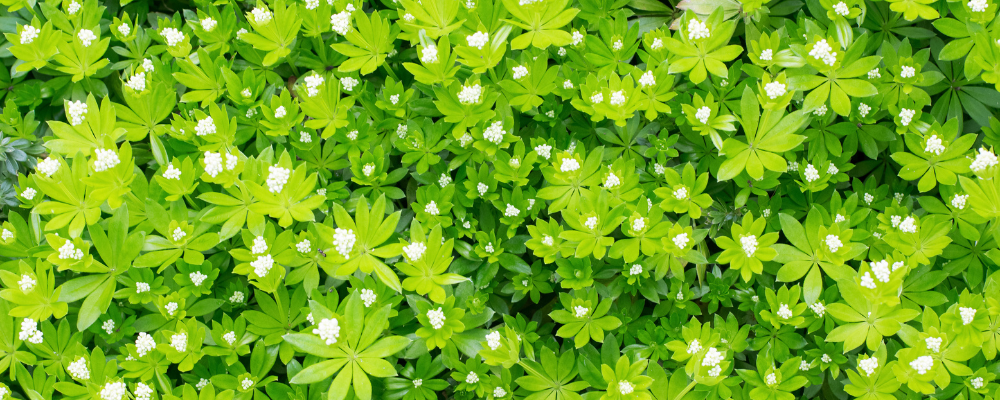
Green crowns at ground level in the woods
Galium odoratum has quadrangular stems surrounded by whorls of lanceolate leaves. Small white flowers with four lobes appear in spring. The fruits bear hooks that attach to fur and clothing.
Kew accepts the species and places its native range in temperate Eurasia and Algeria. The plant is a perennial of temperate climates. Kew, Galium odoratum.
The organs arranged in a crown give the impression of several leaves at the same level. Some of these elements are enlarged stipules. The visible geometry therefore brings together organs of different origins.
This plant crown creates an image of a composite circle. Several functions are arranged around the same axis, while the stem continues its upward growth toward the flowers.

The fragrance revealed by wilting
The characteristic fragrance intensifies when the plant begins to wilt. The transformation of the precursors releases coumarin, a molecule associated with the smell of freshly cut hay. The leaf loses water and gains an olfactory presence.
Technische Universität Braunschweig presents Sweet Woodruff as the plant of the month of May and highlights this intensification during wilting. TU Braunschweig, May plant.
The phenomenon fueled its mystery: less-fresh matter appears more expressive. Withdrawal therefore signifies more than decline. It can reveal a quality that was previously held back.
The leaf withdraws, the fragrance appears. Sweet Woodruff gives sensory form to the memory released by change.
May wine and Wandalbert of Prüm
In German-speaking regions, Sweet Woodruff flavors Maiwein or Maibowle, a drink associated with spring. The name “May herb” directly links the plant to the calendar.
A historical tradition traces the first mention of May wine back to Wandalbert of Prüm, a 9th-century monk and poet, in 854. The account places the plant within a monastic culture of time, seasons, and gardens. Wein.plus, history of Maiwein.
The spring cup unites the collective and the date. It marks less an intoxication than a change recognized together: the wood turns green again, the days grow longer, and a familiar scent returns.
The contemporary gesture keeps the date and the sharing without reproducing the drink. A shared page can receive the signs of the season and the group's commitments.
Crown, season, and memory
The crown of leaves distributes several points around the stem. It suits work in which each person or each memory retains a place around a central event.
The fragrance released after wilting adds deferred time. An experience can become legible after it ends, when immediate emotion loses some of its moisture and reveals another trace.
But it does not give a reopening date. The plant does not ask us to keep all seasons active at the same time. It invites us to recognize the moment when a memory can rejoin shared life.
Sweet woodruff thus carries a light and precise magic of commemoration. The circle welcomes memory, the axis sustains the present, and the flower indicates what comes next.
Forming a crown of memory
Draw a vertical stem and four successive crowns of eight leaves. The lower crown represents what has just ended. The next receives what remains of it today.
In the third, write the people or resources that supported the passage. In the upper crown, place the acts that the new cycle makes possible.
Add four white flowers at the top. Give each flower a date: opening, sharing, revision, and closure. Place the sealed product to the left of the page.
Review the drawing on the first day of a month. Choose a leaf from the upper crown and carry out the written act before the following date. Memory becomes passage when it supports a living action.
Historical correspondences
| Reference | Correspondence |
|---|---|
| Botanical name | Galium odoratum (L.) Scop. |
| Family | Rubiaceae |
| Sensitive transformation | Coumarin fragrance intensified during wilting |
| Historical reference | May wine, a reference attributed to Wandalbert of Prüm in 854 |
| Magical domains | Spring, memory, passage, and circle |
| Safe form | Drawn crown and sealed product |