















































































































































































































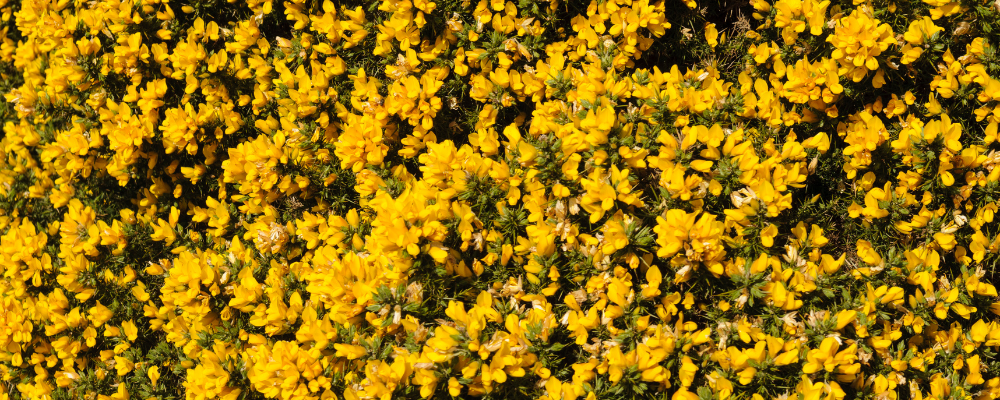
Gorse guards the heathland with its thorns and lights it with yellow flowers. In Irish archives from the 20th century, gorse bushes are reported on the eve of May, hung in front of houses or decorated as “May bush.” One account specifies that the branch was meant to drive away harmful spirits throughout the year. The plant thus brings together two gestures: closing the passage with its thorn and welcoming the warmer season with its color.
The reference species is Ulex europaeus L., an evergreen shrub in the Fabaceae family. Its green branches carry out part of the photosynthesis, while the adult leaves are reduced to spines. The yellow papilionaceous flowers may appear over a long period.
The selected magical uses come from the Schools’ Collection, the school archive of Ireland’s national collection of folk traditions. These local accounts describe May customs experienced or recounted in the 1930s. They give Gorse a precise place in front of the house, between protection, celebration, and seasonal transition.
A shrub of thorns and light
Ulex europaeus forms a dense shrub whose young branches are ridged and green. The leaves become rigid spines. The yellow flowers have the characteristic shape of the Fabaceae and later produce dark pods.
Kew accepts the species and places its native range in Madeira, western and central Europe, and Algeria. Gorse has been introduced to many regions, where it can become invasive. Kew, Ulex europaeus.
The thorns slow the passage of large herbivores and provide shelter for small animals. The seeds can remain in the soil for a long time and germinate after a disturbance. Fire opens some of the pods, after which the plant regrows from the stump or the seed bank.
Botany supports an image of a living threshold. Gorse does not build a smooth wall: it creates a dense zone where entry requires attention, respect for the path, and restraint.
The May bush in front of the house
On a page from the Schools’ Collection gathered in Athlone, the witness describes residents cutting gorse bushes on April 30, then bringing them back to hang in front of the house on May 1. The text adds that the gesture was meant to keep evil spirits at a distance throughout the year.
The branch therefore occupies the façade, the place of passage between the hearth and the road. Its thorns face outward, while its yellow flowers announce the bright season. Dúchas, “May Day Customs”.
Other Irish collections show an ordinary “May bush” made of gorse, decorated with ribbons, eggshells, or candles. Children dance around it, and some communities then burn it at the end of the celebration.
The thorn guards, the flower welcomes. The same bush protects the opening and marks the entrance into the month of May.
A protection placed outside
The position of the gorse matters as much as the plant itself. Suspended outside, it encounters whatever comes from the road first. The house receives neither prickly branches in its rooms nor smoke in the hearth.
This arrangement gives threshold magic a clear rule: the defense remains at the point of contact. It does not invade the protected space. The boundary knows where it begins and where it ends.
Yellow also transforms the guardian. May’s protection is not a permanent closure. It allows for celebration, dancing, chosen visitors, and the growth of herds or crops.
A successful threshold filters rather than isolates. The thorn slows intrusion, the flower signals welcome, and the date places the gesture within a collective cycle.
The plant that regrows after fire
Gorse contains oils and produces a great deal of fine wood. A dry bush catches fire intensely. Heath fires can spread very quickly and endanger people, habitats, and homes.
After a fire, seeds preserved in the soil may germinate and the stump may regrow. This ability has inspired the image of vegetation returning after destruction, but it does not make any ritual fire safe.
The Irish Department of Agriculture reminds us that gorse burns easily in every season and that the risk increases during dry and windy periods. Irish Government, fire risk management.
The renewal of gorse is therefore worked through the image of the dormant seed. A reserve can wait beneath the surface and resume after the crisis, without reproducing the crisis itself.
Drawing a threshold bush
Draw a door in the center of a landscape-format page. On the outer side, draw seven thorny branches. Give each thorn the name of a rejected behavior, phrased in observable terms.
Add five yellow flowers between the branches. In each flower, write what the place welcomes: an invited person, respectful speech, help, rest, or work. The entrance becomes legible from both sides.
Above the door, write an opening date and a review date. Beneath the threshold, draw three seeds representing the resources saved to begin again after a difficulty.
Place the drawing indoors, near the entrance, without a real branch. Re-read it at the beginning of each month for three months. Remove thorns that are no longer needed and add the flowers made possible by your actions.
Historical correspondences
| Reference | Correspondence |
|---|---|
| Botanical name | Ulex europaeus L. |
| Family | Fabaceae |
| Ritual archive | Schools’ Collection, Irish May Day customs |
| Place of the act | In front of the house, at the point of passage |
| Magical areas | Protection, welcome, season, and renewal |
| Safe form | Drawing of the bush, without a branch or flame |










